United Nations Development Programme launches Blockchain Advisory Group with 26 member organizations
The UNDP's new multi-stakeholder forum, unveiled at Proof of Talk in Paris, aims to apply blockchain technology to development challenges like financial inclusion and digital governance.
Share
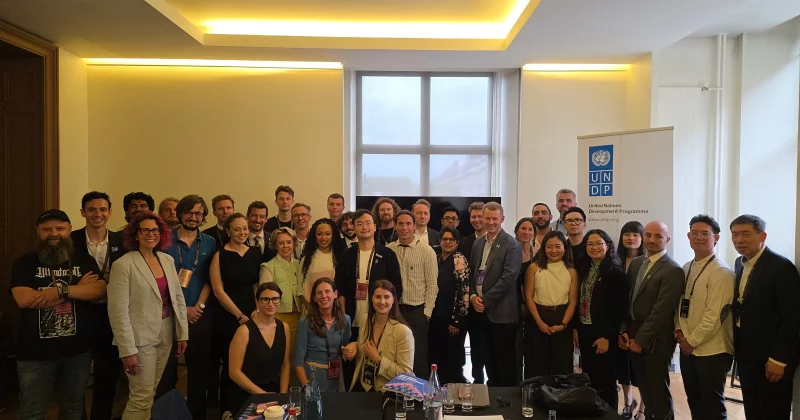
Add us on Google by Editorial Team Jun. 9, 2026The United Nations Development Programme just brought blockchain into its institutional toolkit in a formal way. The agency launched its Blockchain Advisory Group on June 3 at the Proof of Talk event in Paris, assembling 26 member organizations from across the blockchain industry to advise on how distributed ledger technology can support development goals.
What the Blockchain Advisory Group actually does
The BAG, as it’s being called, is chaired by UNDP Associate Administrator Haoliang Xu. Its mandate is to explore how blockchain technologies can address development challenges while strengthening digital public infrastructure and public systems more broadly.
The group’s inaugural meeting in Paris zeroed in on financial inclusion and digital finance. That’s a logical starting point. Roughly 1.4 billion adults worldwide remain unbanked, and blockchain-based payment rails have long been pitched as a solution for populations that traditional finance forgot.
Going forward, the BAG plans to convene twice per year. Future sessions will tackle topics including digital governance and public trust.
AdvertisementThe 26 member organizations span foundations and associations from across the blockchain sector. The UNDP hasn’t spotlighted individual tokens or specific cryptocurrency projects, which tells you something about the framing here. This is about the technology as infrastructure, not about picking winners in the token market.
Years of groundwork led to this moment
The BAG didn’t materialize overnight. It builds on years of UNDP pilot projects testing blockchain applications in regions across Africa, Latin America, the Middle East, Europe, and Asia-Pacific.
Those pilots explored use cases in digital payments, climate finance, digital identity, and public procurement.
Preparatory discussions for the advisory group began in late 2025. A technical working meeting was held in Copenhagen in November 2025 to lay the groundwork for the formal launch.
What this means for the blockchain industry and investors
The BAG’s focus on fostering “ethical and interoperable blockchain solutions” suggests it could eventually influence how governments think about blockchain standards and regulation. A multi-stakeholder group with 26 members meeting biannually has the structure to produce recommendations that filter into national policy discussions.
The BAG’s mandate explicitly includes addressing risks associated with blockchain technology, including privacy concerns, energy consumption, governance vulnerabilities, and the challenge of deploying complex technology in low-resource environments.
The next BAG meeting hasn’t been scheduled publicly yet, but with a biannual cadence, it should convene again before the end of 2026. The topics of digital governance and public trust are expected to feature prominently.
Disclosure: This article was edited by Editorial Team. For more information on how we create and review content, see our Editorial Policy.