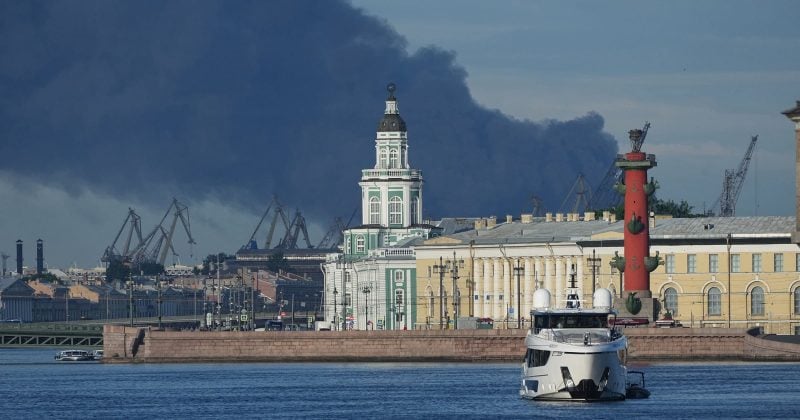
Ukrainian drones strike oil terminal in St. Petersburg during major economic forum
Long-range drones traveled over 1,000 kilometers to hit a critical Baltic Sea export hub just 17 kilometers from where Putin was courting foreign investors.
Share
Add us on Google by Editorial Team Jun. 3, 2026Nothing kills the vibe at an investment conference quite like columns of black smoke rising over the host city. On June 3, 2026, Ukrainian long-range drones struck the Petersburg Oil Terminal, igniting fires visible across St. Petersburg, just as the city opened its doors for the St. Petersburg International Economic Forum, Russia’s premier event for attracting foreign capital.
The timing was not subtle, and it was not meant to be. Ukrainian President Volodymyr Zelenskyy confirmed the strike, noting the drones had traveled over 1,000 kilometers, more than 600 miles, to reach their target. The terminal sits roughly 17 kilometers from the SPIEF venue, where around 20,000 participants had gathered to hear President Putin pitch Russia as an investment destination.
What got hit, and why it matters
The Petersburg Oil Terminal is not some minor fuel depot. It covers 37 hectares, houses 21 storage tanks, and handles up to 12.5 million tonnes of fuel annually. It is a critical node for Russian oil-product exports transiting through the Baltic Sea.
AdvertisementRussian authorities in the Leningrad region reported intercepting between 50 and 59 Ukrainian drones, though clearly not all of them were stopped. Officials confirmed infrastructure damage but stated there were no fatalities. Some injuries were reported at the affected sites.
Ukrainian sources also indicated that strikes were carried out on a nearby naval facility in Kronstadt, which hosts elements of Russia’s Baltic Fleet.
The message behind the timing
SPIEF runs from June 3 through June 6, and it has long served as Russia’s answer to Davos. It is where the Kremlin courts Middle Eastern sovereign wealth funds, Central Asian trade partners, and anyone else willing to do business despite Western sanctions.
Zelenskyy’s public confirmation of the attack was itself a strategic choice. By claiming credit openly and emphasizing the 1,000-kilometer range, Ukraine was sending a clear signal not just to Moscow, but to every foreign delegation sitting in those SPIEF panels.
Energy infrastructure as a strategic target
Russia’s claim of intercepting 50 to 59 drones in the Leningrad region alone suggests the scale of the operation was substantial. Even with a high interception rate, enough drones penetrated defenses to cause visible fires and confirmed damage.
For global energy markets, the immediate impact depends on how long the terminal remains offline and whether structural damage was sustained by the storage tanks. A facility handling 12.5 million tonnes annually represents meaningful throughput.
Disclosure: This article was edited by Editorial Team. For more information on how we create and review content, see our Editorial Policy.