
 Written by Christina Comben , Staff Writer.Reviewed by Bryan O'Shea , Staff Editor.Written by Christina Comben , Staff Writer.Reviewed by Bryan O'Shea , Staff Editor.
UK Lords warn BoE could regulate pound stablecoins into irrelevance
Latest NewsPublishedJun 2, 2026A UK House of Lords committee warned that strict stablecoin rules could make pound sterling tokens commercially unworkable despite supporting regulation.

The United Kingdom should press ahead with stablecoin regulation but avoid rules that make a pound sterling stablecoin market commercially unworkable, a House of Lords committee warned in a report released Wednesday.
The cross-party Financial Services Regulation Committee said the UK was “lagging behind” the United States and the European Union and that the absence of a clear regime has “suppressed stablecoin development and investment in the UK,” despite the growth of global US dollar-pegged tokens such as USDt (USDT) and USDC (USDC).
While backing much of the Bank of England (BoE) and Financial Conduct Authority’s proposed framework, the committee warned that some measures risk undermining the viability and competitiveness of UK-issued stablecoins.
The report backs requirements for fiat-referenced stablecoins to be backed 1:1 by high-quality assets and a proposed BoE backstop lending facility for systemic issuers.
However, it singles out several elements of the Bank’s November 2025 consultation as potentially damaging, warning that a requirement for systemic issuers to hold at least 40% of their backing assets in unremunerated central bank deposits has attracted “considerable criticism” and could “impact negatively on the viability of stablecoin issuers and the international competitiveness of the UK market.”
Proposed temporary holding limits for businesses and individuals are also flagged as measures that could “unnecessarily inhibit the growth of GBP stablecoins” and prove impractical to implement.
Related: UK FCA seeks feedback on guidance for crypto rules ahead of 2027 rollout
Interest bans and rewards uncertainty cloud UK tokens
Peers also turn to the politically sensitive question of returns. The Bank’s draft regime would prohibit remuneration for coinholders of sterling-denominated systemic stablecoins, putting the UK on a similar footing to the EU’s Markets in Crypto-Assets Regulation (MiCA), which bars stablecoin issuers from paying interest to holders. The US GENIUS Act prohibits payment stablecoin issuers from paying interest, though US debate continues over whether exchanges and other intermediaries can offer rewards.
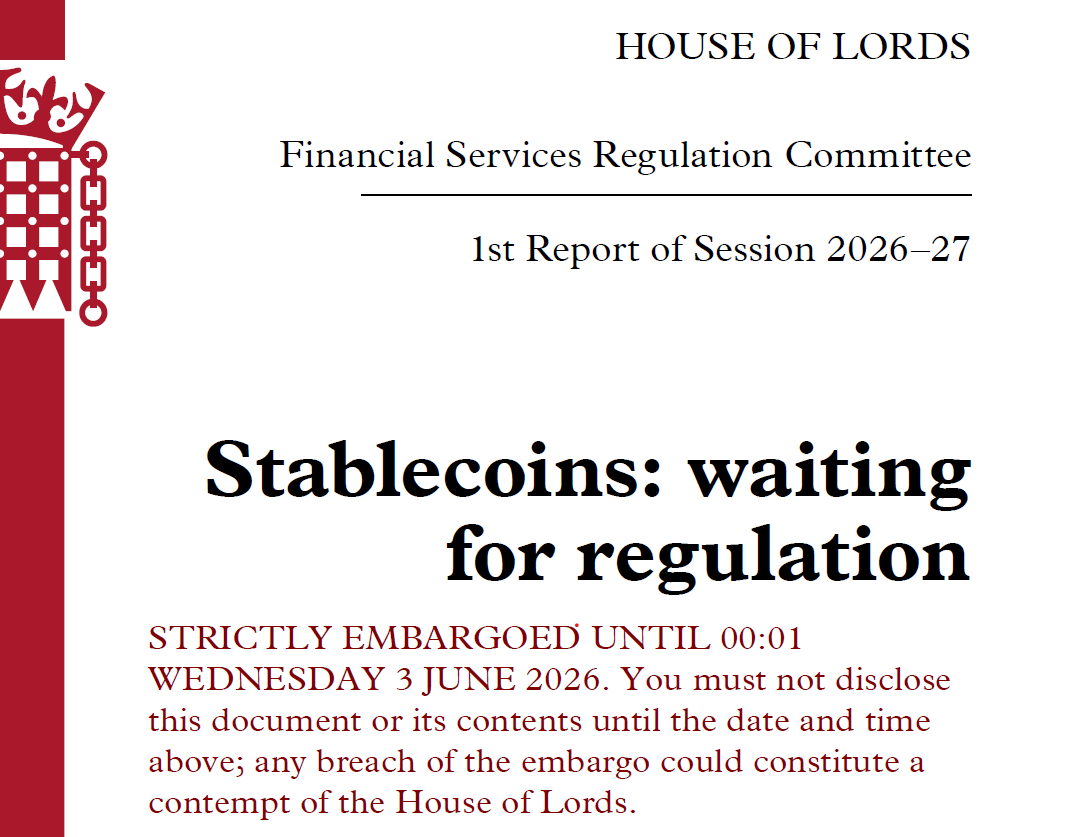
House of Lords Stablecoin Report. Source: House of Lords
The committee presents payment-focused stablecoins primarily as instruments for fast, low-cost transactions rather than as investment products. However, it warns that the combination of strict reserve rules and a ban on interest or other remuneration could weigh on the “business viability” and competitiveness of UK-issued tokens, especially while it remains unclear whether card-style rewards or other non-interest incentives will be allowed.
Inquiry evidence highlights risks and UK’s strategic choice
The conclusions follow months of evidence gathering in which the committee pressed industry and academic witnesses on whether stablecoins can move much beyond “on and off-ramps into crypto,” challenged them on financial stability, bank funding and consumer protection risks, and probed sharply divergent views on the US GENIUS Act’s approach to non-bank issuers.
While stressing that the expansion of stablecoin markets “must not create new opportunities for illicit activity to flourish,” the Lords argue the UK should aim to nurture, not just police, a pound-denominated stablecoin sector.
They urge His Majesty’s Treasury, the Bank of England and the FCA to stick to existing timelines, clarify how dual regulation of systemic issuers will work in practice, and recalibrate measures such as holding limits and reserve requirements so that sterling stablecoins can “compete with other forms of payment in the UK” rather than be regulated out of relevance.
Magazine: Guide to the top and emerging global crypto hubs — Mid-2026
Cointelegraph is committed to independent, transparent journalism. This news article is produced in accordance with Cointelegraph’s Editorial Policy and aims to provide accurate and timely information. Readers are encouraged to verify information independently.More on the subject
 US lawmakers push back on Labor Department plans to include crypto in 401(k)s3 hours agoTurner Wright
 CFTC chair claims Gemini case was politically motivated, seeks to reverse settlement8 hours agoTurner Wright
 Debate on CLARITY Act continues this week as US Senate returnsJun 1, 2026Turner WrightUS lawmakers push back on Labor Department plans to include crypto in 401(k)s3 hours agoTurner WrightCFTC chair claims Gemini case was politically motivated, seeks to reverse settlement8 hours agoTurner WrightDebate on CLARITY Act continues this week as US Senate returnsJun 1, 2026Turner Wright