Most traders already know where they want to trade. They mark support levels. They mark resistance. They decide where they would buy more if price moves. But executing that plan is harder.
Manual trading means staying in front of the screen. Standard bot setups also limit flexibility. DCA bots use fixed spacing. GRID bots mostly work in ranges. Real trading plans rarely look like that.
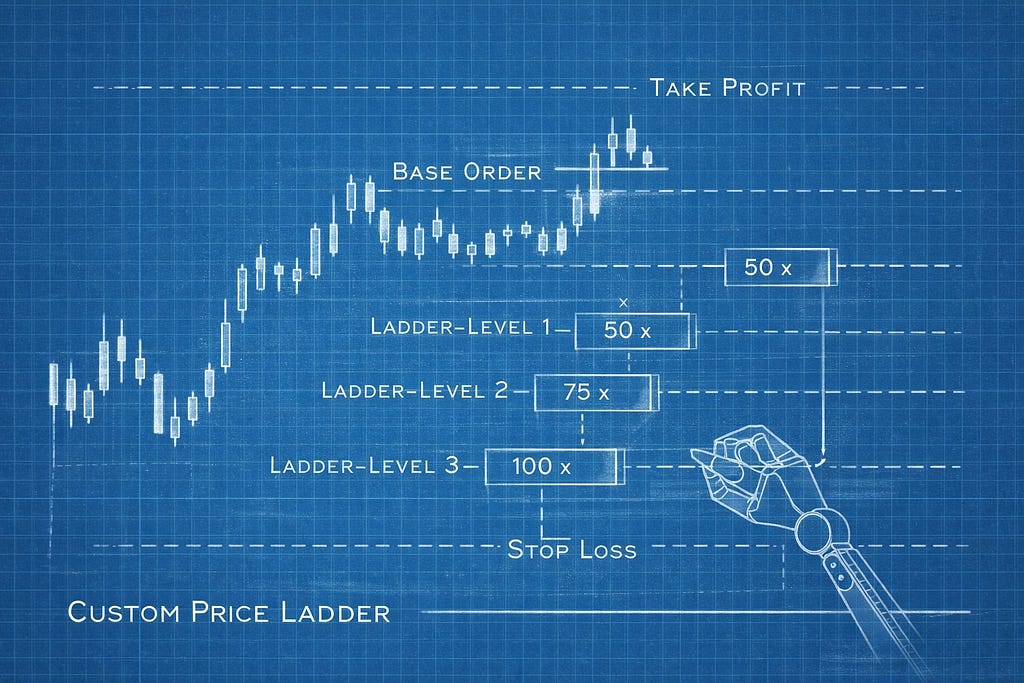
Custom Price Ladder lets you predefine exact price levels and order sizes so the bot follows the structure you want.
What a Custom Price Ladder Does
Custom Price Ladder lets you place several orders at specific price levels.
You control:
- the exact price of each order
- the size of every order
- how the position grows as price moves
As orders fill, the weighted average price (WAP) updates automatically. Profit targets or stop losses tied to that average adjust as well.
Instead of using fixed spacing, you build the position exactly the way you planned.
https://medium.com/media/12180a1507c95a7a5158fe58347fe6eb/hrefAveraging Down
Orders are placed below the entry price. The purpose is simple: improve the average entry so a smaller bounce can close the trade in profit.
Typical structure:
- base order near the middle of the range
- additional orders lower
- larger orders deeper in the ladder
Averaging Up
Orders are placed above the entry price. The logic is different: increase the position only after the move proves itself.
Typical structure:
- small initial order
- additional orders above the breakout
- stop placed below the breakout level
Many traders add more to losing trades and reduce winning ones. Averaging up does the opposite.
Three Ladder Structures Traders Often Use
Range Ladder
Used when price moves between clear support and resistance.
Basic idea:
- base order near the center of the range
- several orders below it
- profit targets closer to the upper range
This lowers the average entry during dips and closes the trade during rebounds.
Breakout Ladder
Used when resistance breaks and momentum builds.
Structure:
- small entry at breakout
- additional orders slightly higher
- partial profits during the move
This avoids building a large position before the move is confirmed.
Pullback Ladder
Used during a strong trend. Orders are placed both below and above the entry.
That way the strategy handles two outcomes:
- a deeper pullback
- continuation of the trend
Order Size Changes the Risk
The way you size ladder orders affects the trade.
Common approaches include:
- Equal size orders. Simple and easy to control.
- Larger orders deeper in the ladder. Improves the average entry faster but uses more capital.
- Larger orders higher in the ladder. Often used when adding to winning trades.
Many traders begin with equal sizes and adjust after reviewing backtests.
Risk Controls Still Matter
A ladder structure does not remove risk.
Basic risk control rules include:
- Set a cap on total capital used by the bot
- Define stop loss or trailing stop
- Move stop to break-even after profit
- Test strategies before scaling
What to Review in Backtests
Before running a ladder strategy live, check a few key metrics:
- percentage of orders filled
- drawdown versus capital used
- win rate and profit factor
- ROI versus total profit
These numbers help determine whether the ladder is balanced.
Full Guide
This article only covers the core ideas.
The full guide includes:
- complete ladder setups
- charts and configuration examples
- ready-to-try settings
Turn Price Levels on Your Chart Into a Bot Strategy was originally published in Coinmonks on Medium, where people are continuing the conversation by highlighting and responding to this story.