Trust, Designed: The End of DeFi “Trustless” Fantasy
--
1️⃣ Start With the Myth
“Don’t trust people. Trust code.”
This mantra defined the first era of decentralized finance. The promise was seductive: trustless systems where smart contracts execute impartially, intermediaries become obsolete, and “code is law” guarantees fairness. For a time, this narrative powered explosive growth.
But reality introduced a necessary correction: no system is fully trustless.
The question was never whether trust exists in DeFi — it is where trust resides, who holds it, and how it is managed. As research on blockchain trust mechanisms observes, the concept of “trustlessness” often obscures rather than eliminates dependencies
Trust didn’t disappear. It migrated — into layers less visible, but no less critical.
2️⃣ Show Where Trust Actually Lives
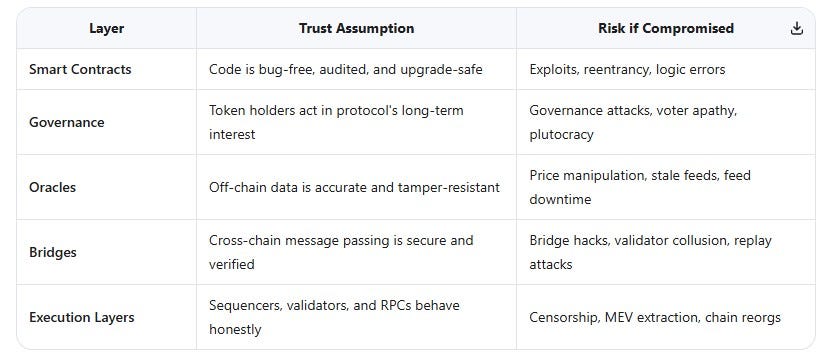
DeFi abstracts complexity, but abstraction is not elimination. Beneath the surface, trust concentrates in several engineered layers:
Each layer represents a trust interface. As one analysis notes, trust-minimization in DeFi aims to reduce reliance on intermediaries — but cannot eliminate the need for verifiable assumptions
learn.greeks.live
The illusion of decentralization often hides centralized points of failure behind modular architecture.
3️⃣ Explain the Problem With “Decentralization Theatre”
Many protocols optimize for the appearance of decentralization rather than its substance. This creates what we might call Decentralization Theatre:
- Multisigs as security proxies: A 5-of-9 multisig may look robust, but if signers are affiliated or geographically concentrated, resilience is illusory.
- DAOs with low participation: When <5% of token holders vote, “community governance” becomes governance by a motivated minority.
- Timelocks that delay but don’t prevent risk: A 48-hour timelock gives attackers time to prepare, not defenders time to react.
- Systems that can’t respond during critical moments: Immutable contracts cannot patch zero-day exploits; “decentralized” protocols may lack emergency coordination mechanisms.
The distinction matters: appearance of decentralization ≠ actual safety. As institutional frameworks increasingly emphasize, operational resilience requires explicit accountability structures — not just ideological purity
4️⃣ Introduce Engineered Trust
The mature path forward isn’t to deny trust, but to engineer it deliberately.
Engineered trust means designing systems where:
- Roles and responsibilities are explicit, not implied
- Permissions are defined and auditable, not assumed
- Constraints are enforced by protocol, not policy
- Failure modes trigger structured responses, not chaos
This mirrors how traditional financial infrastructure operates: not by eliminating human judgment, but by embedding it within layered controls, monitoring, and escalation protocols. As conceptual engineering research suggests, aligning trust mechanisms with system design — not rhetoric — is essential for sustainable blockchain applications
link.springer.com
The goal shifts from “Can we remove trust?” to “How do we make trust observable, accountable, and recoverable?”
5️⃣ Connect This to Operational Security
Code alone cannot handle every edge case. Real-world DeFi security demands operational security:
- Continuous monitoring: Detecting anomalies before they become exploits
- Rapid response mechanisms: Circuit breakers, pause functions, and escalation paths that activate under stress
- Human judgment in edge cases: Automated systems lack contextual awareness; trained operators can interpret novel threats
- Layered security: Defense-in-depth across smart contracts, infrastructure, and governance
Recent analysis of 2026 DeFi exploits underscores this: bridge failures and oracle manipulations accounted for the majority of losses, precisely because protocols lacked responsive operational layers
. Resilience isn’t just about preventing attacks — it’s about containing damage and recovering gracefully when prevention fails.
6️⃣ Connect This to Concrete
This is where Concrete takes a fundamentally different approach.
Explore Concrete at https://concrete.xyz/
Rather than hiding trust behind decentralization aesthetics, Concrete makes trust explicit, structured, and enforceable:
🔹 Trust is explicit, not hidden
Concrete vaults document risk parameters, strategy logic, and operational boundaries on-chain. Users see what they’re exposed to — not just APY.
🔹 Systems designed for response, not just prevention
Concrete integrates monitoring, alerting, and controlled intervention capabilities. When market conditions shift or anomalies emerge, the system can adapt — not just fail.
🔹 Onchain enforcement + off-chain intelligence
Smart contracts enforce hard constraints (withdrawal limits, strategy bounds), while off-chain quant models and risk engines provide adaptive intelligence. This hybrid architecture enables both autonomy and oversight.
🔹 Role-based architecture
Permissions are granular and auditable: who can rebalance, who can pause, who can upgrade. No implicit admin keys; no shadow governance.
🔹 Controlled execution environments
Concrete vaults operate within defined risk corridors, with automated rebalancing and liquidation protection. This isn’t “trustless” — it’s trust-engineered.
Concrete vaults exemplify institutional DeFi: automated yield strategies built with quantitative rigor, audited infrastructure, and operational discipline
concrete.xyz
. The result isn’t ideology — it’s reliability.
7️⃣ Close With the Bigger Shift
DeFi is maturing beyond the “trustless” narrative.
The next phase won’t be won by protocols that claim to eliminate trust. It will be won by those that engineer trust best — making it transparent, accountable, and resilient under stress.
Key shifts underway:
- From “code is law” → “code is contract, with defined recourse”
- From “decentralization at all costs” → “resilience through structured governance”
- From “APY maximization” → “risk-adjusted yield with operational safeguards”
Infrastructure will be judged not by its ideology, but by its behavior under stress.
The future of DeFi infrastructure belongs to systems that acknowledge trust as a design variable — not a bug to be abstracted away. That means prioritizing operational security over theatrical decentralization, onchain enforcement over vague promises, and engineered trust over marketing slogans.