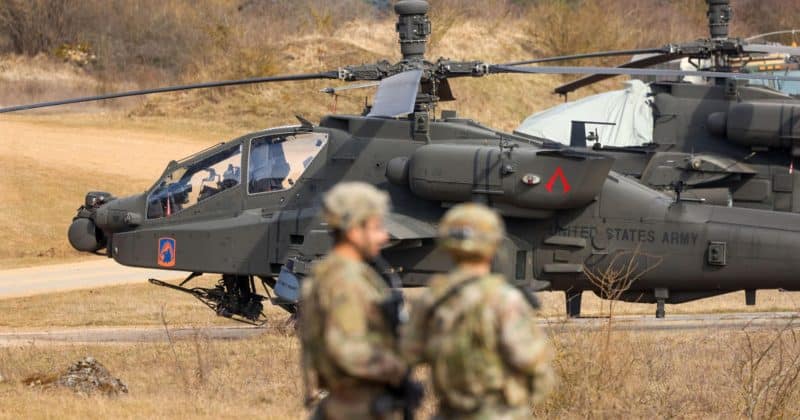
Trump vows US response to Iran after military helicopter shot down over Strait of Hormuz
Both pilots survived the incident, but the escalation threatens to upend ongoing peace negotiations and is already rattling crypto and oil markets.
Share
Add us on Google by Editorial Team Jun. 9, 2026President Donald Trump announced on June 9 that Iran shot down a US Army Apache helicopter patrolling the Strait of Hormuz the previous night, declaring that a US response is necessary. Both pilots were rescued safely, reportedly via drone boat, but the incident has injected a sudden dose of geopolitical chaos into markets that were already on edge.
Negotiations between the US and Iran for a potential peace deal were reportedly in their final stages. Shooting down a military helicopter is, to put it mildly, not a great way to close a deal.
What we know so far
Trump disclosed the incident on Truth Social, confirming the Apache was downed while on patrol off Oman’s coast in the Strait of Hormuz. The narrow waterway, through which roughly a fifth of the world’s oil supply passes daily, has been a flashpoint for US-Iran tensions for decades.
AdvertisementBoth pilots aboard the helicopter survived and were recovered. Trump emphasized that a response from the United States would be forthcoming, though he did not specify what form that response might take.
The Pentagon has not officially confirmed the details of the incident as of June 9. No independent verification has come from Iranian sources either, and no footage of the shootdown has been released publicly.
Markets react with predictable anxiety
Oil prices moved higher immediately following Trump’s announcement. Equity futures also reflected the uncertainty, trading lower as investors began gaming out scenarios ranging from targeted retaliation to broader military engagement.
Bitcoin and digital assets were not immune. The crypto market exhibited risk-off trading behavior as the news circulated, with traders reducing exposure amid the uncertainty.
Why crypto investors should be paying attention
The Strait of Hormuz isn’t just an oil story. Higher oil prices mean higher input costs for Bitcoin miners who rely on energy-intensive proof-of-work computation. They also mean inflationary pressure, which can influence central bank policy, which in turn shapes the macro environment that digital assets trade within.
There’s also the sanctions angle. Any escalation with Iran almost certainly means tighter financial restrictions, which historically has driven increased interest in crypto as a sanctions evasion tool. That dynamic creates a strange duality: the same event that pressures Bitcoin’s price could simultaneously increase demand for crypto rails in sanctioned economies.
The gap between Trump’s Truth Social post and official military confirmation is exactly the kind of information asymmetry that burns retail traders who move too fast.
Disclosure: This article was edited by Editorial Team. For more information on how we create and review content, see our Editorial Policy.