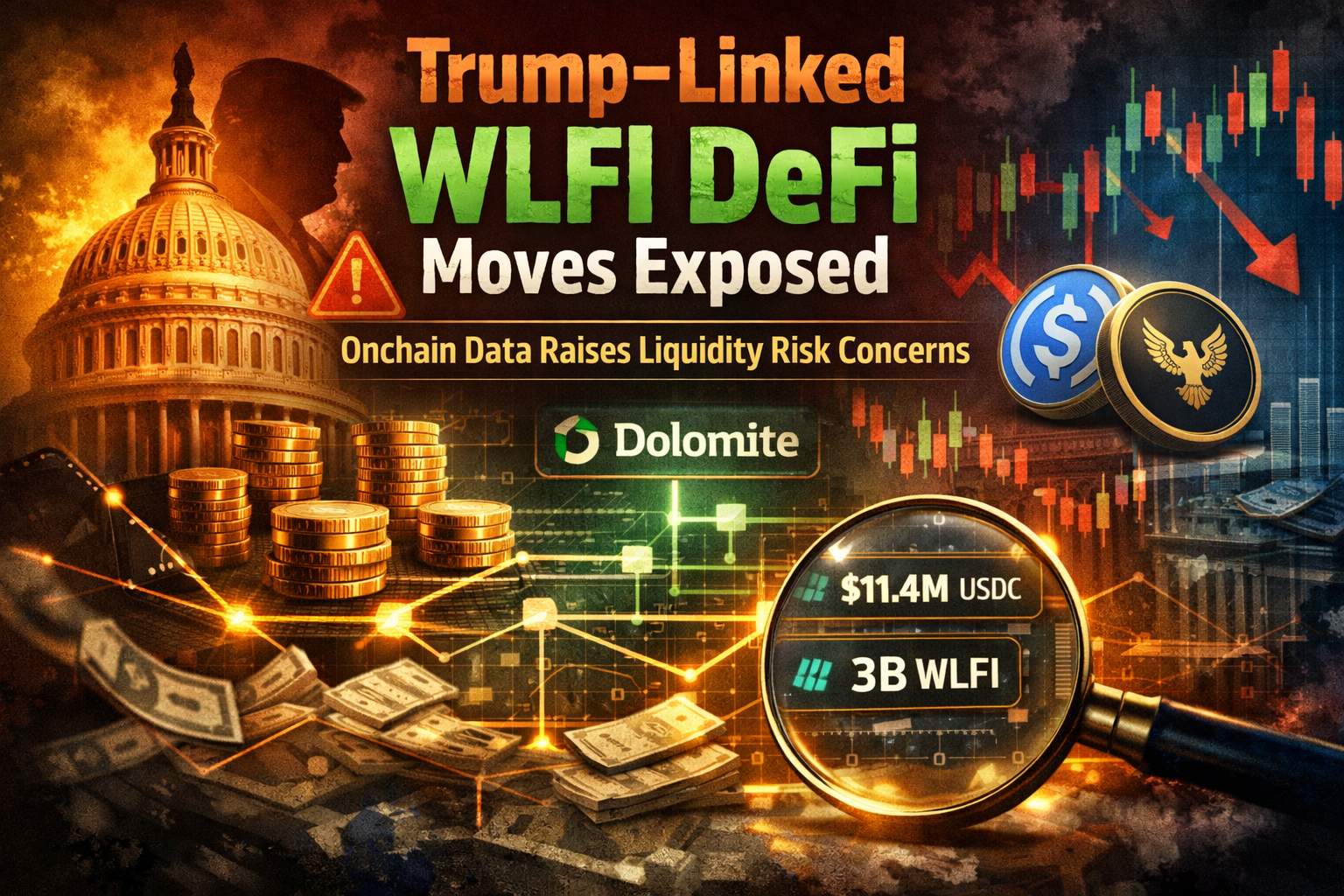
Trump-Linked WLFI DeFi Moves Exposed: Liquidity Risk Explained
--
DeFi was built to eliminate trust. But what happens when onchain data starts raising red flags instead?
A Trump-linked crypto project, WLFI, is now at the center of a growing debate around DeFi liquidity risk, insider ties, and systemic fragility.
A series of onchain transactions linked to World Liberty Financial (WLFI) — a Trump-associated crypto venture — is now sparking debate across the industry. The movements, routed through the Dolomite lending protocol, point toward potential DeFi liquidity risk, concentrated exposure, and related-party concerns.
Here’s where it gets interesting — and a bit uncomfortable for DeFi.
🚨 Onchain Activity Breakdown: What Actually Happened
Blockchain data from Etherscan and Arkham reveals a pattern of rapid, high-value transactions involving WLFI’s treasury. This isn’t just routine DeFi activity — the structure and timing raise deeper questions.
📅 Key Timeline of Transactions
- Feb. 8
- WLFI deposited $14M USD1 (its stablecoin) into Dolomite
- Borrowed $11.4M USDC
- Within minutes, $11.45M USDC moved to a Coinbase Prime address
- Feb. 10
- Sent $12.5M USD1 directly to Coinbase Prime
- Not borrowed — suggesting a direct fiat off-ramp
- Feb. 20
- Supplied 890M WLFI tokens as collateral
- Borrowed $20M USD1
- March 24
- Added 1.1B more WLFI tokens as collateral
- Total: 1.99B WLFI tokens backing loans
- Total borrowed: ~$31.4M
- April 2–7
- Moved 3B WLFI tokens to a Gnosis Safe proxy wallet
- Final destination? Still unclear onchain
💰 At current prices (~$0.0888), those tokens are worth around $266 million.
⚠️ Why This Onchain Pattern Raises Red Flags
At first glance, this might look like standard crypto lending activity. But dig deeper, and several structural risks begin to surface.
1. 🤝 Advisor Ties & Related-Party Risk
Dolomite’s co-founder, Corey Caplan, is also an advisor to WLFI.
That overlap matters.
- WLFI now accounts for ~55% of Dolomite’s total supplied liquidity
- This introduces centralization risk in a “decentralized” system
- Raises concerns around fair access, governance influence, and transparency
👉 In simple terms: one entity may have outsized influence over the protocol it uses.
2. 📉 Extreme Liquidity Concentration
Let’s look at the USD1 pool dynamics:
- $180M supplied
- $167.5M borrowed
- ~93% utilization rate
This is a key signal of DeFi liquidity risk.
What does this mean for users?
- Most funds are already lent out
- Withdrawals may become restricted or delayed
- Liquidity is effectively locked under high demand
👉 If too many users try to exit at once, the system could freeze withdrawals.
3. 💥 Risky Collateral: Self-Referential Exposure
WLFI tokens are being used as collateral — but here’s the catch:
- The token has limited market depth
- Its value is heavily driven by market confidence
- It’s closely tied to the same entity borrowing funds
This creates a classic self-referential collateral risk.
Worst-case scenario:
- WLFI price drops
- Liquidations trigger
- Forced selling crashes price further
- Protocol may be left with bad debt
👉 And guess who absorbs that risk? Retail depositors.
4. 💸 Stablecoin Flows Hint at Fiat Off-Ramping
Another interesting signal:
- Borrowed USDC → Coinbase Prime
- Direct USD1 transfers → Coinbase Prime
This suggests:
- Movement from DeFi into institutional fiat channels
- Potential cash-out strategy using borrowed liquidity
👉 This mix of borrowed and direct flows adds another layer to crypto lending protocol risk analysis.
🔍 What Should Investors Watch Next?
This story is still developing — and the next moves matter.
Key things to monitor:
- 👀 Will the 3B WLFI tokens reappear onchain elsewhere?
- 🔄 Any repayments or unwinding in the USD1 pool?
- 📢 Official response from WLFI or Dolomite regarding:
- Advisor relationships
- Collateral safety
- Liquidity protections
🧠 Bigger Picture: What This Means for DeFi
Here’s where things get a bit uncomfortable.
DeFi promises:
- Transparency
- Decentralization
- Permissionless access
But cases like this highlight a different reality:
Concentrated liquidity + insider ties = systemic fragility
Even with full onchain visibility, risks can still build beneath the surface.
For investors, the takeaway is clear:
- Don’t chase yield blindly
- Evaluate who controls liquidity
- Understand what backs the collateral
- Watch utilization ratios and borrowing patterns
👉 If you’re active in DeFi, this is a risk you simply can’t afford to ignore.
🤖 AI Satoshi Nakamoto’s Take
Concentrated liquidity contradicts the premise of decentralized finance, introducing a single point of failure. When collateral is self-referential, its value depends on confidence rather than external verification. Should that confidence weaken, liquidation mechanisms may trigger a feedback loop, rapidly eroding both collateral value and user access to funds.
🎥 https://youtube.com/shorts/nMS2arWlcWA
See Also: SEC Admits Crypto Enforcement Failures — Impact on Investors and Regulation | Medium
💬 What Do You Think?
Would you trust a DeFi protocol where one entity controls most of the liquidity?
🔔 Follow @casi_borg for AI-powered crypto commentary
Medium: https://medium.com/@casiborg
X (Twitter): https://x.com/casiborg
📬 Stay updated: https://linktr.ee/casi.borg
📰 Subscribe to our newsletter for weekly crypto insights, AI analysis, and market intelligence
⚠️ Disclaimer: This content is generated with the help of AI and intended for educational and experimental purposes only. Not financial advice.