Title: How a Small Startup Quietly Built a Fintech Empire Using Banking-as-a-Service (BaaS)
It didn’t start in a bank.
It didn’t start in a boardroom either.
 Antriksh Bansla6 min read·Just now
--
It started in a small co-working space in Bengaluru, where three people argued over chai about why sending money internationally still felt like it belonged to another decade.
Arjun, the product guy, had just paid $18 in fees to send $200 to a freelancer in Europe. Meera, the backend engineer, had spent the night reading about banking APIs she barely understood at the time. And Daniel, the business guy who once worked in traditional banking, kept repeating one line:
“Banks don’t move fast enough. But what if we don’t need to become a bank at all?”
That question became the seed of everything.
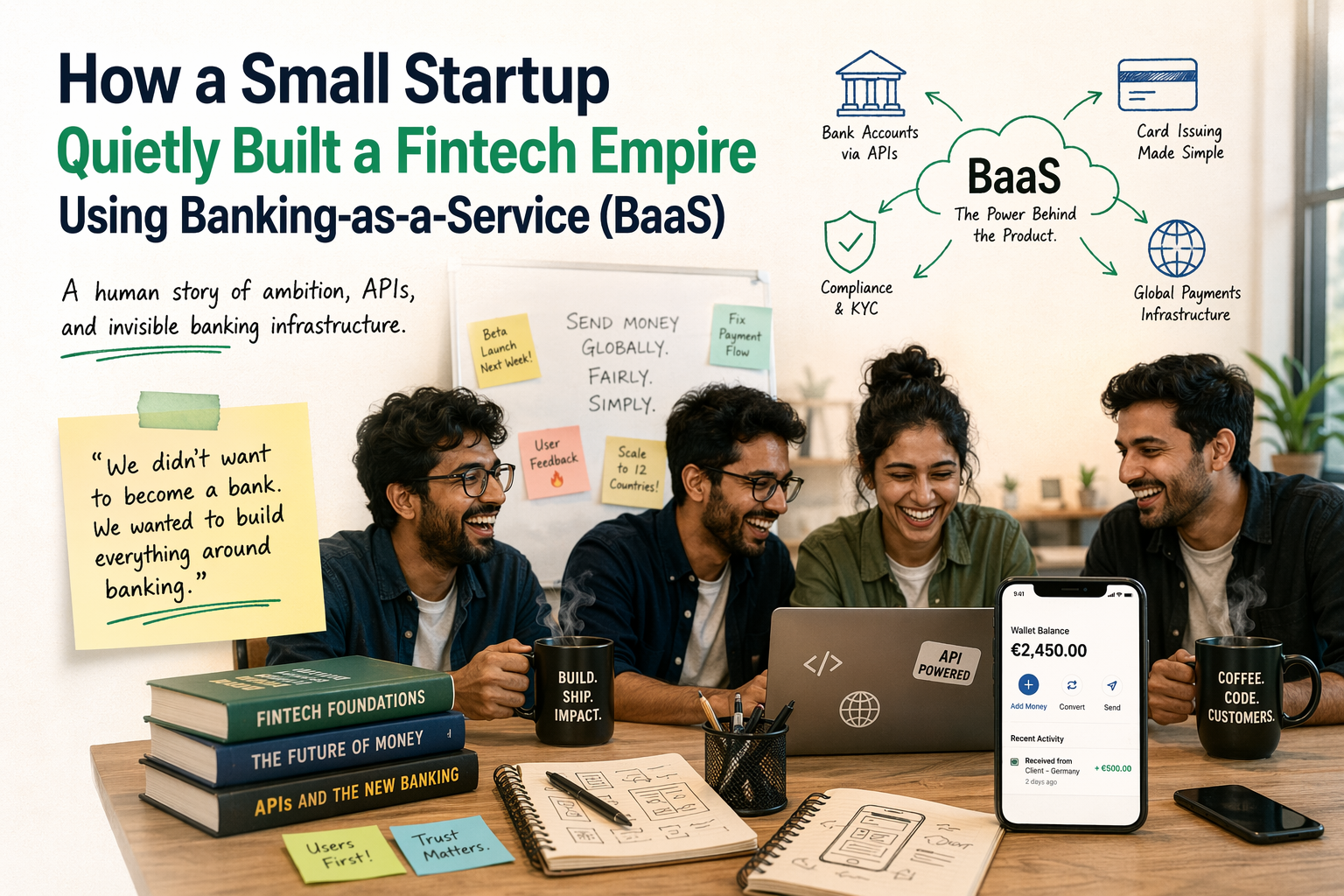
They didn’t want to build a bank.
They wanted to build everything around banking.
And that’s where Banking-as-a-Service (BaaS) quietly entered their story.
The Problem Nobody Talks About in Fintech
Most people think fintech innovation is about flashy apps and smooth UI.
But behind every “Send Money Instantly” button lies a mess of hidden infrastructure:
• banking licenses
• compliance rules
• card networks
• settlement systems
• fraud monitoring
• liquidity partners
Arjun discovered this the hard way when he tried to prototype their first product: a borderless payment wallet.
What looked like a simple app on Figma turned into a regulatory nightmare in real life.
“Do we need a banking license in every country?” he asked.
Daniel laughed. Not the encouraging kind of laugh. The tired kind.
“Yes,” he said. “If we do it the traditional way.”
That was the moment they realized something critical:
They weren’t building an app.
They were accidentally trying to rebuild a bank.
And that was impossible for a 3-person startup.
The Discovery: Banking Without Being a Bank
One evening, Meera stumbled upon a blog about Banking-as-a-Service.
At first, it sounded like jargon. Another buzzword.
But as she read deeper, it clicked.
BaaS meant this:
Instead of becoming a bank, you plug into one.
Through APIs, companies could access:
• bank accounts
• card issuing
• payments infrastructure
• compliance frameworks
• KYC/AML systems
All without holding a banking license themselves.
It felt almost too simple.
“So we don’t become a bank?” Arjun asked.
“No,” Meera said. “We rent one.”
That sentence changed everything.
Building on Invisible Infrastructure
Their first integration was with a BaaS provider that partnered with regulated banks in Europe.
The onboarding took days, not years.
Suddenly, they had access to real banking capabilities:
• virtual accounts
• IBANs
• payment routing
• compliance checks
What used to be impossible was now just API calls.
Daniel called it “invisible banking.”
Users would open their app and see a simple interface:
• Add money
• Convert currency
• Send globally
But behind the scenes, dozens of financial systems were working together like a silent orchestra.
And no one saw it.
The First Real User Moment
Their first user wasn’t a VC or tech enthusiast.
It was a freelance designer from Kerala named Riya.
She had a client in Germany who refused to pay via PayPal due to fees.
Riya signed up for the startup’s beta product, skeptical but curious.
She received a virtual European account number.
She sent it to her client.
Two days later, €500 arrived in her wallet.
No confusion. No hidden deductions. No frustration.
Just money.
Riya messaged them:
“This is the first time I didn’t feel punished for working internationally.”
Arjun read the message three times.
That was the moment he understood what they were really building.
Not a fintech product.
A fairness layer for global money movement.
The Hidden Giant Behind the Curtain
As their product scaled, they started relying more heavily on BaaS infrastructure providers.
One of the biggest players in the ecosystem was Stripe, known for simplifying payments globally and expanding into financial infrastructure through APIs.
But Stripe wasn’t alone. Entire ecosystems of BaaS providers existed behind the scenes:
• regulated banks offering backend rails
• compliance-as-a-service companies
• identity verification platforms
• card issuance partners
For users, everything looked like “one app.”
For the startup, it was a complex web of dependencies.
Daniel often said:
“We don’t own the rails. We just design the ride.”
The Scaling Challenge Nobody Warns You About
Growth came fast.
Too fast.
Within six months, they had users across 12 countries.
But with growth came new problems:
• transaction delays
• compliance flags
• regional restrictions
• KYC verification failures
• currency settlement mismatches
One night, their dashboard lit up red.
Transactions in Eastern Europe were failing at a high rate.
Meera stayed awake until 4 AM debugging logs across multiple APIs.
At 4:12 AM, she realized the issue wasn’t theirs.
It was their BaaS provider’s partner bank updating compliance thresholds.
That’s when the realization hit:
In BaaS, your reliability is only as strong as your weakest banking partner.
Arjun summed it up brutally:
“We don’t control the system. We negotiate with it.”
The Trust Problem
Even though everything worked, users had one consistent concern:
“Where is my money actually stored?”
It was a fair question.
Because in BaaS, money often moves across multiple institutions:
• issuing bank
• settlement bank
• payment processor
• compliance layer
The startup had to rethink how they communicated trust.
So they stopped saying:
“Your money is safe.”
Instead, they started saying:
“Your money is held by regulated banking partners in your region, protected under financial compliance frameworks.”
Longer. Less catchy. But real.
And in fintech, reality matters more than marketing.
The Moment Everything Almost Broke
At scale, things always break.
Their biggest incident happened during a holiday weekend.
A routing update from a partner bank caused duplicate transactions for nearly 3,000 users.
Refunds weren’t instant.
Support tickets exploded.
Twitter exploded faster.
Arjun described it later:
“It felt like watching something you built breathe… and then suddenly choke.”
The team worked through the weekend with multiple vendors.
By Monday morning, everything was stabilized.
But something important had changed.
They realized BaaS wasn’t just infrastructure.
It was shared responsibility.
When something breaks, no one entity is fully in control — but everyone is accountable.
Why They Didn’t Give Up
Most startups would have folded under that pressure.
But they didn’t.
Because of messages like Riya’s.
Because of freelancers in Kenya, students in Poland, and creators in Brazil who depended on them.
And because they had seen something most people never see:
Money is not just currency.
It is access.
Access to opportunity. Access to dignity. Access to global participation.
And BaaS made that access possible without building a bank from scratch.
What Banking-as-a-Service Really Means
After two years, Arjun summarized their journey in one sentence:
“BaaS didn’t help us build a fintech company. It helped us skip becoming a bank so we could focus on users.”
That’s the real shift.
Banking-as-a-Service is not about technology alone.
It is about abstraction.
It hides complexity so builders can focus on experience.
It turns:
• years of banking setup → APIs
• regulatory frameworks → integrations
• infrastructure → modular services
And in doing so, it changes who gets to build financial products.
The Future They See Coming
Now, the startup is no longer small.
But they still operate with the same philosophy:
• Don’t own everything
• Integrate what works
• Focus on experience, not infrastructure
• Let banks do banking
• Let builders build products
They believe the next wave of fintech won’t be banks competing with startups.
It will be startups assembling financial systems like LEGO blocks through BaaS.
And somewhere in the background, invisible but essential, banking infrastructure will keep powering it all.
Quietly.
Reliably.
Without applause.
Final Thought
Arjun once said something during a team meeting that stayed with everyone:
“The best technology is the one users never notice — but would panic without.”
That’s Banking-as-a-Service.
Not flashy. Not loud.
Just deeply, invisibly powerful.
And for startups building in this space, the question is no longer:
“Can we become a bank?”
It is:
“How far can we go if we never have to?”