Three Protocols Now in Place, Compute Layer the First to Be Institutionalized: Where the Web4.0 Race Actually Stands in 2026
 N7 Capital10 min read·Just now
--
The window for positioning at the infrastructure layer is narrowing. The vertical application layer — where protocol capability translates into real commercial loops — is where the more meaningful opportunity sits between 2026 and 2027.
Since the beginning of 2026, a concept tightly bound to AI has been surfacing repeatedly across crypto research and investment circles: Web4.0. Unlike the previous round of debate, which centered on consensus mechanisms and throughput, the focus this time isn’t a new consensus protocol or higher transaction speeds. It’s a switch in who’s actually executing — from humans operating the internet to autonomous AI Agents directly participating in economic activity.
N7 Capital has been tracking the evolution of protocol-layer infrastructure over the long term. This report enters from the actual buildout milestones of that infrastructure, assessing where the sector genuinely stands in mid-2026, where the structural opportunities sit, and the practical constraints that protocol-layer investors cannot afford to overlook.
I. A Structural Mismatch That’s Been Overlooked Too Long
Before discussing an Agent economy, one reality has to be confronted: today’s AI models already have meaningful perception and decision-making capability, but their commercial agency is almost entirely absent. Every link in the traditional financial system — account opening, identity verification, payment authorization, contract signing — is built on the foundation of natural-person or legal-entity identity. An AI program running in the cloud cannot legally open a commercial bank account, nor can it independently sign legally enforceable agreements. The result is that AI can only assist humans as a tool. It can’t take on the role of an independent economic actor.
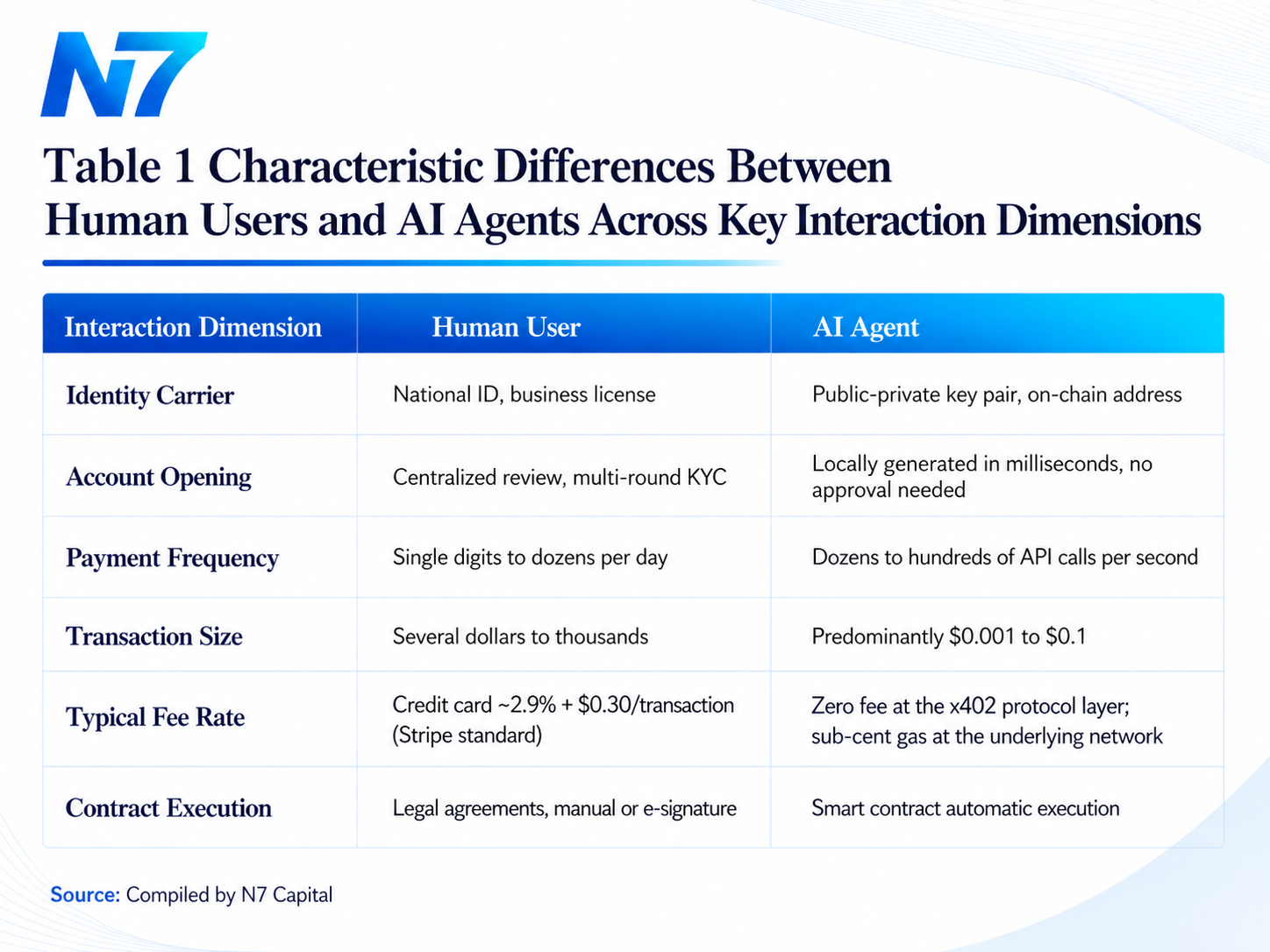
The deeper mismatch shows up in payment granularity. Take Stripe’s standard rate as an example: a single transaction carries a fixed cost of 2.9% plus $0.30. That pricing assumes a scenario of relatively large, low-frequency human consumer behavior. But the actual behavioral pattern of an Agent runs in the opposite direction — a single API call may only require $0.001 to $0.01, but call frequency can reach dozens of times per second. Under those transaction characteristics, the fixed processing fee from traditional card networks alone exceeds the transaction value. It simply cannot support a commercially viable micro-payment scenario.
The table below maps out the differences between the two user types across several key dimensions.
This mismatch means that no matter how capable the model becomes, AI under the existing financial system can still only play the role of an information processor. The prerequisite for an Agent to actually become an economic actor is finding an underlying protocol stack that steps outside the traditional financial identity framework.
II. Why Crypto Infrastructure Becomes the Substitute Path
Permissionless blockchain networks happen to provide a structural solution to the problem above.
On networks like Ethereum, Solana, and TRON, generating an on-chain address only requires a single local public-private key pair generation — completed in milliseconds, with no centralized approval. This means an AI Agent can create independent identity carriers for itself or its derived sub-tasks at any time, and directly participate in on-chain transactions as the asset-receiving party. Stablecoins resolve the unit-of-value problem — USDT and USDC currently have a combined circulating supply exceeding $250 billion, providing a stable medium for pricing and settlement. Combined with smart contracts and composable DeFi protocols, complex financial operations like fund routing, lending, and hedging can be executed through programmatic interfaces, no longer constrained by business hours or manual approval.
The appeal of this substitute path is precisely the core reason institutional investors have publicly turned bullish on the role of crypto infrastructure within the Agent economy. The underlying logic: the determinism and verifiability of crypto rails align more naturally with the requirements of machine behavior. AI doesn’t tire and doesn’t forget. It can complete contract audits and address verification in seconds — exactly the area where human users have long been the weak link.
Within this narrative, the Web 4.0 thesis has gradually taken shape:
Web 4.0 = Web 3.0 + AI Agent
The underlying premise of Web4.0 is established here: combining crypto infrastructure with autonomously running AI Agents, moving machines from the information layer into the economic layer.
[Figure 1 Web 4.0 Conceptual Diagram]
III. Progress and Constraints Across Three Critical Protocols
For an Agent to genuinely become an economic actor, three protocol gaps had to be filled on top of existing blockchain infrastructure: payment, identity, and tool invocation. Over the past twelve months, these three gaps have been addressed by three representative protocols, all of which made concentrated progress between H2 2025 and Q1 2026.
[Figure 2 Web4.0 Infrastructure Buildout Key Milestones (May 2025 to April 2026)]
The payment layer is filled by the x402 protocol, released by Coinbase in May 2025. The protocol repurposes the long-dormant 402 Payment Required status code in the HTTP standard, allowing the server side to embed a payment requirement directly in a single HTTP response. The client completes the payment via stablecoin signature and gains access to the resource. On April 2, 2026, the x402 Foundation officially joined the Linux Foundation for open-source governance. The Foundation was co-founded by Coinbase, Cloudflare, and Stripe, with over twenty additional institutions participating in governance — including AWS, American Express, Google, Mastercard, Microsoft, Polygon Labs, Shopify, Solana Foundation, and Visa.
The identity layer is filled by ERC-8004, led by the Ethereum ecosystem. The standard was co-drafted by representatives from MetaMask, the Ethereum Foundation, Google, and Coinbase, and the reference registry deployment on Ethereum mainnet was completed on January 29, 2026.
The tool invocation layer is led by the MCP protocol, open-sourced by Anthropic in November 2024 and donated to the newly established Agentic AI Foundation under the Linux Foundation on December 9, 2025.
Worth noting: the pace of protocol-layer progress is materially ahead of actual commercial flow accumulation. According to an Unchained report on April 3, 2026, x402 averages roughly 55,000 daily transactions on Base, with cumulative on-chain transactions on Base reaching approximately 97 million. On-chain analytics firm Artemis reports that x402’s cross-chain daily transaction volume averages around $28,000, with an average single transaction of approximately $0.20. At the same time, roughly half of current transactions are estimated to be wash trades or test activity. Real commercial flow is still in the very earliest stages.
The lag between protocol standardization and commercial adoption is the most critical observation point at this stage.
IV. A Representative Case: The Compute Layer — The First Foundational Asset to Be Embraced by Capital Markets
While payment protocols and application scenarios are still in early commercial validation, the bottom layer of the Web4.0 stack — compute assets — has been the first to complete its connection to traditional financial channels. This is an easily overlooked but highly significant signal: traditional capital didn’t wait for Agent applications to prove product-market fit before entering. It chose to first build asset exposure at the compute layer.
The most representative marker comes from Grayscale. On December 30, 2025, Grayscale filed a Form S-1 registration statement with the SEC to convert the Grayscale Bittensor Trust into a spot ETP, intended for listing on NYSE Arca under the ticker GTAO. On the same day, Bitwise also filed Form N-1A registrations with the SEC for eleven strategy-type crypto ETFs, including a product specifically tracking TAO — the Bitwise TAO Strategy ETF. On April 2, 2026, Grayscale further filed Amendment №1 to the aforementioned S-1, pushing the product closer to formal listing.
In Switzerland, the Safello Bittensor Staked TAO ETP (ticker: STAO), jointly issued by Deutsche Digital Assets and Safello, listed on the SIX Swiss Exchange on November 19, 2025, trading in USD with 100% physical backing plus staking yield overlay. This means that before the North American ETF received final approval, European markets had already brought TAO-related products onto a major exchange.
Institutional secondary asset allocation is also accelerating. On April 7, 2026, Grayscale rebalanced its Decentralized AI Fund, raising TAO’s weighting from 31.35% to 43.06% — the single largest weight change in this rebalancing, with no other assets added or removed. This shift signals that institutions are beginning to formally bring decentralized AI into the mainstream AI narrative — previously, institutional expression of this theme has been almost entirely channeled through Nvidia and a handful of large model providers. TAO is the first crypto-native asset to be substantially overweighted by a mainstream decentralized AI thematic fund.
Supply-side scarcity further reinforces the long-term logic. Bittensor completed its first halving on December 14, 2025, with daily new issuance dropping from 7,200 to 3,600 — a supply cadence designed in alignment with Bitcoin. With approximately 70% of circulating supply locked in long-term staking, and the limited remainder absorbed by listed-company treasuries and ETP structures, circulation pressure on compute-layer assets is structurally tightening. This is precisely why institutions are willing to build positions ahead of the application layer.
But a real risk has to be flagged here. On April 10, 2026, Covenant AI — operator of one of the leading subnets on the Bittensor network — announced its withdrawal from the network and sold approximately 37,000 TAO, briefly triggering a 20%+ price correction and reigniting concerns about centralization in network governance. This event reminds institutional capital that while the asset-ization logic of the compute layer holds, the network is still in a dual adjustment phase across governance structure and network stability. It cannot be simply mapped onto Bitcoin’s early institutional adoption trajectory.
The signals released by the compute layer carry two layers of meaning.
First, the opening of institutional channels means that node operators, staking service providers, subnet developers, and compliant custodians built around this layer will receive structural dividends as capital enters. This is a direction worth deep participation in the next phase.
Second, once institutions bind TAO to decentralized AI as a configurable asset, valuation anchoring for the rest of the Web4.0 stack will gradually take shape — the asset-ization paths of the payment, identity, and application layers will gain reference coordinates as a result.
V. N7 Capital’s Key Judgments
Pulling together the observations above, the Web4.0 race is currently in a phase of concentrated infrastructure buildout with relatively lagging commercial adoption. Narrative, capital, and protocol — these three forces have completed initial convergence, but real on-chain commercial flow remains in early validation. For investment institutions and project teams, this phase carries both opportunity and risk. The key is whether one can accurately read the lag between the protocol window and the commercial window.
In its protocol-layer research, N7 Capital consistently applies three evaluation dimensions: whether the protocol holds together under adversarial conditions, whether the incentive mechanism remains coherent at scale, and whether the governance structure can survive complete cycles after the team steps back. Along these three dimensions, three judgments on the current phase of Web4.0 follow.
The first judgment is that the outcome of the standards competition will be settled within the next twelve months. While x402 and ERC-8004 have made phased breakthroughs, real flow accumulation still takes time. Once standards are established, the tooling, SDKs, and audit services built around them will see concentrated opportunity. This aligns with a logic N7 has long held in its protocol-layer research — real protocol value often doesn’t sit in the standard itself, but in the tooling and infrastructure that gets layered on after the standard is broadly adopted.
The second judgment concerns the migration of product form. Composable, programmatically callable product architectures represented by Skills will gradually replicate from AI Trading into traditional industries like insurance underwriting, supply chain fulfillment, and content rights settlement. This direction warrants close attention as a vertical incubation opportunity in the next phase. What N7 evaluates most carefully in projects of this type — whether the composability of Skills is designed at the protocol layer, or stitched together at the product layer. The former carries structural cycle-survivability; the latter is just stage-specific engineering.
The third judgment is that competition at the stablecoin settlement layer will become the decisive battleground for the payment layer’s actual landing. TRON, Solana, Base, and BNB Chain are all competing for mindshare at this layer. Projects building comprehensive Agent financial operating systems around different stablecoin networks carry strong structural opportunity. The verdict at this layer, in N7’s reading, will gradually surface six to twelve months after the standards competition resolves.
The window for positioning at the infrastructure layer is narrowing. The vertical application layer — where protocol capability translates into real commercial loops — is where the more meaningful opportunity sits between 2026 and 2027. The completeness of the protocol layer defines the boundary of what’s possible at the application layer above it. But real value capture, in the end, still has to land in concrete scenarios where machine users are actually being served.
This is the perspective N7 Capital consistently holds in protocol-layer research — narratives rotate, but what can be identified before consensus forms is always the same: systems that hold together coherently across protocol structure, incentive mechanism, and governance design.
N7 Capital | Research-Driven, Protocol-First.
This article represents N7 Capital’s industry observations and research perspectives only. It does not constitute investment advice. Crypto asset investments carry significant risk. Please make independent judgments based on a thorough understanding of the risks involved.