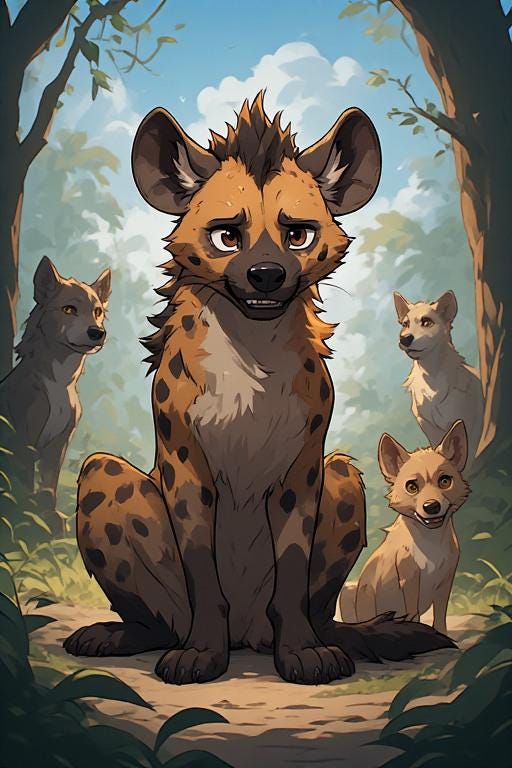
THEY TRIED TO INFECT HIM: Watch This Hyena Get the Last Laugh.
 Frederick Watson7 min read·Just now
--
I once had the unusual privilege — and challenge — of caring for a pet hyena. His name was Sam, a name that, though simple, belied the complexity of his character and the peculiar circumstances of his existence. Taking care of Sam required a strict regimen; I had to feed him fresh meat sourced from the local butcher, as he was utterly particular about his diet. He refused to eat anything other than the freshly cut meat, and no matter how tempting other foods might be, he would turn his nose up at them entirely. When Sam was in a good mood, he radiated a kind of wild happiness; he would prance around, his eyes gleaming, and his demeanor filled with a carefree exuberance that was contagious. However, when he was in a bad mood, his temperament became almost unbearable, and being around him was a test of patience and resilience. The word “my hyena” means “weakness”.
During that time, a flu was spreading through the neighborhood, affecting many of the local dogs. I was deeply concerned about whether Sam, with his unusual nature, would catch the illness as well. I found myself pondering the peculiar hybrid nature of my hyena — was he more like a cat, with aloof independence, or more like a dog, loyal and eager to please? It was a conundrum I couldn’t quite resolve. Ultimately, the flu did take hold of him. He fell into a state of decline, looking pitiably rotten, sluggish, and utterly dejected. The entire process was cumbersome and distressing to witness. As I looked at him lying there, I couldn’t help but think that hyenas were supposed to be resilient, tough creatures — yet, my Sam seemed so fragile, so vulnerable.
Despite his outward appearance as a fierce predator, Sam was more akin to a carefree loafer — an easygoing soul who preferred lazing around rather than confronting challenges head-on. The word “weak” seemed a fitting description for him; in fact, we had a mnemonic phrase to remember the word in our language learning sessions: “My hyena is too weak to laugh.” It was a simple phrase, but it captured the essence of his condition perfectly. When Sam contracted the flu, he was indeed too weak to even manage a laugh — he could barely muster a smile, and his usual lively expressions were replaced by wheezing coughs and a general air of helplessness.
This period of illness led me to a realization: perhaps hyenas, with their reputation for toughness, were more similar to dogs than to cats after all. Sam’s walking style, his mannerisms, and even his scent-marking habits aligned more with canine behavior. He wandered around the yard with his nose constantly to the ground, diligently sniffing and cataloging every scent he encountered. I surmised that he had become familiar with the neighborhood’s other dogs, recognizing their individual scents and perhaps even their territorial boundaries.
However, the other dogs, rather than welcoming Sam’s presence, were visibly terrified of him. They had no idea what kind of creature he was — something that looked like a mutated dog or a strange hybrid — and their fear manifested in increased territorial marking. Everywhere Sam walked, the pavement was saturated with urine from the neighborhood dogs, a territorial display that clearly indicated their discomfort and their efforts to assert dominance over the space. I suspected that their fear and perhaps their attempt to ward off the illness contributed to Sam’s own sickness — one day, he slipped and fell in a patch of urine, which was heavily laced with the dogs’ spreading flu virus. It seemed to be a crude but effective survival tactic: spreading the disease to incapacitate what they perceived as a threat.
One evening, I called Sam from the comfort of the couch, hoping to coax him outside. He, however, refused to leave his resting spot, clearly struck down by the “dog virus,” as I called it. I didn’t blame him; he looked shocking — weak and disheveled, barely able to sniff the air. Usually, when I returned home from work, Sam would greet me with a loud, joyful laugh — his way of expressing happiness. At first, I was offended by his silence, but after speaking with other hyena owners, I learned that his laughter was a sign of contentment. So, when he stopped laughing after falling ill, I understood that he simply wasn’t feeling well. I tried to cheer him up with some raw, uncooked beef, but he had no appetite. I also attempted to play his favorite game — “mull the pig” — a playful activity that always brought a smile to his face, but he was not in the mood. The word “my hyena” means “weakness”.
Despite his illness, I knew I needed to get him out in the evening to breathe some fresh air, though he was reluctant to approach the area where the neighborhood dogs often congregated. After all, those same dogs had been responsible for making him sick — they had deliberately urinated all over the pathway to infect him. It was an act of petty territorial spite, and it only angered me more. I realized that there was much I did not understand about hyenas, their behaviors, and their interactions with other animals in this strange urban environment.
Today, I want to emphasize the word “my hyena,” which in our language means “weak.” The pronunciation is closer to “ma heena,” and I recommend simply remembering the phrase “my hyena” initially. As you become more comfortable, you can gradually adapt to saying “ma heena,” dropping the “hi” sound from “hyena” and emphasizing “heena.” The key idea is that “ma heena” signifies weakness. My hyena, Sam, was too weak to laugh, which is why this phrase encapsulates the concept so neatly.
Days passed, and Sam remained unresponsive in terms of humor and vitality. One day, he almost managed to laugh — a faint, wheezing cough was all that escaped him. I felt a deep sense of pity for him; the dogs had truly gone too far this time. For a creature like a hyena, adapting to a new environment in the city was no small feat, and the constant threats and harassment made it even more difficult. When we went for walks, I had to attach his hyena leash — a special harness I had acquired for him. He was the talk of the town; everyone wanted to see the exotic pet. As we strolled through the park, Sam would often lunge forward, as if embracing the vitality of life itself, sticking out his tongue and investigating every new scent with curiosity.
The neighborhood dogs, still terrified, would immediately run away at the sight of him. They would bark and scatter down the street, their fear palpable. Sam, however, was largely unfazed; he would lift his ears and continue his walk, unconcerned about their reactions — until, of course, they started urinating all over his path again. I knew things had deteriorated further when I nearly saw him slip on a patch of their urine. I cursed the neighborhood dogs for their petty territorial displays. They had no right to urinate so aggressively in his space. Their actions had consequences, and now, Sam was infected with their flu, which had spread from their malicious urination.
As Sam gradually began to recover, he started engaging in his favorite pastimes once more — playing with his squeaky toy and chewing on a sturdy rope. The moment I arrived home, he pricked his ears up, and to my relief, he began to laugh again — softly, but unmistakably. It was a triumphant return to his old self. I quickly retrieved his hyena leash, and Sam willingly approached, slipping it over his head as if eager to resume our walks. We headed outside, and he kept his head low, as usual, sniffing the ground intently. The neighborhood dogs — still wary and hiding in the park — watched us from afar, believing they had finally rid themselves of their hyena problem.
But they had underestimated Sam. He was back, seemingly reborn from the depths of illness. There was something almost supernatural about his spirit — an indomitable resilience that defied the petty machinations of the neighborhood dogs. They had forgotten about his presence during his enforced confinement, and as they emerged from hiding, they all came together in a show of solidarity — urinating and defecating all over the path in a gross display of territorial assertion. Sam was terrified; his eyes widened with alarm at the chaos. We tried to steer clear of the commotion, but the scene was unsettling: dogs united in their petty rebellion, making a mess all over the pathway.
Sam’s distress was palpable. The dogs, still spreading their dog flu, had created a hostile and contaminated environment. I didn’t want him to fall ill again — a recurrence of “my hyena,” which, as you now understand, signifies weakness. The phrase “my hyena” is pronounced “ma heena,” and it reminds us of his vulnerability. The story of Sam’s ordeal was one of resilience: despite the threats, despite the illness, he survived. When the neighborhood dogs started to urinate and defecate indiscriminately, Sam, to my astonishment, lifted his head and began to laugh — an honest, hearty laugh that filled me with pride. It was his final stand, a testament to his enduring spirit. The word “my hyena” means “weakness”.
This moment marked a turning point. The hyena, once thought too weak to even laugh, had shown that he was still alive — still fighting — and in the face of adversity, he chose to laugh at the petty cruelties of the neighborhood dogs. They, embarrassed and defeated, retreated in disarray. Sam’s laughter echoed as a declaration of victory, a reminder that strength isn’t always measured by toughness but by the will to survive — and to find humor even in the direst circumstances.
Please feel free to donate cryptocurrency at the About page. Also check out the dropbox page also on the About page with the complete mnemonic book in EPUB, PDF, and MP3.