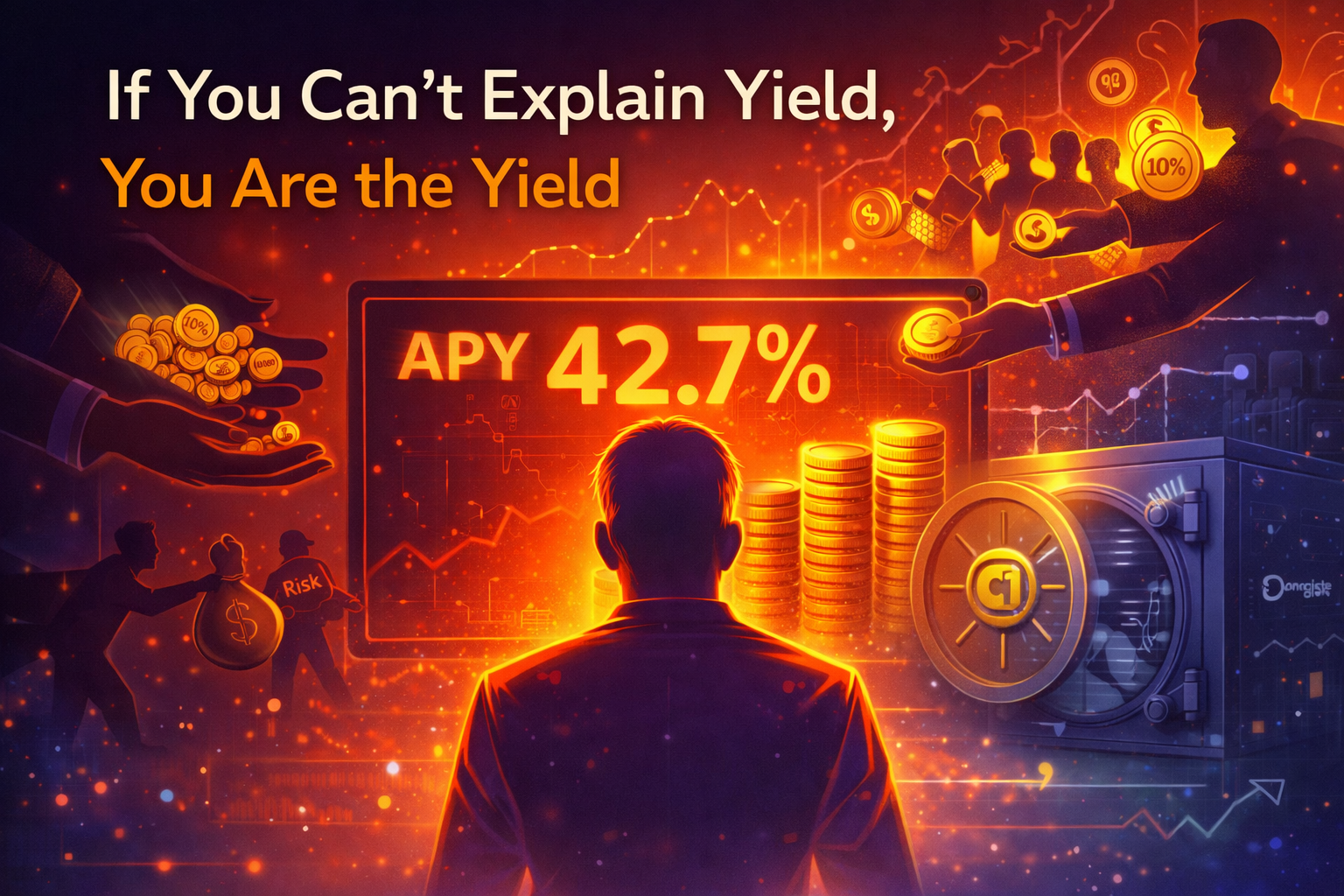
The Yield You See Isn’t the Yield You Get.
 Sarma4 min read·Just now
--
DeFi made returns visible in real time — but what you see on the surface rarely reflects what you actually keep.
There’s a moment I think a lot of people in DeFi have experienced — whether they admit it or not.
You open a dashboard, scroll through a few pools, and suddenly you see it. A number that feels… hard to ignore. Maybe it’s 20%. Maybe it’s 40%. Either way, it looks good enough to act on. So you do what most people do — you deposit.
At first, everything behaves exactly how you expected. Your balance starts creeping up, rewards accumulate, and it feels like you’ve made a smart move.
But then, a few days — or weeks — later, you check again, and something doesn’t quite line up. The returns feel… lower than what you had in your head. Not dramatically wrong. Just off enough to make you pause.
The Part That Looks Simple
One of the things DeFi gets right is visibility. Everything is right there. Live data, real-time updates, transparent positions. Compared to traditional finance, it feels almost refreshing.
But here’s the catch, what you’re seeing is only the clean layer — the part that’s easy to display. The APY, for example, is usually presented as a single number. Simple, digestible, easy to compare, and maybe that’s the problem. Because once something complex is reduced to a single number, it’s very easy to assume you fully understand it.
The Gap No One Talks About
The number you see is rarely the number you keep. Not because anything is necessarily broken — but because the system has more moving parts than the interface suggests. There are things happening in the background that don’t show up in bold text:
- The slow effect of impermanent loss
- Fees from entering, exiting, or adjusting positions
- Slippage during execution
- Market volatility changing the value of what you hold
Individually, each of these might seem small. But together, they reshape your actual outcome. Over time, that gap between expectation and reality becomes very real.
So Where Does Yield Actually Come From?
This is the question that changes everything, because yield isn’t just “generated.” It doesn’t appear out of thin air, it comes from somewhere — and often, from someone. In most DeFi systems, yield is driven by:
- Trading activity generating fees
- Borrowers paying interest
- Arbitrage opportunities across markets
- Liquidations redistributing value
- Token incentives designed to attract capital
Some of these are sustainable, others are temporary, and some are simply redistributive — meaning someone on the other side is effectively paying for the return you’re seeing.
The Subtle Trade-Off Most People Miss
Here’s the part that took me a while to fully internalize. You’re not just earning yield. You’re also taking on something in return, sometimes it’s obvious — like volatility. Other times, it’s less visible:
You provide liquidity, but absorb price divergence. You earn incentives, but take on dilution risk. You join a strategy, but don’t fully understand how it behaves under stress, and none of this feels urgent when things are going well. That’s what makes it tricky.
Same System, Different Outcomes
What’s interesting is that two people can use the exact same protocol — and walk away with completely different results.
One focuses on the highest APY they can find, the other tries to understand what’s behind it. They ask questions like:
- What’s driving this return?
- What could reduce it?
- How does it behave in different conditions?
It’s not that one has access to better tools. They’re just looking at the system differently, and over time, that difference compounds.
A Shift That’s Starting to Happen
Lately, there’s been a subtle shift in how people approach yield. Less chasing, more questioning. Instead of asking, “Where can I get the highest return right now?” people are starting to ask: “What kind of return is this, actually?” It’s a small change in wording — but a big change in mindset. Because once you start thinking that way, yield stops being something you follow… and becomes something you evaluate
From Guessing to Structure
Of course, understanding is one thing, managing it consistently is another. Tracking positions, adjusting exposure, rebalancing over time — it adds up quickly. And realistically, most people aren’t going to do all of that manually.
That’s where structured approaches start to make sense. Concrete Vaults are designed to take on that complexity:
- Allocating capital across strategies
- Managing positions as conditions change
- Rebalancing over time
- Reducing small, compounding inefficiencies
It’s not about removing control, it’s about reducing guesswork.
👉 Explore Concrete at app.concrete.xyz
One Thing That Changed How I See DeFi
At some point, I stopped looking at APY as the answer, and started seeing it as the starting point. Because yield isn’t just a number, it’s what’s left after everything else plays out:
After costs, after risk, after market conditions do their thing, and once you really get that, your behavior changes. You stop chasing what looks highest, and start paying attention to what actually holds up. If there’s one takeaway from all of this, it’s simple:
The yield you see isn’t the yield you get.
And understanding that — even a little — puts you ahead of most participants in the system. If you want to explore more, you can start here: Explore Concrete at app.concrete.xyz