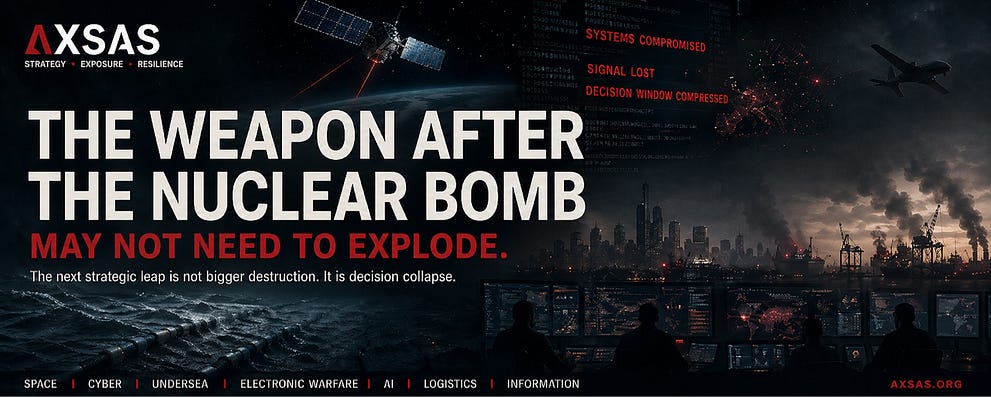
The next strategic leap is not bigger destruction. It is decision collapse.
Executive Assessment
The nuclear bomb remains the most destructive weapon ever built. That has not changed. Any serious assessment of future weapons has to start with that reality, because nuclear weapons still define the upper limit of physical devastation, political coercion and national survival.
But the next leap in strategic power is unlikely to be a larger bomb. It is more likely to be a campaign that blinds a state, corrupts its command picture, fractures alliance coordination, compresses decision time and forces national leaders to act before they understand what is happening.
That campaign may already have started.
Not as one declared act of war. Not as one clean sequence that can be mapped from a single command centre. The evidence is not that neat. But the pressure points are already visible. Critical infrastructure networks are being accessed. Undersea cables are being damaged. Satellite dependent services are being jammed and spoofed. Counterspace capabilities are expanding. Logistics, transport, energy, communications and data corridors are being tested in the grey space between accident, espionage, sabotage and escalation.
That is the shift most nuclear proliferation debates are missing. The next decisive weapon may not be judged by explosive yield. It may be judged by how quickly it can make a government uncertain about what it can see, who it can trust, whether its allies can respond, whether its logistics still function and whether escalation has already started.
Nuclear weapons threaten destruction. The next strategic weapons may threaten decision collapse.
The Wrong Question
The public debate often asks whether there is anything more powerful than a nuclear bomb. It is a dramatic question, but it points in the wrong direction.
A nuclear weapon is still unmatched as a single instrument of physical destruction. It can erase a city, contaminate territory, fracture a society and force decisions that sit above normal politics. No cyber weapon, satellite jammer, drone swarm, directed energy system or autonomous platform replaces that effect.
But strategy is not only about destruction. It is about coercion. It is about timing, access, visibility and the ability to force an adversary into decisions it does not want to make.
That is where the next leap is taking shape.
The weapon after the nuclear bomb may not seek to destroy a city. It may seek to blind the state responsible for defending it. It may degrade satellites, jam communications, corrupt logistics platforms, spoof warning data, disrupt undersea cables, freeze port operations and leave political leaders unsure whether they are facing attack, accident, deception or escalation.
That is not a bigger explosion. It is a more dangerous form of uncertainty.
Nuclear Weapons Are Not Disappearing
This argument should not be mistaken for optimism about nuclear weapons. They are not fading into the background.
The global nuclear environment is moving in the opposite direction. SIPRI assessed in 2025 that a dangerous new nuclear arms race is emerging while arms control regimes are severely weakened, with nearly all nuclear armed states continuing intensive modernisation programs during 2024.[1]
China is the clearest example of the shift. The Pentagon’s 2025 China Military Power Report assessed that China’s nuclear stockpile remained in the low 600s through 2024 and that the People’s Liberation Army remains on track to possess more than 1,000 nuclear warheads by 2030.[2]
That changes deterrence geometry. For decades, nuclear stability was dominated by the United States and Russia. China’s expansion pushes the world further toward a three power nuclear problem, with less transparency, weaker arms control and more complex escalation pathways.
So the nuclear problem is not disappearing. It is becoming more crowded.
But while warhead numbers grow, the strategic environment around them is changing faster. The danger is no longer only the missile. It is the information, communications, space, cyber and infrastructure system that determines whether leaders understand what the missile picture actually means.
The New Strategic Target Is Confidence
The defining feature of deterrence is credibility. A state must believe that an adversary can see, decide, communicate and respond. Once that confidence weakens, deterrence becomes less stable.
That is where the next generation of strategic weapons is aimed.
If satellites are degraded, early warning becomes less reliable. If navigation signals are jammed or spoofed, targeting becomes less certain. If undersea cables are disrupted, alliance communication slows. If cyber operations corrupt logistics systems, mobilisation becomes unreliable. If port, fuel, rail and financial systems are paralysed, the state may still exist on a map while losing the ability to respond at speed.
The next strategic weapon does not need to defeat every tank, ship, aircraft or missile. It only needs to make the command system doubt its own picture at the moment decisions are most time sensitive.
This is why space, cyber, electronic warfare, hypersonics, undersea sabotage, autonomous systems and AI enabled targeting cannot be treated as separate debates anymore. They are beginning to converge into one effect. They do not replace nuclear weapons. They surround them. They make warning time shorter, alliance response slower, escalation control weaker and political judgement less reliable.
The Campaign May Already Have Started
The mistake is to treat this as a future weapons problem only. A cleaner reading is that the campaign may already be underway, not as one declared act of war, but as repeated probing across the systems modern states depend on.
The public evidence does not prove one single coordinated global campaign. That would be too neat. But it does show the same pressure points being tested again and again: critical infrastructure networks, undersea cables, satellite dependent services, logistics routes, transport systems, defence industry nodes and the political grey space between accident, sabotage and attribution.
The future weapon after the bomb may not arrive as a sudden new device. It may arrive as a pattern that governments only recognise after the dependencies have already been mapped.
The cyber evidence is the clearest starting point. Australian and allied cyber authorities warned in 2024 that the China linked Volt Typhoon activity involved pre positioning on United States critical infrastructure networks to enable disruption or destruction of critical services during a future geopolitical crisis or military conflict with the United States and its allies. The sectors named included communications, energy, transport, water and wastewater systems.[3]
That is not ordinary espionage. That is access designed for future coercion.
The undersea pattern points in the same direction. CSIS assessed in 2025 that Russia was conducting an escalating campaign of sabotage and subversion against European and US targets in Europe, and that the number of Russian attacks nearly tripled between 2023 and 2024. The target set included transport, government, critical infrastructure and industry, with critical infrastructure covering pipelines and undersea fibre optic cables.[4]
Taiwan is the clearest Indo Pacific warning. Testimony to the US China Economic and Security Review Commission in March 2026 argued that China’s activity against Taiwan’s undersea cables fits inside Beijing’s grey zone warfare strategy, with cable resilience becoming central to Taiwan’s ability to communicate, coordinate and endure coercion before or during crisis.[5]
Space is moving in the same direction. Secure World Foundation’s 2026 Global Counterspace Capabilities Report tracks counterspace capabilities being developed across co orbital systems, direct ascent systems, electronic warfare, directed energy and cyber. It also notes that only not destructive counterspace capabilities are currently being used in active military conflicts, which is exactly the point. The most usable strategic tools are not always the most spectacular ones.[6]
The civilian exposure is worse than most boards recognise. The World Economic Forum’s 2026 Global Cybersecurity Outlook found that only 15 percent of respondents consider space assets in cyber risk mitigation and only 18 percent account for undersea cables, despite warning that even small disruptions to satellite or cable infrastructure could create widespread effects across digital systems.[7]
That is why this should not be written as a future threat article. It is a recognition article.
The campaign after the nuclear bomb does not need to start with a nuclear launch. It starts with access. It starts with mapping. It starts with probing repair times, watching attribution delays, testing cable resilience, placing cyber access inside infrastructure, jamming navigation, pressuring satellites and learning which governments can still make decisions when evidence is incomplete.
Space Is No Longer a Sanctuary
Space is one of the clearest signs of this shift.
Modern militaries depend on satellites for intelligence, surveillance, reconnaissance, communications, navigation, missile warning, weather, timing and targeting. Civilian economies rely on the same orbital infrastructure for finance, logistics, transport, energy and communications.
That makes space both an enabler and a target.
ODNI’s 2026 Annual Threat Assessment describes the space domain as increasingly contested and identifies China and Russia as developing counterspace capabilities designed to challenge US space efforts and dominance.[8] CSIS reached a similar conclusion in its 2025 Space Threat Assessment, warning that counterspace development, testing and use are now continuing strategic concerns rather than distant possibilities.[9]
The Pentagon’s China report is even more direct. It describes Chinese counterspace development across anti satellite operations, disruptive lasers, jammers, on orbit systems, cyber operations against satellite networks, electronic warfare and directed energy weapons.[10]
This is not science fiction. It is the militarisation of dependence.
The more a state relies on satellites to see, communicate and target, the more vulnerable it becomes to weapons that can degrade those functions at scale. A strategic strike may begin not with a flash over a city, but with silence in orbit.
Cyber Is Now Part of Deterrence
Cyber is still too often treated as a technical problem. That is a mistake.
In strategic terms, cyber is about whether a state can still move fuel, money, orders, people, ships, aircraft and ammunition under pressure. A serious cyber operation against logistics, energy, telecommunications, transport, ports or command networks can produce strategic effects without producing visible destruction.
That is why cyber now sits inside the deterrence problem.
A state can use cyber operations to prepare the battlefield before conflict begins. It can map dependencies, pre position access, test responses and hold infrastructure at risk. If crisis arrives, those accesses may become tools of delay, confusion or coercion.
This is not the same as a nuclear strike. It is not meant to be. Its value lies in ambiguity. A missile launch is visible. A cyber compromise can be denied, misread, delayed in attribution or confused with routine failure. That ambiguity creates a dangerous window where political leaders may not know whether they are already inside an attack.
The weapon is not just the code. The weapon is the uncertainty it creates.
Undersea Infrastructure Is the Exposed Layer
Undersea cables are another part of the same problem.
Modern economies move enormous volumes of data through seabed cable systems. Financial transactions, cloud services, government communications, military coordination, shipping, aviation, energy and civilian communications all depend on infrastructure that was built mainly for commercial efficiency, not wartime transparency.
The 2024 New York Joint Statement on the Security and Resilience of Undersea Cables warned that reliance on undersea cables creates national and economic security risks and called for stronger security, resilience and integrity across the cable system.[11]
That concern is not abstract. Cable disruption does not need to remove an entire country from the internet to create strategic pressure. It only needs to degrade enough capacity, in the right corridor, at the right time, while other systems are already under pressure.
That is how exposure compounds. A satellite disruption is serious. A cyber intrusion is serious. A cable disruption is serious. When they arrive together, they become something else.
They become strategic paralysis.
AI Changes the Speed of the Problem
AI does not need to become a magical battlefield brain to alter deterrence. It only needs to make detection, targeting, deception, cyber reconnaissance, drone coordination and decision support faster.
Speed is the issue.
ODNI’s 2026 assessment identifies artificial intelligence and quantum computing as emerging technologies expected to have significant national security impact, while also warning that technological competition, supply chain exposure and national security risks are increasingly connected.[12]
That is the relevant point. AI does not sit outside the strategic weapons debate. It accelerates the systems around it. It can improve targeting pipelines, process satellite imagery, support cyber reconnaissance, generate deception at scale and increase the volume of signals moving through command systems.
This creates a dangerous imbalance. Machines can accelerate options faster than human leaders can absorb consequences. In a crisis involving nuclear forces, degraded satellites, cyber disruption and uncertain warning data, that imbalance becomes strategically dangerous.
The risk is not simply that AI independently starts a war. That framing is too narrow. The risk is that AI compresses decision cycles inside an already compromised system and makes leaders feel they have less time than they actually do.
That is how escalation control weakens.
The Weapon After the Bomb Is a Campaign
The next strategic weapon is unlikely to be one object. It will be a campaign.
It may begin months or years earlier with cyber access, supply chain compromise, satellite mapping, seabed reconnaissance, logistics dependency analysis and influence activity. It may then activate during crisis through jamming, spoofing, data corruption, selective cable disruption, autonomous saturation and targeted attacks against command nodes.
The aim may not be immediate mass death. The aim may be to make response slow, confused and politically risky.
That is why the phrase “beyond nuclear” needs caution. Nothing is beyond nuclear in raw destructive power. But some capabilities may create nuclear level coercion without nuclear level blast.
That is the new danger.
A state may be able to threaten another state’s ability to decide, communicate and mobilise while staying below the visible threshold of nuclear war. It may be able to create paralysis without offering the clarity that would justify immediate retaliation.
A weapon that cannot be used is mainly a deterrent. A weapon that can be used while attribution remains uncertain is something else. It becomes a tool of coercion.
That distinction should worry policymakers.
The AXSAS Exposure Lens
For Australia and its partners, the lesson is direct.
The issue is not only whether the country can acquire advanced platforms, long range missiles, submarines, aircraft or space capabilities. The issue is whether the systems supporting those capabilities can withstand coordinated pressure across time, access, industrial elasticity, supplier visibility and governance visibility.
Time is being tested through repair delay, attribution delay and decision delay. Access is being tested through cables, ports, satellites, logistics nodes and contested corridors. Industrial elasticity is being tested through defence plants, shipping, energy systems and replacement capacity. Supplier visibility is being tested through commercial vessels, offshore ownership, cloud infrastructure, subcontractors and opaque networks. Governance visibility is being tested every time ministers, boards and agencies have to decide whether an incident is accident, espionage, sabotage or escalation.
That is where future deterrence will be tested.
Not only in warhead counts. Not only in platform acquisition. Not only in defence spending announcements. But in whether the state can keep deciding under pressure.
Conclusion
The weapon after the nuclear bomb may not need to explode because it may not be designed to destroy first.
It may be designed to blind first, isolate first, corrupt first and slow first. The nuclear age was built around fear of destruction. The next strategic age may be built around fear of uncertainty.
That does not make nuclear weapons less dangerous. It makes the systems around them more dangerous.
A nuclear weapon tells a state it may be destroyed. A strategic paralysis weapon tells a state it may already be blind.
The next arms race will not only be measured by who has the most warheads. It will be measured by who can still see, decide, communicate and mobilise when satellites, cables, networks, logistics and command confidence start failing together.
That is where deterrence now has to be understood.
Not at the edge of the blast radius.
At the edge of decision collapse.
About AXSAS
AXSAS examines defence exposure, industrial readiness, AI and cyber governance, and the strategic systems that decide whether nations can sustain action under pressure. The focus is not platform optimism. It is feasibility, visibility and execution under real world constraint.
Footnotes
[1] SIPRI, 16 June 2025. SIPRI assessed that a dangerous new nuclear arms race is emerging while arms control regimes are severely weakened, and that nearly all nuclear armed states continued intensive modernisation during 2024.
[2] US Department of Defense, Military and Security Developments Involving the People’s Republic of China 2025, 23 December 2025. The report assessed that China’s nuclear stockpile remained in the low 600s through 2024 and that China remains on track to exceed 1,000 warheads by 2030.
[3] Australian Signals Directorate, Australian Cyber Security Centre, 20 March 2024. The advisory stated that Volt Typhoon had been pre positioning on US critical infrastructure networks to enable disruption or destruction of critical services in a future geopolitical crisis or military conflict with the United States and allies.
[4] CSIS, Russia’s Shadow War Against the West, 18 March 2025. CSIS assessed that Russian sabotage and subversion attacks against European and US targets in Europe nearly tripled between 2023 and 2024, with transport, government, critical infrastructure and industry among the principal target categories.
[5] Jason Hsu testimony to the US China Economic and Security Review Commission, 2 March 2026. The testimony addressed the strategic importance of subsea cables to Taiwan and the Indo Pacific, China’s sabotage campaign and its integration into Beijing’s grey zone warfare strategy.
[6] Secure World Foundation, Global Counterspace Capabilities Report 2026, 8 April 2026. The report tracks counterspace capabilities across co orbital, direct ascent, electronic warfare, directed energy and cyber categories, and notes continued development by 13 countries.
[7] World Economic Forum, Global Cybersecurity Outlook 2026, January 2026. The report found that only 15 percent of respondents consider space assets in cyber risk mitigation and only 18 percent account for undersea cables, while warning that small disruptions to satellite or cable infrastructure could generate widespread digital effects.
[8] Office of the Director of National Intelligence, 2026 Annual Threat Assessment, March 2026. ODNI described a complex threat environment and identified China and Russia as developing counterspace capabilities.
[9] CSIS, Space Threat Assessment 2025, 25 April 2025. The report assessed trends in the development, testing and use of counterspace weapons, including threats involving GPS jamming and spoofing, satellite manoeuvring and other counterspace activity.
[10] US Department of Defense, Military and Security Developments Involving the People’s Republic of China 2025, 23 December 2025. The report describes China’s continuing development of military technology including military AI, biotechnology, hypersonic missiles and counterspace capabilities.
[11] Australian Department of Foreign Affairs and Trade, New York Joint Statement on the Security and Resilience of Undersea Cables in a Globally Digitalized World, 26 September 2024. The statement warned that reliance on undersea cables can present national and economic security risks and called for stronger cable security, resilience and integrity.
[12] Office of the Director of National Intelligence, 2026 Annual Threat Assessment, March 2026. ODNI identified artificial intelligence and quantum computing as emerging technologies with significant national security impact and discussed the growing connection between technology, supply chains and strategic competition.
The Weapon After the Nuclear Bomb May Not Need to Explode was originally published in DataDrivenInvestor on Medium, where people are continuing the conversation by highlighting and responding to this story.