The US Treasury market is the foundation of the global financial system. It determines mortgage rates, government borrowing costs, corporate lending, and the price of money across the world. For decades, investors treated it as the safest and most stable market on Earth.
But after years of exploding government debt, repeated liquidity scares, and increasingly aggressive Federal Reserve interventions, Wall Street is starting to confront an uncomfortable possibility: the Treasury market may have become too large, too leveraged, and too systemically important to function without constant support.
Now, with debt issuance accelerating and bond yields elevated, a different fear has taken hold inside financial markets: whether the world's most important market can still absorb America's borrowing needs without something breaking.
Total marketable Treasury debt has more than doubled since 2018, crossing $30.2 trillion by the end of fiscal year 2025, a year in which the US also ran a $1.8 trillion deficit and, for the first time, paid more than $1 trillion in interest on its publicly held debt, outpacing both defense spending and Medicare in a single budget cycle.
The refinancing calendar adds more pressure: nearly $3 trillion of outstanding debt matured in 2025 alone, all of it requiring fresh buyers, and the pool of buyers that used to handle that load has been steadily thinning.
Foreign central banks have reduced their share of Treasury holdings, and the Federal Reserve, after expanding its balance sheet to $8.5 trillion at the 2022 peak through successive rounds of quantitative easing, has spent the years since trying to shrink it.
That left private markets, including hedge funds, asset managers, individual investors, and increasingly stablecoin issuers, to absorb what sovereign and central bank demand once handled.
When the debt market started needing support
The warning signs had been accumulating for years. The September 2019 repo market freeze was the first real signal that something changed beneath the surface: short-term funding markets seized without warning, and the Fed was forced to inject emergency liquidity within days.
The second and far more alarming episode came in March 2020, when the onset of COVID-19 triggered a mass liquidation of Treasury securities, with institutional investors selling “the world's safest asset” alongside everything else as they scrambled for cash at any price.
What Brookings Institution researchers later described as the evaporation of bond market liquidity forced the Fed into massive, unprecedented emergency purchases to restore market functioning, interventions that worked but also established a precedent that's proven difficult to walk back.
Underneath those acute stress events is a structural feature of modern Treasury trading that regulators have grown increasingly worried about. Hedge funds have become central players in what's known as the cash-futures basis trade, a leveraged arbitrage strategy that exploits tiny price differences between Treasury securities and Treasury futures contracts by holding bond positions funded almost entirely through overnight repo borrowing.
By March 2025, leveraged funds' notional short Treasury futures positions had exceeded $1 trillion, well above pre-pandemic levels, with the largest funds carrying leverage ratios exceeding 18:1 according to Fed officials.
In November 2025, Fed Governor Lisa Cook formally flagged the arrangement as a systemic vulnerability, warning that positions at this scale make the Treasury market considerably more susceptible to stress.
The April 2025 tariff announcement tested that assessment almost immediately: liquidity deteriorated sharply within days, prompting speculation about Fed intervention before conditions eventually stabilized.
The repo facilities, standing liquidity programs, and targeted purchases used to stabilize those episodes were designed as emergency instruments, but they've since become recurring features of the system.
What a strained Treasury market means for everyone
Mortgage rates are where this kind of structural pressure becomes tangible for the average person. The 30-year fixed mortgage rate tracks the 10-year Treasury yield closely, which is why the 10-year's refusal to fall below 4.3% through much of 2025 and into 2026 kept home loan rates pinned well above 6% even after the Fed cut its benchmark rate three consecutive times.
The central bank's short-term policy rate and the long bond have now essentially decoupled, showing the bond market's growing preoccupation with debt supply over short-term monetary signals from the Fed.
At the government level, the numbers are self-reinforcing in ways the Congressional Budget Office has put in specific dollar terms: interest payments are projected to climb from $1 trillion annually in 2026 toward $2.1 trillion by 2036, with an alternative scenario where persistently elevated yields push that figure toward $2.2 trillion.
Every dollar spent servicing debt is a dollar unavailable for anything else, and the debt is rolling over at higher rates every year. A run of weak Treasury auctions in early 2026 brought that into sharp focus: in a two-year note sale in late March, primary dealers absorbed roughly twice their normal share, a clear sign that the marginal buyer base has thinned considerably.
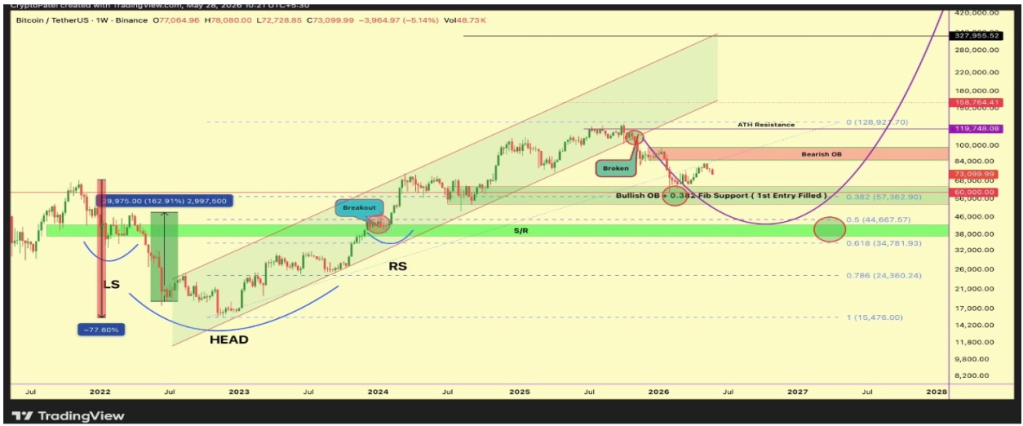
The connection to Treasury yields has become one of Bitcoin's defining macro features of 2026. CryptoSlate has documented how Bitcoin's near-term price ceiling has repeatedly been set by yield movements.
The 10-year crossing above 4.5% and the 30-year climbing toward 5.1%, its highest level since 2007, pushed Bitcoin back below $80,000 last week even after Congress advanced one of the industry's most-watched regulatory milestones.
The Fed rate cuts that crypto markets treated as a reliable macro tailwind have been priced out of the near-term picture entirely, with Barclays moving its first expected cut to March 2027 and futures markets now assigning meaningful odds to a hike before the end of the year.
There's a specifically crypto-native dimension to how the buyer composition has shifted. As foreign central banks and the Fed have pulled back from Treasury markets, Tether has filled part of the gap, with its Treasury exposure reaching $141 billion in 2025 and making it one of the largest non-sovereign holders of US government debt.
That demand supports the short end of the market, and it means that crypto-native capital is now embedded in America's debt infrastructure in a way that would have seemed implausible a decade ago. It also means that any stress in the stablecoin market is now capable of rippling directly through Treasuries. For years, inflation prints were the primary input that moved markets.
Today, Treasury auction results, refinancing calendars, and the buyers absorbing new supply have taken over the weekly agenda. The concern growing across the financial system is now deeper than the scale of America's borrowing.
It reaches toward whether the combination of central bank backstops, leveraged private capital, and an increasingly disparate group of marginal buyers is stable enough to keep absorbing it.
The post The US debt machine is getting harder to stabilize – So where does Bitcoin fit in? appeared first on CryptoSlate.