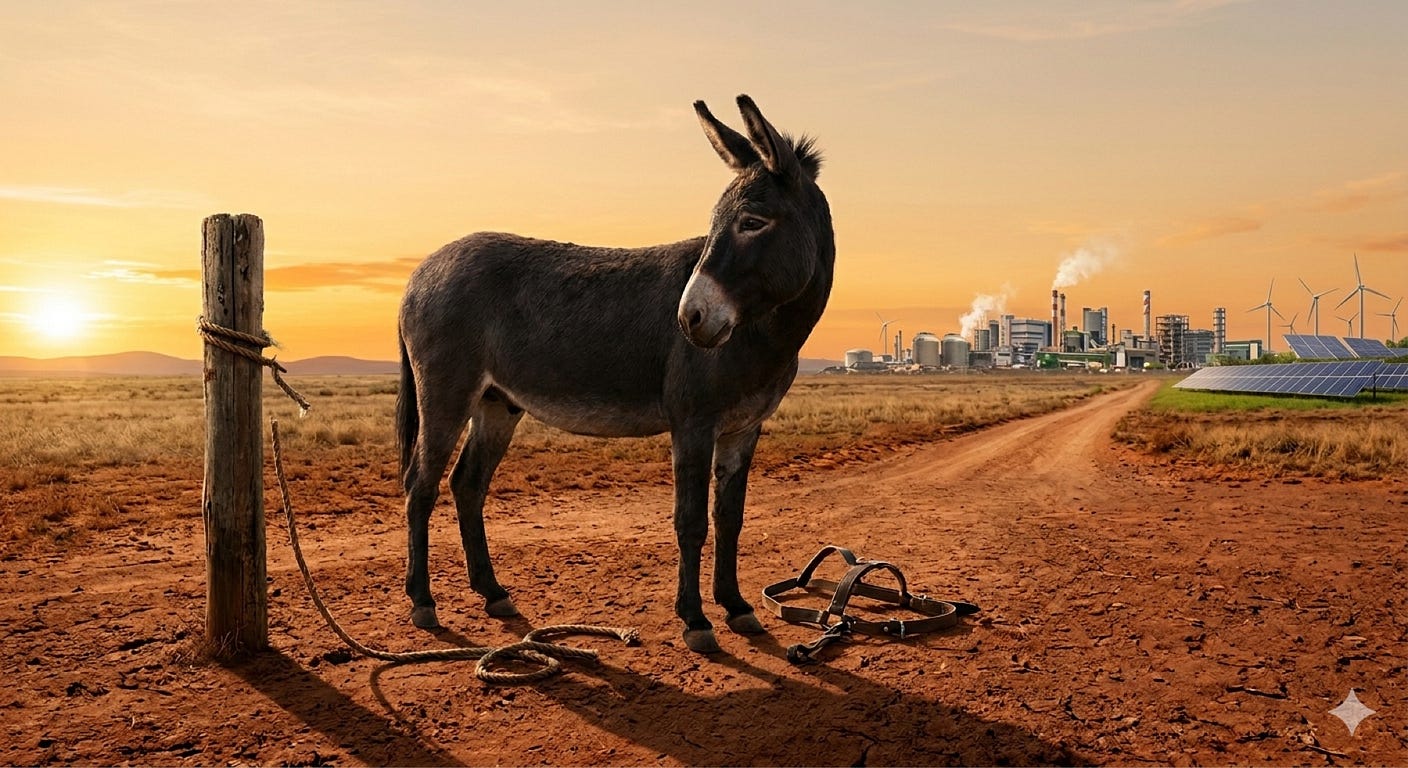
The Untied Donkey: Why African Leaders Still Wait for Western Permission to Prosper
--
The global financial architecture remains a gatekeeper to Africa’s industrial liberation. President Tinubu speaks truth: you cannot reform your way into fairness when the system’s design predicates African risk as structural, not circumstantial. Fuel subsidy removal, forex alignment — these are sacrifices made in good faith, excruciating down payments on a promise of growth that never arrives. Why? Because access to real capital remains tethered to outdated, biased risk models blind to Africa’s undeniable potential.
It is a perverse economic conditioning. For decades, African economies have been the beast of burden for Western-dominated financial institutions, conditioned to believe that the rope of conditionalities and Western credit ratings is the only thing keeping us grounded.
The rope has been cut by political independence and our emerging economic weight, yet like the foolish donkey, our leaders stand paralyzed, fearing to move forward because they are accustomed to feeling the imaginary tug of the reins.
They are waiting for permission to walk when the gate is already wide open.
What is needed is not appeal, but realignment. Not more lobbying for a seat at a table designed to keep us serving, but building our own banqueting hall. We require a parallel financing infrastructure — sovereign, pooled, and aggressively backed by continental assets and cash flows — that bypasses the colonial logic of today’s MDBs. Think AFREXIMBANK on steroids, utilizing diaspora bonds, commodity swaps, and green mineral equity as central pillars. Africa must finance Africa, set its own credit terms, and treat industrial policy as a right, not a request.
The Nairobi summit could be a hinge moment — if it moves from plea to pact. We are done with declarations; we need capital commitments. Enough with the speeches; let’s see syndicated loans for regional value chains. Let Nairobi be the birthplace of the African Merchant Consortium: a trade-finance engine powered by our own rules.
I recommend we task ministry of finance to immediately to model a Pan-African Industrial Credit Facility — backed by strategic sectors like agro-processing, renewables, and light manufacturing — and empower the ministry of digital economy to explore blockchain-verified commodity titling as collateral rails.
This isn’t a theoretical exercise; it is 21st-century economic sovereignty. The only question is whether African leaders are ready to stop behaving like tethered beasts and finally take their first steps toward freedom.