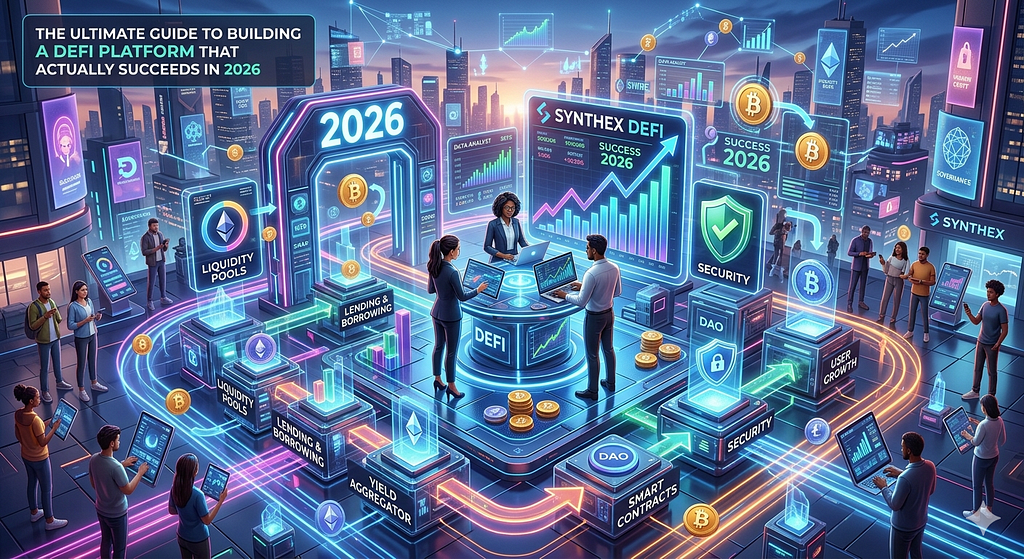
The DeFi landscape has evolved significantly over the past few years. What was initially a fast-paced phenomenon has now become a legitimate part of our overall financial structure. However, in 2026, it has never been easier to start a new project than it is right now. The problem comes in when you want to build a project that lasts, and this is what most teams struggle with.
The overall user has become much savvier, and they expect much more from a platform than they did a few years ago. This means, if you want to build a DeFi platform, you can no longer just think in terms of coding and token launches. You need to think in terms of how a system works, why most projects fail, and what makes a platform successful in the long term. This guide will take you through exactly this, so you can build a platform that users can trust and use.
What Is a DeFi Platform?
Decentralized finance (DeFi) is a way to access financial services without relying on banks or middlemen. It runs on blockchains using smart contracts, which are automated codes that handle transactions in a transparent and secure way.
DeFi started to take off between 2020 and 2022. It grew very fast.. Then it went through a reset, which got rid of projects that were just hype and made the ecosystem stronger. Today DeFi matters because it solves problems.
Many people still do not have access to banking and sending money across borders can be expensive and slow. DeFi changes this by offering borderless financial services to anyone with an internet connection and a crypto wallet.
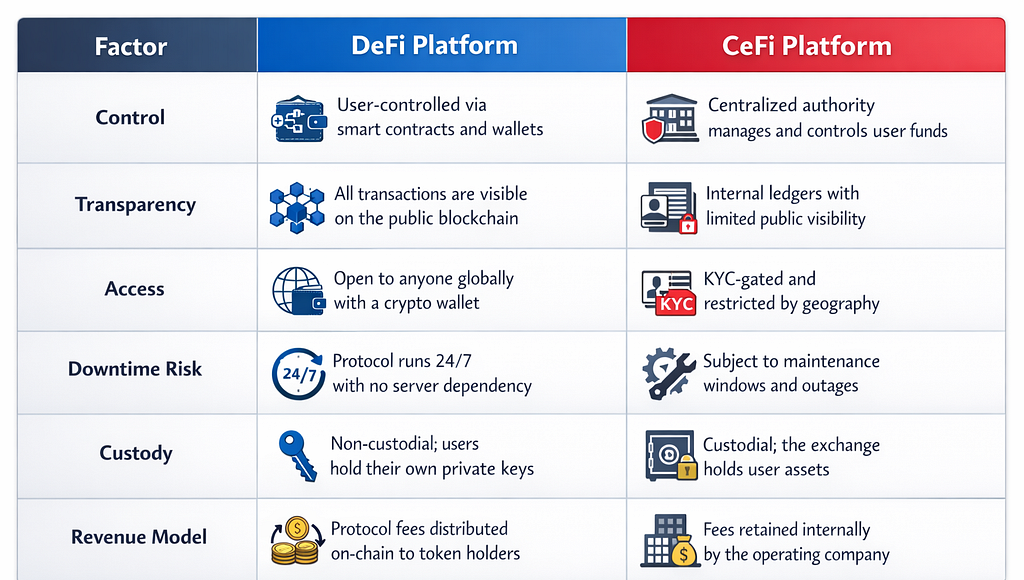
DeFi vs CeFi: Understanding the Core Difference
DeFi is different from finance and this difference is important. You need to understand how DeFi works to build the platform. This difference affects your platform design, your target users and the risks you need to handle.
Building the Right Architecture for Your DeFi Platform
One of the most common mistakes teams make early on is treating a DeFi platform like a traditional web application with a blockchain backend. It is not. A DeFi platform is financial infrastructure that operates in an adversarial environment, processes real money, and cannot be patched with a hotfix after a critical failure.
Architecture decisions made before writing code will shape your platform’s security, scalability, and composability for years.
Types of DeFi Platforms You Can Build
DeFi isn’t just one type of product, it’s a whole ecosystem of financial tools, each solving a different problem.
Choosing what to build is one of your most important decisions. It defines who your users are, who you compete with, and how your platform needs to be designed from day one.
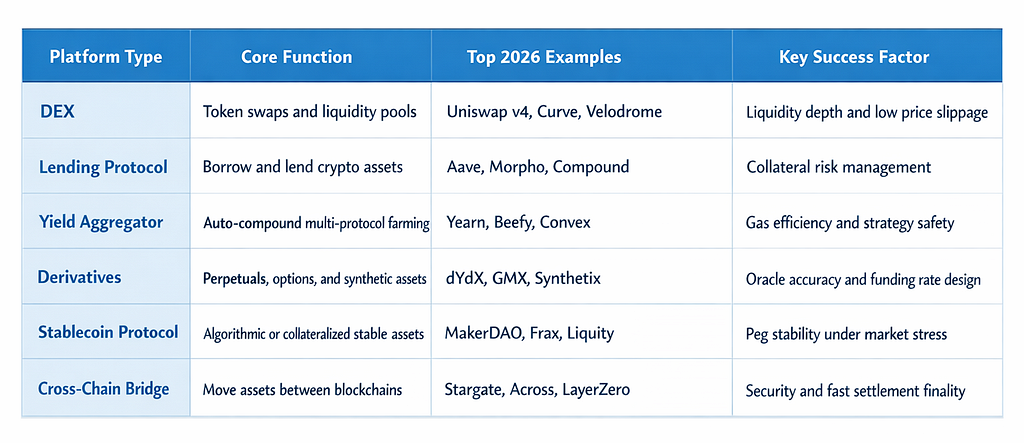
Every DeFi platform is different. Some win with better user experience, others with stronger risk control or more options.That’s why choosing your niche early isn’t optional — it’s the foundation of everything you build.
Choosing Your Blockchain
The choice of underlying blockchain is one of the most consequential decisions in your DeFi platform development journey. Each chain offers a different set of tradeoffs across security, speed, cost, and ecosystem liquidity.
There are now Ethereum Layer 2 networks like Arbitrum, Base, Optimism and zkSync Era that offer transaction costs and inherit Ethereums security. For DeFi applications launching in 2026 an Ethereum Layer 2 is a good starting point.
Solana offers high throughput and near-instant finality, making it genuinely competitive for DeFi applications that need to process thousands of transactions per second, such as perpetual futures or high-frequency trading protocols. Do not choose a chain because it is new or because a grant is on the table.
Choose it because the chain’s performance profile matches your product requirements and its existing users overlap with your target audience.
Essential DeFi Development Practices You Can’t Ignore
• Formal Verification: Tools like Certora Prover and Halmos allow you to mathematically prove the correctness of critical contract properties, going beyond testing to actual proof that certain failure states are impossible
• Comprehensive Testing: Use Foundry for unit tests, fuzz tests, and invariant tests. Your test suite must cover not just happy paths but edge cases, failure modes, and economic attack scenarios
• Security Audits: Engage at least one Tier 1 security firm before mainnet deployment. Firms like Trail of Bits, OpenZeppelin, and Spearbit are industry benchmarks. Never treat an audit as a rubber stamp
• Bug Bounty Programs: Launch your Immunefi bounty before your public mainnet release, not after. A live bounty signals confidence in your code and incentivizes external researchers to find problems you missed
• Upgradeability Safeguards: If using upgradeable proxy patterns, implement strict timelocks of at least 48 hours on all upgrades and require multi-signature approval. A single key should never be able to upgrade a contract holding user funds
Working with an experienced DeFi development services team during the smart contract phase can substantially reduce the risk of deploying vulnerable code, particularly for teams that are strong on product thinking but newer to on-chain security patterns. The cost of thorough development is a fraction of the cost of a single exploit.
The Layered Architecture Model
Production DeFi platforms are built in layers, and each layer must be designed, secured, and monitored independently. Here is how those layers break down:
• Smart Contract Layer: The core of your platform contains all financial logic including swaps, lending, staking, and rewards. Must be immutable where possible and exhaustively audited before deployment
• Oracle Layer: Brings real-world price data on-chain. Manipulated or stale oracle data has caused more DeFi exploits than any other single vector. Chainlink, Pyth, and Chronicle are the trusted options in 2026
• Liquidity Layer: The depth and stability of your trading pairs or lending markets. Without it, your platform is technically functional but practically useless
• Governance Layer: The mechanism through which token holders vote on protocol upgrades, parameter changes, and treasury allocations
• Interface Layer: The frontend your users interact with. Often underinvested by technical teams despite being the primary trust signal for non-technical users
Each layer can become your weakest link. Teams that treat the interface as an afterthought often discover this when phishing attacks targeting their frontend drain user funds, even when the underlying contracts are perfectly secure.
Smart Contract Development
Smart contracts are the beating heart of any DeFi platform. They execute financial transactions automatically, hold user funds, and enforce every rule of your protocol without human oversight. That autonomy is precisely what makes them powerful, and precisely what makes them dangerous when written carelessly.
The history of DeFi is full of projects that lost a lot of money because of contract vulnerabilities. These vulnerabilities could have been caught if the projects had rigorous development practices.
The Upgradeability Dilemma
Upgradeable contracts give you flexibility to fix bugs and ship features post-launch. They also introduce centralization risk, governance attack surfaces, and additional complexity that itself becomes a vulnerability. Core financial logic should be as immutable as possible.
Peripheral components such as fee configurations and reward parameters can use upgradeable patterns with proper safeguards, always time-locked and governed by a credibly decentralized multi-signature structure.
Liquidity Strategy: Building Depth That Actually Lasts
To build liquidity that lasts you need to focus on strategies. One way is to build and control your liquidity instead of renting it. You can also use models to maximize capital efficiency and improve depth with less capital. Working with liquidity providers and market makers can also bring stability.
You can also use platforms like Tokemak and Gamma to bootstrap depth without relying much on token rewards. Integrating with aggregators like 1inch, Paraswap and Odos from the start can make your liquidity instantly accessible.
Some key strategies for building liquidity include:
Strategic LP Partnerships: working with institutional liquidity providers and market makers
Protocol-Owned Liquidity: building and controlling your liquidity
Concentrated Liquidity Management: using advanced models to maximize capital efficiency
Liquidity as a Service: using platforms like Tokemak and Gamma to bootstrap depth
Aggregator Integrations: integrating with aggregators like 1inch, Paraswap and Odos from the start
Strong liquidity isn’t built overnight. but without it, nothing else you build will matter.
Tokenomics Design
DeFi projects are at a point where they need to show if they are building financial infrastructure or just something that looks good for a short time. The years 2021 and 2022 were an example of what happens when the economics of a token are designed to make the price go up quickly rather than to create value in the long term.
In 2026 people who use DeFi and institutions that invest in it are looking closely at token models. They want to know if the token has a purpose in the project if it gets value from the money the project makes and if the plan for releasing new tokens is made to last a long time or just to get people excited at first.
Value Capture Mechanisms That Have Proven Durable
• Fee Sharing: a part of all the fees the project gets is given to people who have tokens, which makes a direct connection between using the project and the value of the token
• Buyback and Burn: the project uses some of the money it makes to buy tokens and then gets rid of them which reduces the number of tokens available as more people use the project
• Vote-Escrowed Models: people lock their tokens for a long time to get more power in voting and a share of the money the project makes which makes sure that people who hold tokens for a long time are in line with the projects decisions
• Real Yield Staking: the rewards for staking tokens come from the money the project makes not from making tokens, which makes this way of doing things more sustainable
DeFi Security Beyond Smart Contracts
Even if the code is perfect the project can still fail if the rest of the infrastructure is not built well. Many big attacks happen because of points like oracles, governance systems and bridges between chains.
To build a DeFi project that’s really secure you need a complete security system. This includes:
- Real-Time On-Chain Monitoring: using tools to watch for suspicious activity and respond automatically
- Circuit Breaker Mechanisms: being able to pause the project if something goes wrong
- Multi-Signature Key Management: making sure that important actions need approval from people
- Incident Response Runbooks: having a plan for what to do if something goes wrong
- Transparent Security Communication: being open about security and how it is managed
Regulatory Compliance
The regulatory landscape for DeFi has shifted dramatically over the past three years. The United States, European Union, United Arab Emirates, Singapore, and most major financial jurisdictions now have active regulatory frameworks or enforcement postures that directly affect DeFi platforms serving their residents.
Treating compliance as optional has resulted in enforcement actions, exchange delistings, and in some cases personal legal liability for founders.
This does not mean DeFi must become CeFi. It means the industry has reached a maturity point where building sustainable platforms requires engaging with the regulatory environment intelligently rather than pretending it does not exist.
Practical Compliance Approaches for DeFi Platforms
• Geo-Blocking Restricted Jurisdictions: not letting people from certain countries use your project
• On-Chain KYC Solutions: using products that let people prove who they are without giving away much information
• Legal Entity Structure: making sure your project is set up in a way that’s clear and follows the law
• AML and Wallet Screening: Integrate Chainalysis or TRM Labs to identify and make sure people are not using your project for bad things
• MiCA Compliance for European Users: The EU’s Markets in Crypto-Assets regulation is fully in force in 2026 and requires platforms serving European users to meet specific whitepaper, disclosure, and operational standards
These steps don’t make your platform centralized they simply help you operate safely within today’s regulatory environment.
Community Building and Go-to-Market Strategy
The most technically excellent DeFi platform in the world will fail without a community that understands, trusts, and actively uses it. Community is not a marketing afterthought.
It is a core product requirement in a space where trust is the scarcest resource and where the difference between a thriving protocol and an abandoned one is often the quality of its communication.
Building Community Before Launch
• Technical Transparency: Share your architecture decisions, audit findings, and the tradeoffs you considered and rejected. This establishes credibility with sophisticated users who become your most valuable early adopters
• Developer Relations: Publish thorough documentation, maintain an open SDK, and actively support developers who want to integrate with your protocol. Composability is a growth engine in DeFi
• Honest Communication: If you encounter a bug in testing, share it. If your launch timeline slips, explain why. Community trust in your team is more valuable than the impression of flawless execution
• Incentivized Testnet Programs: Run a structured testnet with meaningful incentives for stress-testing. This generates valuable feedback, builds product familiarity, and creates a cohort of early advocates before mainnet
The Launch Sequence That Builds Durable Trust
When you launch your project you should do it in a way that builds trust. This means:
• Phase 1: Internal development with extensive testing. No external communication about launch timelines until the security team is genuinely confident in the code
• Phase 2: External security audit completion and full publication of findings, including all issues identified and how each was resolved
• Phase 3: Public testnet deployment with incentivized community testing. Collect real feedback on UX, performance, and edge cases
• Phase 4: Mainnet deployment with conservative TVL caps. Limit potential losses from undiscovered vulnerabilities while demonstrating stability under real conditions
• Phase 5: Gradual cap removal as the protocol demonstrates reliability over time. Communicate every milestone transparently to your community as it happens
This sequence feels frustratingly slow when you are eager to launch. It is also the sequence followed by almost every DeFi protocol still operating with meaningful users twelve months after its initial deployment.
The Supporting Infrastructure Most Teams Underestimate
The smart contracts are the core of your DeFi platform, but the infrastructure surrounding them determines whether users actually have a reliable experience.
Slow data indexing, unreliable RPC connections, poor error handling in the frontend, and the absence of real-time monitoring have all contributed to user loss and protocol failures that had nothing to do with the underlying contract logic.
• Data Indexing: The Graph Protocol and Envio are the leading options for indexing on-chain events and making them queryable for your frontend. Well-structured subgraphs are the foundation of a responsive, real-time user interface
• RPC Infrastructure: Relying on a single RPC provider is an operational risk. Use providers like Alchemy, QuickNode, or Infura with fallback configurations to ensure frontend availability even when individual providers experience outages
• Analytics Integration: Build on-chain analytics into your protocol from day one. Understanding how users interact with your platform, where they drop off, and what drives retention is critical for product iteration
• Wallet Compatibility: Support MetaMask, WalletConnect, Coinbase Wallet, and Ledger at minimum. Each represents a meaningfully different user segment you cannot afford to exclude at launch
• Gas Optimization: Inefficient contracts cost your users real money on every transaction. Gas optimization is not a nice-to-have. It is a user experience requirement, especially on Ethereum mainnet during periods of high network congestion
The Bottom Line
DeFi in 2026 does not need platforms it needs better DeFi platforms. To be successful now you have to build DeFi platforms with fundamentals. This means you have to focus on security when you are developing DeFi platforms have sustainable liquidity for your DeFi platforms have clear tokenomics for your DeFi platforms be aware of compliance for your DeFi platforms and be genuinely transparent with your DeFi platforms.
The opportunity to build DeFi platforms is still huge but the people who use DeFi platforms are smarter now and they expect more from DeFi platforms. To make your DeFi platform stand out you need to have more than an idea for your DeFi platform. You need to have a DeFi product that people can trust from the first day they use your DeFi platform.
If you are serious, about building a DeFi platform that’s good enough to be used by people you have to have the right people helping you build your DeFi platform. Working with a team that has experience building DeFi platforms can help you deal with security problems, compliance problems and scalability problems so you can launch your DeFi platform with confidence. Build a DeFi platform that will last for a long time.
The Ultimate Guide to Building a DeFi Platform That Actually Succeeds in 2026 was originally published in Coinmonks on Medium, where people are continuing the conversation by highlighting and responding to this story.