The Twin Tsunamis of June 5th: Macro Gravity, the Broadcom Cracks, and the Anatomy of an AI Repricing Event
 Ausnznet4 min read·Just now
--
The Twin Tsunamis of June 5th: Macro Gravity, the Broadcom Cracks, and the Anatomy of an AI Repricing Event
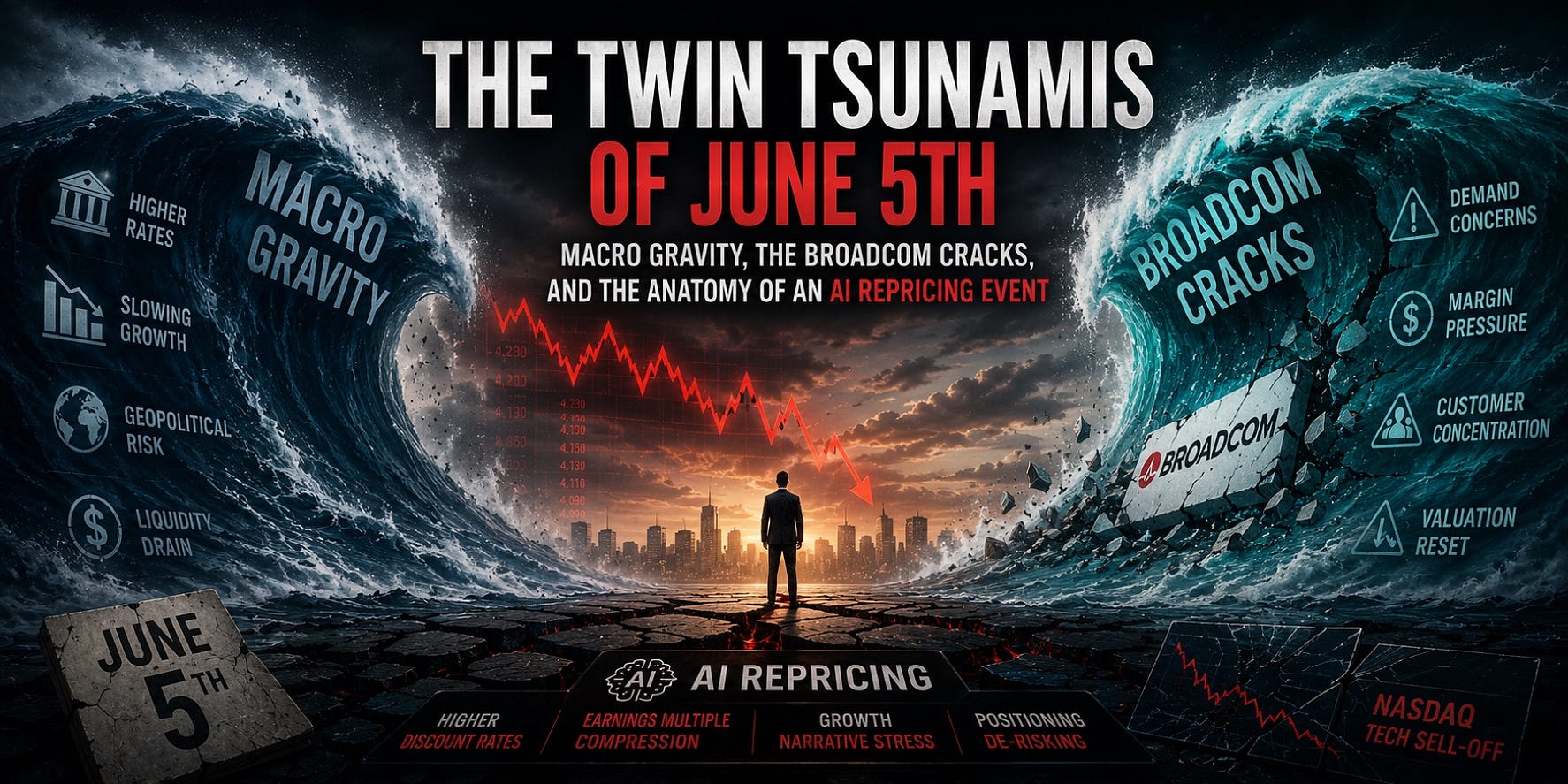
The global financial markets transitioned from artificial euphoria to a cold, clinical liquidation on Friday, June 5th, leaving retail traders wondering if market makers had once again “pulled the plug.” However, a forensic analysis of the cross-asset price action reveals something far more systemic: a violent synchronization of macroeconomic gravity and the re-anchoring of hyper-extended tech valuations.
By the closing bell, the tech-heavy Nasdaq 100 suffered a historic, unilateral liquidation, plunging -6.2% to settle at 28,783.25. Concurrently, the physical world mirrored this digital rout; Brent Crude collapsed through its short-term moving averages, closing at 95.629, effectively erasing its entire geopolitical war premium in a single session.
Here is the strategic breakdown of the two macro-bombs that detonated the market, and the hidden correlation that triggered the cross-asset domino effect.
The Macro Shock: Nonfarm Payrolls and the “Good News is Destruction” Paradox
The initial trigger pulled at 8:30 AM EST was the U.S. Nonfarm Payrolls (NFP) report for May. The Bureau of Labor Statistics reported an addition of 172,000 jobs, over double the consensus expectation of 85,000. Under normal economic textbooks, a robust job market is a sign of economic health. In the inverted reality of a late-stage inflationary cycle, it was a death sentence for loose monetary policy.
This hyper-resilient labor data, coupled with sticky inflation hovering at 3.8%, completely shattered Wall Street’s collective hallucination of a near-term Federal Reserve pivot or rate cuts in 2026. The 10-year U.S. Treasury yield instantly spiked toward 4.54%, while the 2-year yield hit a 15-month high. Traders began programming a terrifying new matrix into their algorithms: higher-for-longer interest rates, with a non-zero probability of another rate hike before the end of 2026. For high-multiplier mega-cap technology stocks whose valuations rely entirely on future liquidity discounting, the pool of cheap money was instantly drained.
The Micro Fracture: Broadcom and the Tyranny of Impossible Expectations
If the NFP report acted as the macro vacuum draining liquidity, the catalyst for the absolute capitulation in technology came from within the AI ecosystem itself. Semiconductor giant Broadcom (NASDAQ: AVGO) collapsed over 12% on Friday, despite delivering what would historically be considered a spectacular earnings report – beating consensus revenue and posting a 143% surge in AI-specific hardware demand.
The paradox of Broadcom’s liquidation lies in its forward guidance. It didn’t miss; it merely met expectations. In the current hyper-extended AI super-cycle, meeting expectations is treated by algorithmic execution systems as an absolute failure. Having priced in permanent, flawless exponential growth following earlier structural hypes – such as Anthropic’s confidential IPO filing – Wall Street confronted a harsh reality: the physical deployment of AI enterprise hardware is hitting a linear capital expenditure constraint. As Broadcom cracked, a sympathetic bleed corrupted the entire semiconductor architecture, punishing AMD, Micron, and Marvell in a cascading margin liquidation.
Cross-Asset Contagion: Why the War Premium in Brent Crude Evaporated
The most sophisticated lesson of Friday’s session lies in the sudden capitulation of Brent Crude. Despite unresolved tensions surrounding the Qeshim Island airstrikes and constricted global inventories, oil plummeted beneath its 200-period simple moving average (the green support vector).
This was not a reflection of shifting energy fundamentals, but a textbook liquidity margin squeeze.
When a core index like the Nasdaq 100 drops over 6% in a single day, highly leveraged multi-strategy hedge funds face existential margin calls. In a forced liquidation architecture, risk management algorithms do not look at geopolitical narratives; they look at liquidity. To shore up capital and preserve cash balance sheets against catastrophic tech drawdowns, institutional traders unconditionally liquidated their most liquid, profitable commodity positions. Brent Crude was simply the ATM used to fund the technology wreckage.
Conclusion: From Speculative Clouds to Tangible Code
The trading week ending June 5th proved once again that relying on hyper-extended narratives in secondary markets is a game of musical chairs orchestrated by institutional market makers. When the macro environment turns hostile, the “plug is pulled” not by a malicious broker, but by the cold mathematics of margin maintenance and interest rate gravity.
For sophisticated builders and operators, this volatility signals a structural rotation. True alpha in the remaining half of 2026 will not be found in chasing volatile semiconductor multiples or speculating on geopolitical friction. Instead, it lies in the migration toward utility – taking these hyper-capable, depreciating AI models and embedding them into local, physical Micro-SaaS architectures that solve real-world human friction. The secondary markets belong to the algorithms; the real economy belongs to the builders.