The Trustless Myth: Why DeFi’s Biggest Promise Was Always a Half-Truth
--
“Don’t trust, verify” was always a simplification. The real question is: what are you actually trusting, and how well is it built?
The founding narrative of DeFi was clean and compelling.
Remove the intermediaries. Replace institutions with code. Build systems where no single party can act against the interests of participants, because no single party has the power to. Trust the math, not the people.
It was a powerful idea. It drove billions of dollars into a new financial ecosystem and demonstrated that decentralized systems could do things that traditional finance could not. The narrative was not wrong, exactly. But it was incomplete in ways that became increasingly expensive to ignore.
Because trust did not disappear when DeFi was built. It moved.
It moved into smart contracts written by teams with varying levels of competence and incentive alignment. It moved into governance systems controlled by token holders whose participation rates are often single-digit percentages. It moved into oracles operated by external parties whose integrity the protocol depends on entirely. It moved into bridges that became among the most exploited infrastructure in crypto history. It moved into execution layers that make assumptions about latency, sequencing, and validator behavior.
DeFi didn’t eliminate trust. It redistributed it and in many cases, made it harder to see.
Where Trust Actually Lives
The “trustless” framing persists because it describes something real at the transaction layer. When you interact with a well-audited smart contract, you don’t need to trust that a human counterparty will honor the agreement. The code executes as written, without discretion.
But zoom out from any individual transaction and the trust surface expands dramatically.
Smart contract assumptions. Every smart contract is only as trustworthy as its code, and code has bugs. Audits reduce the probability of exploits but cannot eliminate it. The history of DeFi is littered with protocols that were audited, verified, and still drained because audits are snapshots, not guarantees, and adversaries are creative. Trusting a smart contract means trusting that the code is correct, that it handles all edge cases, that it behaves as intended under conditions the developers may not have anticipated. That is a meaningful trust assumption, even if it is different in nature from trusting a counterparty.
Governance systems. Most DeFi protocols with upgrade mechanisms are ultimately governed by token holders. In theory, this distributes control broadly and prevents any single party from making unilateral changes. In practice, governance participation is often low, token distribution is often concentrated, and the mechanisms that protect against governance attacks - timelocks, quorum requirements, veto structures - are imperfect. Trusting a governed protocol means trusting that the governance system will behave well over time, including in adversarial conditions designed to exploit it.
Oracle dependencies. DeFi protocols that use external price data (and most of the interesting ones do) are dependent on the accuracy and integrity of oracle systems. A price oracle that can be manipulated, whether through flash loans, thin market conditions, or direct compromise, can be used to drain a lending protocol, trigger false liquidations, or distort any system that uses prices as inputs. The protocol is only as trustworthy as the oracle it depends on, and that oracle is operated by parties external to the protocol itself.
Bridge security. Cross-chain infrastructure has been one of the most consistently exploited layers in DeFi. Bridges require some form of trust in the entities or mechanisms that validate state across chains and that trust assumption has proven costly when those entities or mechanisms fail. Capital that moves cross-chain is exposed to the security of the bridge, regardless of how well the protocols on either end are designed.
Execution layers. The assumptions built into DeFi protocols about how transactions are ordered, how quickly they execute, and how validators or sequencers behave are themselves trust assumptions. MEV, front-running, and sequencer manipulation are all expressions of trust assumptions at the execution layer that turned out to be poorly specified.
Trust in DeFi is not absent. It is distributed across a complex stack of interdependent systems, each of which carries its own failure modes and each of which is less visible than the human intermediaries it was designed to replace.
The Problem With Decentralization Theatre
There is a category of DeFi system that presents the appearance of decentralization without the substance of resilience. It is worth naming directly, because the gap between appearance and reality is where the most serious failures tend to occur.
Multisigs as a proxy for security. Many protocols that describe themselves as decentralized are ultimately controlled by a small multisig a set of private keys held by a handful of individuals. The multisig may require multiple signatures, which distributes control somewhat, but it does not distribute it broadly, and it does not make the system resilient to coordinated failure, coercion, or compromise of the key holders. A 3-of-5 multisig is not decentralization in any meaningful sense of the term. It is a slightly distributed single point of control.
DAOs with low participation. Governance systems that are theoretically open to all token holders but practically dominated by a small number of large holders , or that see single-digit participation rates on most proposals , are not realizing the distributed decision-making that decentralization promises. They are creating the appearance of democratic control while concentrating effective power in the hands of whoever is paying attention.
Timelocks that delay but don’t prevent. Timelocks are a meaningful security mechanism they give participants time to react to governance decisions they consider harmful. But a timelock does not prevent a bad decision from being executed. It delays it. In practice, most participants do not monitor governance continuously, and the window a timelock provides is only useful to those who are watching. For the broader participant base, the protection is theoretical.
Systems that can’t respond during critical moments. Perhaps the most significant failure mode of pure on-chain governance is the inability to respond rapidly to emergent threats. When a protocol is under active exploit, the speed of response matters enormously. A system that requires a governance vote with a timelock, a quorum requirement, and a delay to take any protective action is a system that cannot defend itself in real time. The exploit proceeds at the speed of code. The defense proceeds at the speed of governance. The outcome is predictable.
The difference between the appearance of decentralization and actual resilience is the difference between a system designed to look trustless and a system designed to behave safely under stress. These are not the same thing, and confusing them is expensive.
Engineered Trust: A Better Model
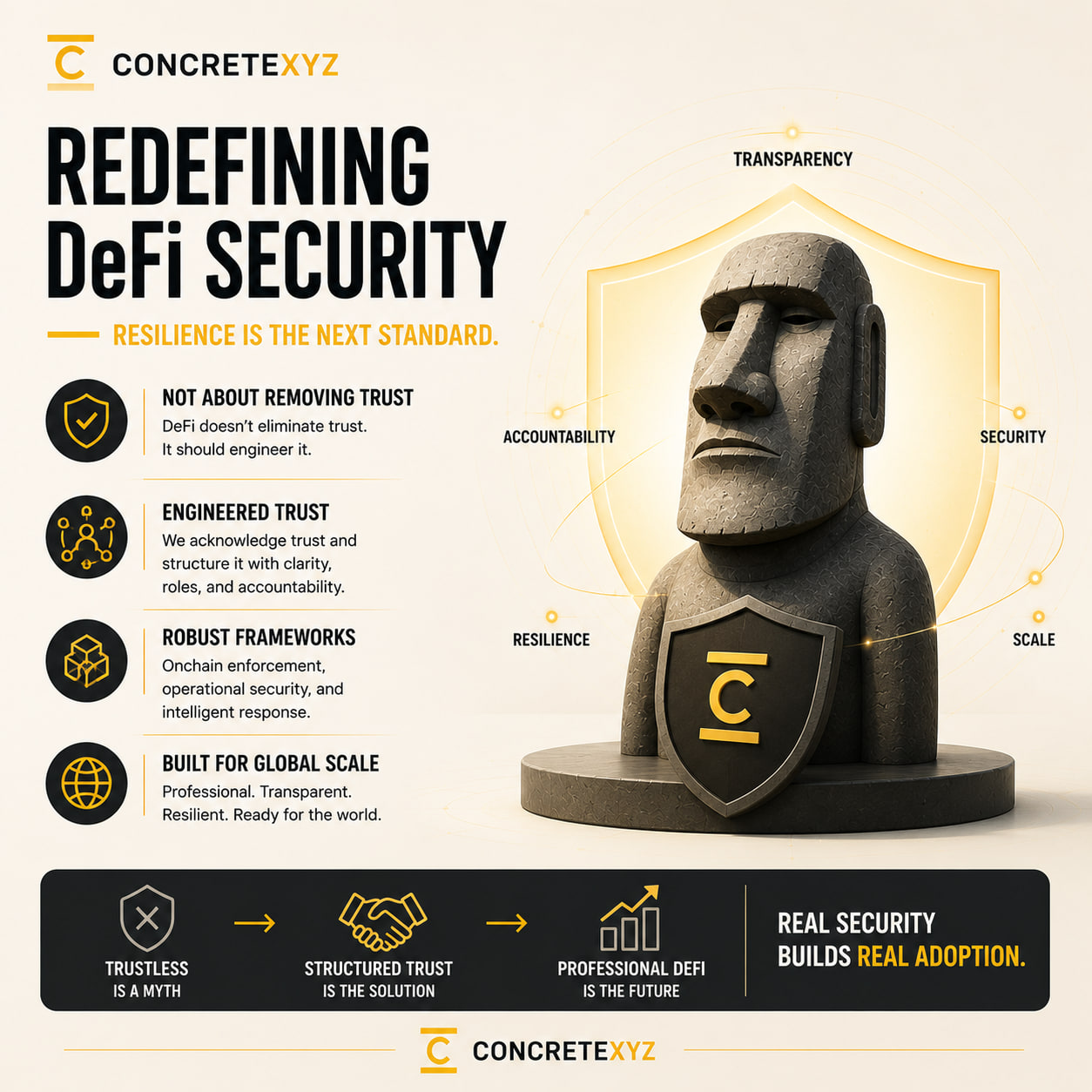
The alternative to hidden trust is not more trust — it is trust that is explicit, structured, and designed to function well under pressure.
Mature financial infrastructure does not claim to be trustless. It claims to be trustworthy and it earns that claim through specific design choices: clear roles and responsibilities, defined permissions and their limits, enforced constraints that prevent the system from behaving in ways outside its intended boundaries, and mechanisms for response when something goes wrong.
This is engineered trust. Not the absence of trust, but the deliberate construction of systems where trust is placed in the right components, with the right constraints, with the right mechanisms for monitoring and response.
Engineered trust means knowing exactly where the trust assumptions in a system live not having them obscured by a “trustless” narrative that makes them harder to examine. It means designing systems that acknowledge failure modes rather than ignoring them. It means building response capabilities alongside prevention capabilities, because prevention alone is never sufficient in adversarial environments.
It means treating security as an operational discipline, not a static property. A smart contract that was secure at deployment may not be secure after market conditions change, after new attack vectors are discovered, or after the ecosystem around it evolves in ways the original designers didn’t anticipate. Maintaining security requires ongoing vigilance, not just a one-time audit.
This is how institutions that manage significant capital have always operated. Not by eliminating the need for trust, but by structuring it carefully, monitoring it continuously, and building the capacity to respond when the structure is stressed.
Why Real Security Requires More Than Code
Code is a powerful tool for enforcing constraints. It is not a sufficient foundation for operational security.
The space of possible failure modes in a complex DeFi system extends beyond what any smart contract can handle autonomously. Market conditions can create scenarios that were not anticipated at design time. Governance attacks can be constructed that are technically valid but clearly adversarial in intent. External dependencies, like oracles, bridges, execution layers, can fail in ways that are not visible from inside the protocol. Social engineering can compromise key holders regardless of how well the code is written.
Real security requires monitoring (continuous observation of system state, transaction patterns, and external conditions that might signal emerging risk. It requires rapid response mechanisms) the ability to take protective action faster than a governance vote can be assembled. It requires human judgment in edge cases the recognition that some situations require interpretation and decision-making that cannot be fully specified in advance. And it requires layered security, multiple overlapping mechanisms so that the failure of any single layer does not result in catastrophic loss.
This is not an argument against smart contracts or on-chain enforcement. On-chain enforcement is valuable precisely because it is automatic, deterministic, and not subject to human discretion in routine operation. The argument is that on-chain enforcement alone is not sufficient that the operational layer around the code matters as much as the code itself, and that pretending otherwise creates systems that look secure until they fail catastrophically.
How Concrete Approaches Trust
Concrete operates from a different premise than the “trustless” framing that much of DeFi inherited.
The premise is this: trust is unavoidable, so it should be engineered explicitly rather than hidden behind ideology.
This means that the trust assumptions in Concrete’s architecture are documented and deliberate, not obscured. The system is designed around the recognition that different components require different trust models — and that the appropriate response to this is careful architecture, not the pretense that trust has been eliminated.
Trust in Concrete is explicit. The roles in the system the Allocator, the Strategy Manager, the Hook Manager have defined responsibilities and defined limits. Permissions are bounded. The system knows what each component can and cannot do, and those boundaries are enforced rather than assumed.
The architecture combines on-chain enforcement with off-chain intelligence. On-chain enforcement provides the deterministic, automatic constraint application that makes the system reliable in routine operation. Off-chain monitoring and response capability provides the situational awareness and rapid response capacity that on-chain systems alone cannot deliver. Neither is sufficient alone. Together, they create a security posture that is robust across the range of scenarios a live system actually encounters.
The system is designed for response, not just prevention. When conditions change, when risk parameters are approached, when external conditions create unusual exposures the architecture is built to respond, not to wait for a governance process to complete. Operational security in adversarial environments requires the capacity to act quickly, and Concrete’s design reflects this.
Controlled execution environments mean that capital cannot be deployed into strategies outside the defined universe, regardless of market pressure or yield incentives. The boundary is enforced at the infrastructure level. The vault cannot be pushed by external conditions into fragile structures that were not part of its design.
This is not decentralization theatre. It is the deliberate construction of a system where trust is placed carefully, monitored continuously, and backed by genuine response capability.
The Future Belongs to Systems That Behave Well Under Stress
DeFi is moving past the “trustless” narrative not because the values behind it were wrong, but because the systems built on it have been tested by reality and found to be more complex than the narrative allowed.
The protocols that have failed catastrophically (exploited, drained, gamed through governance) were not betrayed by the presence of trust. They were betrayed by trust that was hidden, unexamined, or placed in components that couldn’t bear its weight.
The next phase of DeFi will be defined by infrastructure that takes this seriously. Not by systems that claim to have removed trust, but by systems that have engineered it deliberately that know where their trust assumptions live, have designed around their failure modes, and have built the operational capacity to respond when things go wrong.
Resilience matters more than ideology. A system that acknowledges its trust assumptions and manages them well is more trustworthy, in the sense that actually matters, than a system that claims to be trustless while hiding significant dependencies behind the label.
The capital that will define DeFi’s next phase (institutional, professional, long-duration) will not be attracted by claims of trustlessness. It will be attracted by demonstrated operational security: by systems that have been stressed and held, by architectures that are transparent about how they work, and by infrastructure that can be evaluated against a standard more rigorous than a marketing narrative.
The question was never whether DeFi would involve trust. It always did. The question is whether that trust is engineered well enough to deserve it.
Explore Concrete at https://concrete.xyz/