The Trust Gap: Why Fintech Products Lose Users Quietly
The Transaction That Never Landed
The queue at the pepper stall has been moving since 6 a.m. By 10, Mama Chisom has sold half her stock and is already calculating her profit the way she has done for decades, long before banking apps and POS machines entered the picture.
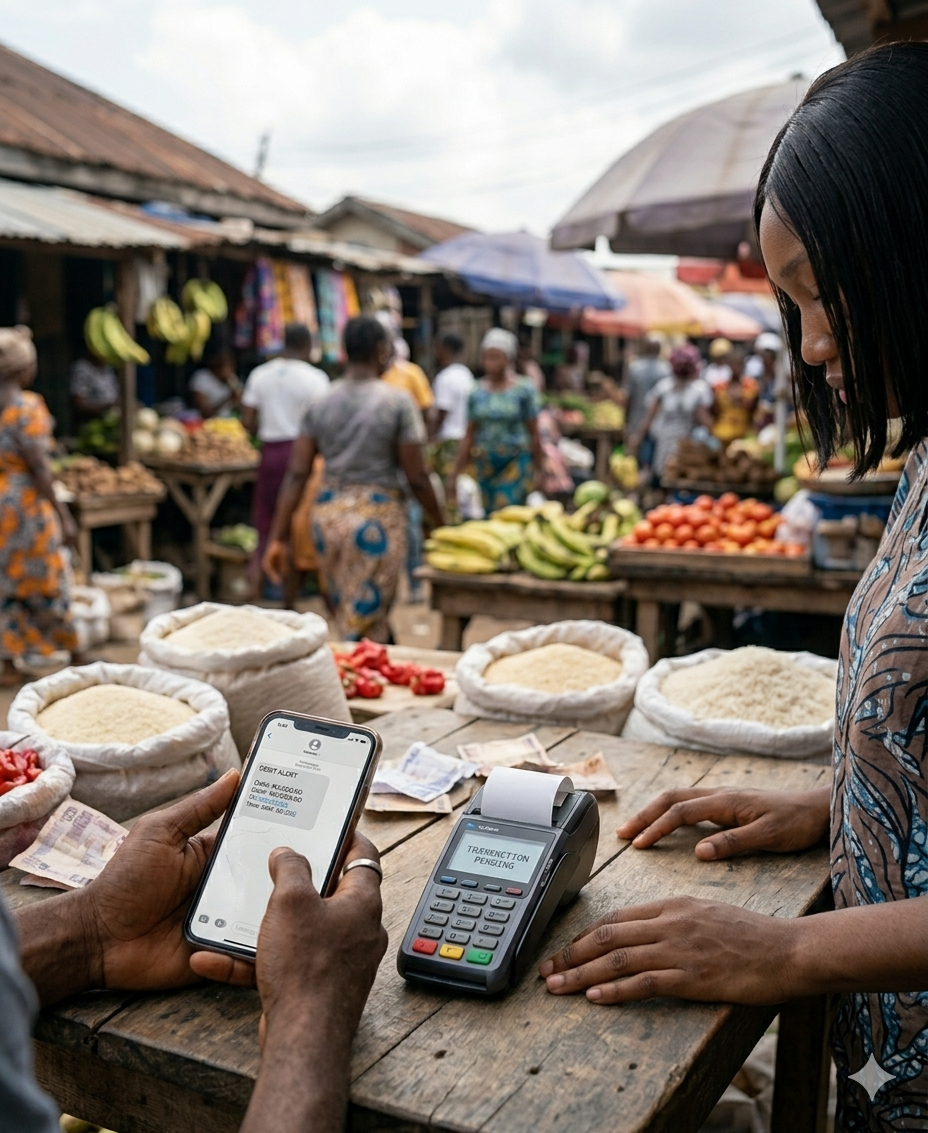
A young man steps forward, buys tomatoes and scent leaf, and taps his card. The machine beeps. Then nothing.
He taps again.
The screen reads: Transaction Pending.
His phone buzzes. A debit alert has landed in his pocket. The vendor’s phone stays silent. Between them, something shifts. Not anger, not confusion, but something quieter. A shared awareness that both of them did everything right and still ended up on opposite sides of a broken system.
For the vendor, it is the third time this month. For the young man, it is the moment he decides to withdraw cash before next Saturday’s market run, just to be safe.
This is not a glitch. It is a trust-breaking moment, and it is happening every day, across markets in Onitsha, bus stops in Lagos, and provision stores in Enugu, quietly reversing whatever progress a fintech campaign announced that morning.
Elsewhere, a fintech company has just launched a new campaign. Clean visuals. A woman in a linen co-ord set tapping her phone effortlessly at a modern café. "Banking made simple," the caption reads.
The gap between that ad and that market stall is not a technology gap. It is a trust gap. And understanding where it comes from requires going further back than the last product launch.
 Obianuju Wendy Osemeka7 min read·Just now
--
The Weight of Memory: Why Nigerian Savers Don't Forget
To understand digital banking resistance in Nigeria, you have to understand what money has meant to Nigerians over the last three decades. This is not sentiment. It is history, and history has a way of writing itself into behavior long after the events that caused it have passed.
In 2005, the Central Bank of Nigeria mandated that all commercial banks meet a minimum capital base of 25 billion naira or face acquisition, merger, or liquidation. The number of banks dropped from 89 to 25. The consolidation looked, from the outside, like progress. But for the ordinary Nigerian saver, it felt like instability arriving without warning. Banks swallowed each other whole. Overnight, the sign on your local branch changed, and suddenly, the person behind the counter didn't know your name or where your money had gone. People who had saved carefully found themselves navigating a system that had restructured itself around their confusion rather than through their understanding.
The message was subtle but lasting: the system can shift at any time, and you will be the last to know.
Then came 2023. The naira redesign policy arrived with the logic of monetary reform and the execution of a crisis. ATMs ran dry. POS operators charged premiums the Central Bank had explicitly prohibited. People queued for hours to collect portions of their own money that felt like rationing. Digital transfers increased. But trust did not. Because behind every transfer was one urgent question: can I actually access this money when I need it?
That answer settled into memory, where it joined everything else the system had already taught people to be cautious about.
When a Nigerian saver keeps cash at home alongside a funded mobile wallet, when they triple-check that a recipient has received funds before releasing goods, they are not being difficult. They are being rational inside a system that has given them every reason to be careful. Fintech does not enter a blank market. It enters a market shaped by memory.
The Emotional Reality of a Failed Transaction
There is a particular kind of dread that arrives with a dispense error, and it begins before the person has fully processed what happened.
You enter your PIN. You select your amount. The machine thinks. Then it returns your card, prints nothing, and displays a message: Transaction could not be completed. Please try again or contact your bank.
Your phone buzzes. The debit alert has arrived.
What follows is immediate. How much is left? Can I wait three to five business days for a reversal? Who do I know inside that bank? The phrase "I'll call my account officer" is not simply a cultural reflex. It is the sound of someone trying to locate a human being inside a system that has just behaved like a machine with no one behind it.
Most fintech products respond poorly to this moment. Some say nothing. Others send vague notifications written in the passive voice, language that communicates process without communicating care. What users need is acknowledgment before they have to ask, clarity instead of a reference number, and assurance that someone is already working on it.
Then there is the quieter friction of unexplained charges. The fear of bank charges in Nigeria is not about the amount. A fifty-naira deduction that arrives without a clear label is not experienced as a small fee. It is experienced as something taken without permission, reopening the question that every financial trauma has already planted: is this institution taking from me when I am not looking?
These moments accumulate. Individually minor. Collectively, they build a relationship defined not by confidence but by managed suspicion. The user does not leave. They simply reduce their exposure, keep a backup account, and reserve serious money for arrangements they trust more completely. The "I'll call my account officer" culture persisted not because Nigerians are resistant to digital tools but because digital tools, for a long time, offered no equivalent of that relationship. Many still do not.
The Case for Clarity: Why Communication Is the Real Product
There is a question that does not appear in most fintech pitch decks but probably should: what does our product say to a user when something goes wrong?
Not what the terms and conditions say. Not what customer care says after a 45-minute hold. What does the product itself say, in the moment, in plain language, to a person standing at a bus stop with three thousand naira left in their account and a transaction that just failed?
Access without trust is a leaking bucket. You can bring a million users onto your platform and lose them quietly, one bad experience at a time, to cash kept at home, to the ajo contributions collected by a neighbor who has never once failed to show up.
Kuda Bank's early growth was driven not just by zero maintenance fees but by the way the product communicated. Notifications had personality. Error messages were direct. The tone signaled consistently that human beings had thought about how each moment would feel. That is not a technology advantage. It is a communication advantage. PiggyVest built loyalty by being honest about user behavior, designing around the reality that saving is hard and communicating that openly. Users felt seen rather than judged.
These are not coincidences. They are the outcome of treating communication as infrastructure rather than afterthought. Every interaction is either building trust or eroding it. There is no interaction that does neither.
Radical Transparency Over Disruption: A Note to Fintech Builders
Disruption, as a founding philosophy, is oriented toward the competition. Radical transparency is oriented toward the user. The fintech founders who have conflated them have built products that are technically superior to the banks they replaced but emotionally indistinguishable from them.
The Nigerian user is not waiting to be disrupted. They are waiting to feel safe.
Safety means receiving communication before you have to ask for it. It means a transaction history where every charge is labeled, where nothing arrives without explanation. It means that the next time a transaction fails in a market in Onitsha, the product speaks first, before the anxiety builds, with one clear sentence: we know what happened, it was not your fault, and here is exactly when your money will be back.
The ceramic pot under the bed is not the enemy of Nigerian fintech. It is the benchmark. It has never sent an unexplained debit alert. It has never frozen access during a policy change. It simply holds what is placed inside it and returns it when asked, reliably, without drama.
To displace it, fintech does not need to be more sophisticated. It needs to be more trustworthy. Trust is built in the small moments most products are not paying attention to. The moment a transaction fails and the product speaks first. The moment a charge appears and it already has a name. The moment something goes wrong and the user thinks, for the first time: they knew this might happen, and they prepared for it.
Build for those moments. The market has been waiting long enough.
The Trust Checklist: 5 Questions for Every Fintech Product Team
Before your next update goes live, ask one question: are we building for trust, or just for transactions?
If a payment fails in a crowded market, does your notification calm the situation immediately, or leave the user holding a reference number with no clarity? In that moment, reassurance matters more than proof.
When something goes wrong, does your product sound human? There is a difference between “An error has occurred” and “We can see the issue, and here is where your money is.” One distances. The other steadies.
Look at your smallest charges. An unexplained ₦50 fee does more damage than teams expect. It is not about the amount. It is about what it suggests.
Then consider onboarding. Does it feel like an interrogation, or a conversation? Users arrive with history, and your product either acknowledges that or ignores it.
Finally, timing. Do you speak before the user starts asking questions, or after? Trust is often built in that gap.
These are small moments. But they are where users decide whether to stay, step back, or return to cash.
#Fintech #DigitalBanking #UserExperience #ProductDesign #Nigeria