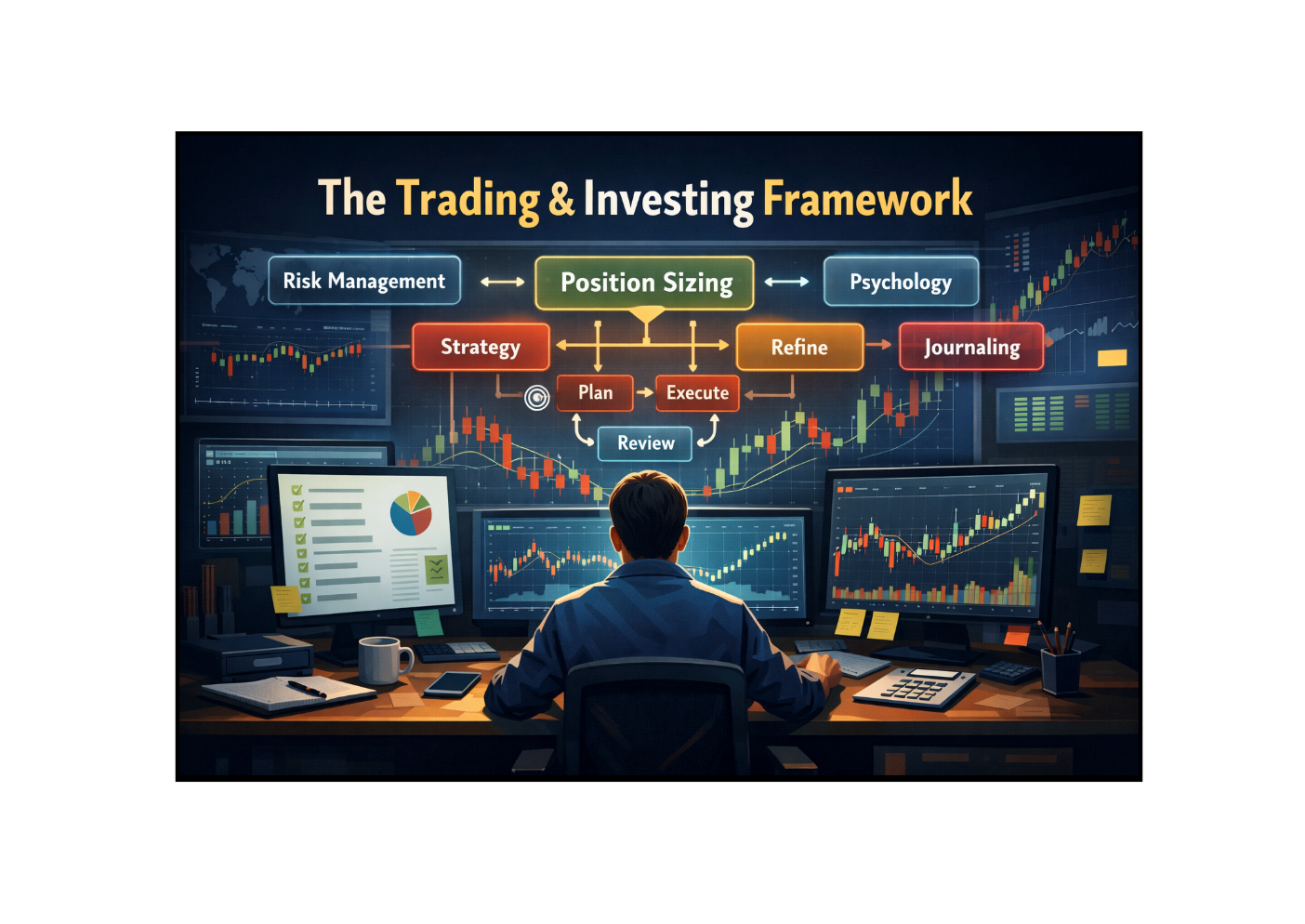
The Trading & Investing Framework: Trend Following — Part 6
 Harsh Shah5 min read·Just now
--
Disclaimer: This article is for educational purposes only and should not be considered financial advice.
In the previous part, we built the foundation — capital allocation, risk management, and choosing your style.
Now we step into one of the most powerful (and misunderstood) strategies in trading:
Trend Following.
If you’re new to technical analysis, start here — I’ve put together a free resource to help you get going.
🌊 The Core Idea: Don’t Fight the Market
There’s a simple truth most traders learn the hard way:
You don’t bet against the trend. You align with it.
Markets move in waves — not straight lines.
And when a strong trend is in place, it tends to continue longer than most people expect.
Yet beginners do the opposite:
- They try to “call the top”
- They try to “buy the bottom”
- They assume price has gone “too far”
This is where they lose.
Trend followers don’t predict. They participate.
🚂 Think Like This: You’re Jumping on a Moving Train
Imagine a train already in motion.
You have two choices:
- Stand in front of it and try to stop it ❌
- Jump on and ride it ✅
Trend following is simply:
- Buying strength (in uptrends)
- Selling weakness (in downtrends)
It sounds counterintuitive — but this is exactly how big money is made.
📈 What Does a Trend Actually Look Like?
A trend isn’t random. It has structure.
This is the market telling you:
- Buyers are in control (uptrend)
- Sellers are in control (downtrend)
Your job is not to argue with that.
Your job is to follow it.
🔍 How to Identify a Trend (Simple & Effective)
You don’t need 10 indicators.
Keep it clean.
1. Price Structure
The most important signal:
UpTrend
- Are highs getting higher?
- Are lows getting higher?
If yes → Uptrend.
If the stock is in an uptrend, you simply ride with it.
Sandisk — Higher highs, higher lows
Downtrend
- Are highs getting lower ?
- Are lows getting lower ?
If yes → Downtrend.
If the stock is in an downtrend, you simply avoid it or short it.
Enphase — Lower Highs and Lower lows
2. Moving Averages (Your Trend Filter)
Use something simple like:
- 8 EMA (slow)
- 21 EMA (fast)
8 EMA > 21 EMA → bullish trend
Google: 165 => 320 (85% move)
When the trend is strong, you simply side in the same direction!
8 EMA below 21 EMA → bearish trend
Hims: 55$ => 20$ (Saved 70% collapse)
No longs if the 8EMA below 21 EMA
3. Momentum Confirmation
Strong trends don’t move slowly — they push aggressively.
Look for:
- Strong breakout candles (example: bullish engulfing etc.)
- Continuation patterns (flags, pullbacks, breakout patterns etc)
Please note: None of the above should be used in isolation, always a combination for stacking odds in your favor!
The Core Philosophy of Trend Following
Most traders fail because they try to outsmart the market — thinking a stock is “too high” to buy or “too low” to sell. In reality, the market doesn’t care about opinions. Strong stocks often keep getting stronger, and weak stocks continue to weaken.
Trend following is about shifting from prediction to reaction. Instead of guessing, you follow price action and align yourself with institutional money — the real force behind market moves. This removes emotion and helps you participate in meaningful trends.
You won’t catch the exact bottom or top — and you don’t need to. The goal is to capture the middle 60–70% of a move, where trends are most reliable.
This approach only works with discipline. Trend following is a process, not a one-time trade. Manage risk, respect your stop-loss, and stay with the trend as long as it remains intact.
Let the market do the heavy lifting.
🚀 How to Get Started
Start simple — use what you already own.
Go through the stocks in your portfolio and begin plotting basic trends. Mark higher highs and higher lows, add key EMAs, and identify breakout candles. Study how these setups worked in the past — this is where real learning happens.
Once you’re comfortable, shift your focus to current stocks. Start scanning for similar patterns in real time. Don’t rush into trades — observe, validate, and build confidence.
Before risking real money, paper trade your setups. Treat it seriously. Track your entries, exits, and outcomes.
Repeat this process at least 100 times.
Either you’ll give up — or you’ll gain clarity.
Over time, review your results. Understand your win rate, what works, and what doesn’t. That’s how you move from guessing to having a system.
You’re not chasing trades — you’re building skill.
🔍 What’s Coming in Part 7
In the next section, we’ll dive into how pattern breakout trading actually works.
You’ll learn how markets move from quiet consolidation into powerful breakouts — and why these moments often lead to the biggest moves. We’ll walk through the core structures that precede these breakouts and how to recognize them early.
🚀 Final Thought
Trend following is simple — but not easy.
It requires:
- Patience (waiting for trends)
- Discipline (not fighting them)
- Consistency (executing your plan)
Most people lose because they try to be right.
Trend followers win because they choose to be aligned.