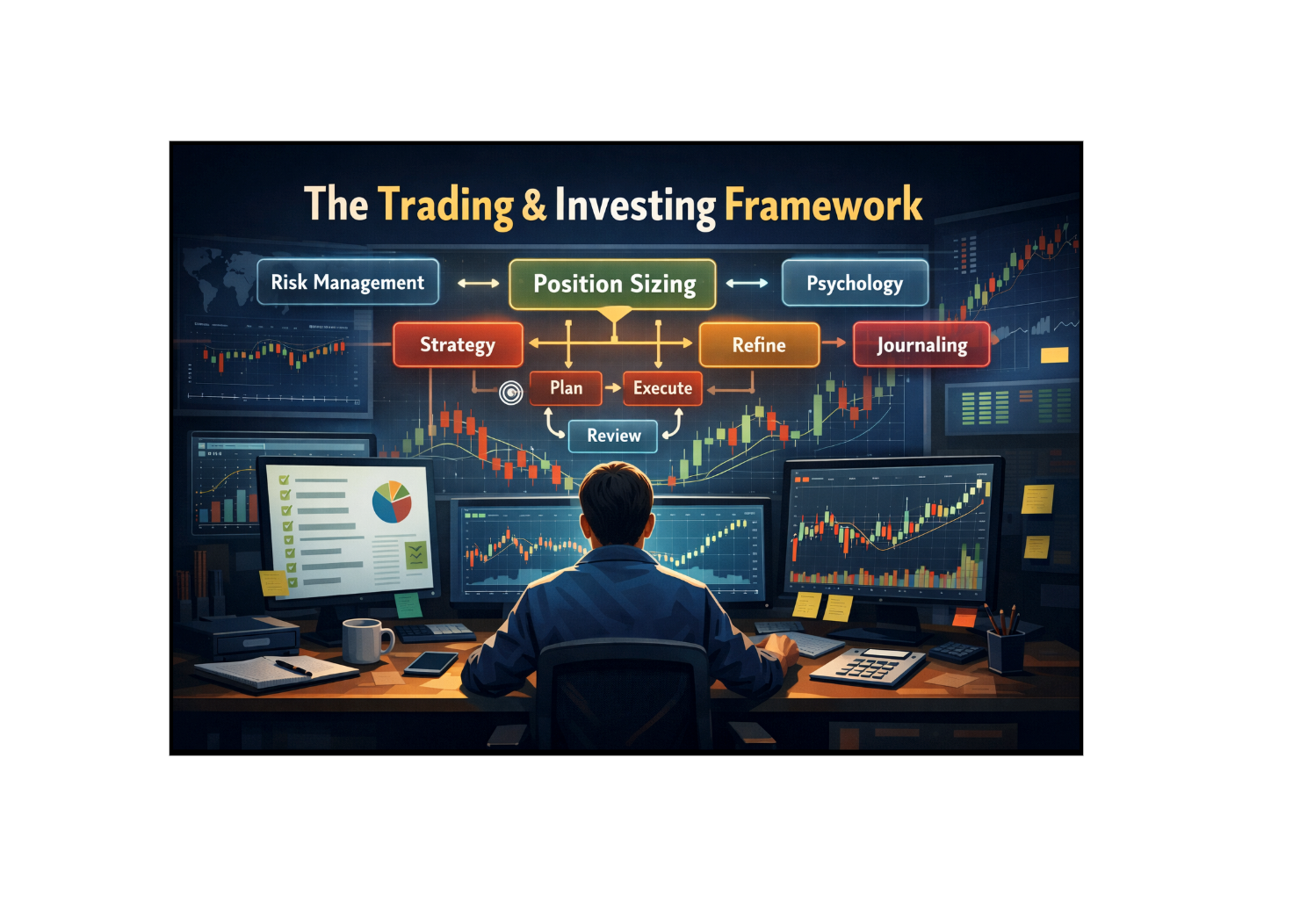
The Trading & Investing Framework: Building your Scanner— Part 9
 Harsh Shah3 min read·Just now
--
Disclaimer: This article is for educational purposes only and should not be considered financial advice.
In Part 8, we focused on mean reversion — the idea that price stretches… then snaps back, in the previous part 6 and part 7 we learnt momentum and pattern trading.
But here’s the truth:
You’re not just trading one setup.
Some days favor:
- Momentum
- Some favor breakouts
- Some favor mean reversion
If your screener only looks for one…
👉 You’re blind to the rest of the market.
Pick One. Master It.
Before we proceed, I request you to:
1. Pick one trading strategy
2. Stick to it
3. Master it
Understand:
How it behaves
When it works best
When it fails
How to manage risk around it
Only after that…
You can expand.
🔍 The Real Goal with the Screener
You’re not building a screener.
You’re building:
A system that adapts to market conditions
Same market. Different behavior.
Your job = be aware of what’s happening right now
🧠 Think in Buckets (Not Indicators)
Instead of random filters…
Structure your screener into 3 buckets:
⚡ 1. Momentum (Strength continues)
This is when:
- Strong stocks get stronger
- Trends don’t pull back much
What to scan for:
- Price near highs (52-week highs / recent highs)
- Strong relative strength
- Above key MAs (50 / 200 EMA)
- Increasing volume
👉 You’re looking for leaders
🚀 2. Pattern Breakouts (Compression → Expansion)
This is where:
- Price coils
- Then explodes
What to scan for:
- Wedge Pattern Breakouts
- Resistance being tested multiple times
- Patterns like Head & Shoulders, Cup & Handle etc.
👉 You’re looking for pressure building up
🔄 3. Mean Reversion (Stretch → Snap Back)
This is when:
- Price goes too far
- Emotions take over
What to scan for:
- Price far from moving averages
- RSI extremes
- Sharp vertical moves
- Exhaustion signs (double top, resistance, top end of the channel etc.)
👉 You’re looking for imbalance
🛠️ Where You Build This
This is where most people should start.
You can create 3 separate screeners:
- Momentum screener
- Breakout screener
- Mean reversion screener
Or one master screener with different filters.
Different tools that I use for screening…
Finviz
Check out Finviz (free) — it lets you scan across multiple stocks using filters like chart patterns, volume expansion, and a lot more.
Quick peek on the steps here.
Trading View
More advanced. I use this momentum scanner. For example:
Other Options
- Broker screeners (basic but usable)
- Custom tools (if you’re building systems)
⚙️ The Right Way to Use It (This Is Where Most Fail)
A screener is NOT:
- A signal generator
- A “buy this now” machine
It’s just:
- A shortlist generator
🧩 Clean Daily/Weekly Workflow
Step 1: Run All 3 Screeners
- Momentum
- Breakout
- Mean Reversion
Step 2: Build Watchlist (10–20 Stocks)
- That’s it. No more.
Step 3: Identify Market Type
Ask:
- Are trends strong? → focus momentum
- Is price coiling? → focus breakouts
- Are moves extended? → focus mean reversion
Step 4: Execute ONE Style
👉 Not all three at once
This is where edge comes from.
⚠️ The Trap
Most traders:
- Mix all 3 styles
- Take random trades
- Lose consistency
Example:
- Shorting a strong momentum stock (mean reversion bias)
- Buying a weak stock breaking down (momentum confusion)
That’s not strategy.
That’s chaos.
What coming next:
Now that you know how to scan for opportunities…
There’s one missing piece.
👉 When should you actually trade them?
Because here’s the reality:
The same setup won’t work in every market.
Some days are built for momentum.
Some reward patience and mean reversion.
And some days… are just noise.
🚀 Final Thought
The market isn’t one-dimensional.
It rotates between:
- Expansion (momentum)
- Breakouts (transition)
- Rebalancing (mean reversion)
Your edge is not picking one forever.
It’s:
Recognizing what’s working… and aligning with it
Build your screener like that —
And it stops being a tool…
👉 It becomes your trading assistant.