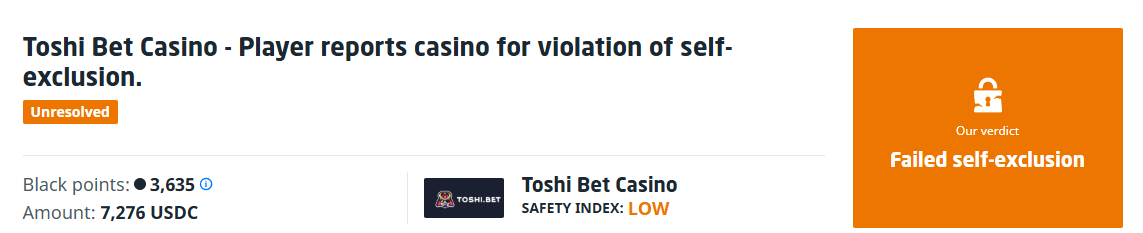
The Toshi.bet “No-Win Trap”: A Technical Analysis of a $7,276 Fraud
--
How an unregulated crypto casino ignores professional mediators and exploits technical loopholes
Anatomy of a Technical Fraud: Toshi.bet and the “$7,276 No-Win Trap”
How a crypto casino exploits systemic loopholes to capture deposits, ignores professional mediators, and the legal irony of its promotion from within Portugal.
As a senior software professional used to auditing system architectures and data flows, I rarely expect to encounter such blatant compliance failures. However, Toshi.bet reveals a pattern of “fraud-by-design” that the Web3 community needs to understand.
The Entry Point: Trust and Promotion
I joined Toshi.bet following the public endorsement of Adar Ziv, a visible figure in the iGaming marketing space. It is, at the very least, ironic to discover that while actively promoting this platform and providing tutorials on how to bypass regional blocks via VPN, the promoter resides in Portugal — a jurisdiction where the promotion of unlicensed gambling platforms is strictly illegal and subject to criminal sanctions.
Archived evidence of these promotions (for legal purposes):
- Promotion Record 👉 https://archive.is/Eg9dW
- VPN/Access Instructions 👉 https://archive.is/FK06C
- Platform Recommendation 👉 https://archive.is/hDj22
The Logic Flaw: The “No-Win Trap”
What makes this case technically egregious is the “selective” nature of Toshi.bet’s detection algorithms. The system operates what I call a “No-Win Trap”:
- Instant Detection for Restrictions: The moment I deposited, the system was “smart” enough to instantly identify my account as a duplicate, automatically restricting all bonuses and promotions.
- Intentional Blindness for Deposits: Yet, the same system remained conveniently “blind” for 12 days, allowing me to deposit a total of $7,276 USDC.
- The Asymmetric Risk Gate: While the balance was ultimately lost during play, the trap was foundational: because the “duplicate” flag was already active in their database, any potential winnings would have been inevitably voided upon a withdrawal attempt.
From a software engineering perspective, this is a “freeroll” algorithm for the house. The system only enforces rules when money is set to leave the ecosystem, never when it is entering. Keeping the deposit gate open while knowing the player is technically ineligible to collect winnings is a mathematically guaranteed capture of funds via asymmetric rule enforcement.
The Verdict: Casino Guru
I submitted this case to Casino Guru, the leading independent mediator for the gambling industry. Their investigation confirmed this technical hypocrisy. The mediator, Martin, explicitly pointed out the double standard in Toshi.bet’s infrastructure:
“Although the casino is able to detect and flag bonus-related activity on duplicate accounts immediately, the second account remained fully active for 10 days. This demonstrates that while the current system may effectively support the casino’s operations in regards to players creating multiple accounts to gain advantage, it is not sufficiently secure for safeguarding vulnerable players.”
The mediator’s conclusion was clear: Toshi.bet was found “At Fault” and was ordered to refund the full $7,276 USDC. To date, the platform has chosen silence, claiming “internal legal processes” to avoid fulfilling the decision.
Evidence Repository and Legal Action
Given the severity of the situation and the fact that the promotion occurred on Portuguese soil by local residents, the case has been formally submitted to the competent authorities:
- Portuguese Judicial Police (PJ)
- SRIJ (National Gambling Regulator)
For full transparency and to protect other users, I have compiled all technical logs, communications, and evidence in a dedicated repository: 👉 Toshi.bet RG Failure — Full Documentation
The impartial, final verdict can be viewed here: 👉 Official Casino Guru Decision
Conclusion
The integrity of the Web3 ecosystem depends on accountability. When platforms ignore mediators and promoters ignore the laws of the countries where they reside, trust is broken. I will pursue justice until the court-recommended refund is issued. Let this case serve as a warning to everyone navigating the world of decentralized casinos.