The Tokenized Internet of Value: Why Real-World Assets on Blockchain Are the Next Financial Revolution
“How Blockchain Is Turning Physical Assets into Borderless, Programmable Value”
 AartiWrites4 min read·Just now
--
Imagine your real estate, investments, invoices or even your future income moving across borders instantly. Without banks, delays or intermediaries. This is no longer something that will happen in the future. It is already happening through one of the powerful changes in modern finance: Real-World Asset tokenization.. Unlike the early days of blockchain this change is being driven not just by new companies but by big institutions, regulators and global financial systems.
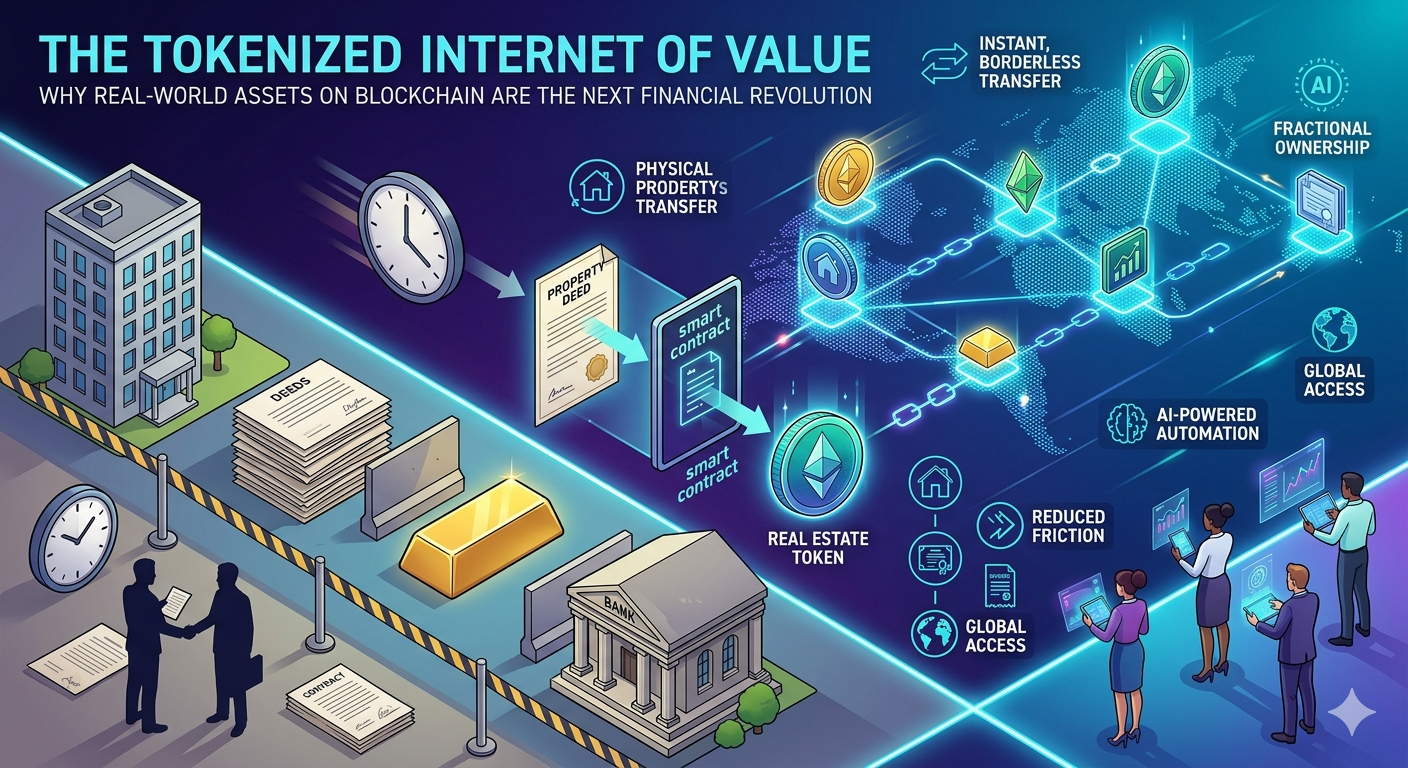
For years the internet changed how we share information. Now blockchain is changing how we transfer value. In systems assets are often hard to sell slow to transfer and locked within complex legal and banking frameworks. Selling property takes months. Cross-border payments take days. Verifying ownership requires intermediaries.. With tokenization these same assets can be converted into digital tokens that represent ownership on a blockchain. Making them instantly transferable, divisible and programmable.
At its core Real-World Asset tokenization is about turning traditional financial assets into digital representations on a blockchain. This includes everything from estate and bonds to gold, private equity and invoices. These tokens can be traded twenty-four hours a day seven days a week fractionalized into units and transferred globally within seconds. For the time a user in one country can own a fraction of an asset in another. Without the friction that once made such transactions nearly impossible.
So why is this trend growing fast now? The answer lies in a convergence of maturity across fronts. First big institutions are adopting blockchain faster. Banks and financial firms are no just experimenting. They are actively building tokenized products and infrastructure. Second stablecoins have proven that digital assets can operate at scale handling real transaction volumes efficiently. Third regulatory clarity is gradually improving, with governments shifting from resistance to participation.. Finally blockchain infrastructure itself has evolved, becoming faster more scalable and more interoperable than ever before.
Another critical driver of this transformation is the convergence of blockchain with intelligence. While blockchain ensures trust, transparency and immutability artificial intelligence introduces automation, intelligence and adaptability. Together they are enabling a paradigm. Autonomous finance. Imagine contracts that automatically execute trades based on real-time data, artificial intelligence systems that manage portfolios without human intervention or lending platforms that dynamically adjust risk and collateral. This is not just digitization. It is the creation of self-operating systems.
As this shift accelerates the banking industry itself is undergoing a transformation. Traditional banks are not disappearing,. Their role is evolving. Of acting as gatekeepers they are becoming infrastructure providers. Offering blockchain-based settlement layers, custody solutions and compliance frameworks. The financial system is moving from centralized networks to more open programmable ecosystems where value can flow freely and efficiently.
Perhaps the powerful implication of tokenization is the concept of permissionless liquidity. In todays world turning assets into capital often requires approvals, intermediaries and time-consuming processes.. In a tokenized system assets can become liquid by design. A property in one country a bond in another or a startup equity stake can all be represented digitally. Traded globally. This unlocks access for a range of investors while improving capital efficiency across markets.
Course this transformation is not without challenges. Questions around regulation, security, asset verification and custody remain critical. However the industry is actively addressing these concerns through innovations like on-chain compliance, regulated stablecoins, auditable smart contracts and institutional-grade custody solutions. Of bypassing regulation blockchain is beginning to embed it directly into the system. Making compliance more transparent and efficient.
The scale of this opportunity is enormous. Global real estate, bonds and equity markets collectively represent hundreds of trillions of dollars. Even a small percentage of these assets transitioning onto blockchain could create a -trillion-dollar digital economy.. As adoption grows we are likely to see entirely new financial models emerge. Ones that were not possible within traditional systems.
Looking ahead the future of finance will be defined by programmability. Real-World Assets could be streamed in time instead of paid monthly. Loans could adjust dynamically based on market conditions. Insurance claims could be processed automatically through verified data feeds. Real-World Assets themselves could become managing liquidity, ownership and compliance without manual intervention. In this world money is no longer static. It becomes dynamic, responsive and integrated into ecosystems.
What makes this revolution truly remarkable is how quietly it is happening. While much of the conversation around blockchain still revolves around cryptocurrencies the real transformation is occurring behind the scenes. In financial infrastructure, settlement systems and ownership models. Over time blockchain will become invisible just like the internet did. We will not think about using it. We will simply experience faster efficient systems built on top of it.
The next decade will not be defined by who creates the assets but by who redefines how ownership works. Tokenization is not an upgrade. It is a fundamental shift, in how value is created, transferred and accessed globally. And as this transformation continues one thing becomes clear: the future of finance is not just digital. It is tokenized, programmable and borderless.
Lets Connect
If you are interested in fintech technology, digital payments or building platforms feel free to connect.
Contact us: [email protected]
Visit us: http://itio.in
If you enjoy exploring topics like fintech, digital payments and financial technology infrastructure follow along for insights into how real fintech systems work behind the scenes.