 MAKAVELI7 min read·Just now
--
How CNPY Powers a Real Economy
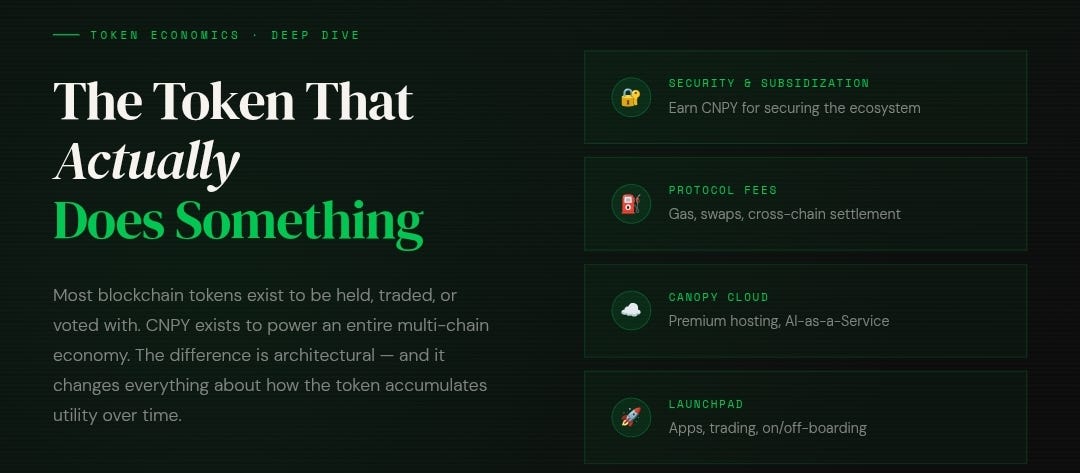
There is a question every serious person asks when evaluating a blockchain project — not what the token is worth, but what it is for. The answer to that question determines whether a token has durable utility or whether it is a temporary narrative waiting to unravel.
For most blockchain projects, the honest answer to that question is uncomfortable. Governance tokens give holders the right to vote on parameters that the founding team controls anyway. Fee tokens generate revenue only if the chain stays relevant long enough to matter. Most tokens exist, fundamentally, because the project needed a fundraising mechanism and a community incentive — not because the architecture required them.
CNPY is different. Not as a claim, but as a structural fact. The token is the payment layer for a multi-chain ecosystem. Remove it, and the economic model of the entire network stops functioning. That is a different kind of utility — and this article explains exactly how it works.
Why Most Tokens Are Economically Hollow
To understand why CNPY's design is significant, it helps to be precise about what most tokens actually do.
Governance tokens give holders the ability to vote on protocol parameters — fee levels, treasury allocations, upgrade proposals. In theory this is decentralized control. In practice, governance participation rates are consistently low, founding teams and early investors hold disproportionate voting power, and the decisions available to governance are usually constrained by what the core team is willing to implement. Governance tokens provide the appearance of ownership without the substance.
- 🔴 MOST TOKENS
— Governance with low participation rates
— Staking rewards funded by inflation
— Fee discounts on a single platform
— Speculation as the primary use case
— Value tied to one chain’s activity
— Required for narrative, not architecture - 🟢 CNPY
— Payment layer for the entire ecosystem
— Validator rewards from real economic activity
— Required for cross-chain settlement
— Utility compounds with each new chain
— Value tied to the entire Nested Chain network
— Required by the architecture itself
Fee tokens are marginally better — they at least have a mechanical connection to network usage.
But fee tokens on single chains are still exposed to a single chain’s adoption curve. If the chain loses relevance, the token loses utility. And in a multi-chain world where users move between ecosystems freely, single-chain fee tokens face a structural ceiling on how much utility they can accumulate.
How Canopy Monetizes at Every Level
Canopy’s economic model operates across two parallel tracks — token-denominated and fiat-denominated — each capturing value from different layers of the ecosystem. Understanding both tracks is essential to understanding why CNPY’s utility is structurally different from most tokens.
The dual-track model matters because it separates two distinct value streams. Token-denominated revenue scales with on-chain activity — every transaction, every cross-chain settlement, every validator interaction. Fiat-denominated revenue scales with builder adoption — every team that uses Canopy Cloud, every project that launches through the Launchpad. Both tracks grow as the ecosystem grows, and neither one is dependent on the other to function.
CNPY as the Cross-Chain Settlement Layer
The most structurally significant role CNPY plays is as the settlement layer for cross-chain activity across the entire Nested Chain ecosystem. This is worth examining carefully because it is what makes CNPY's utility fundamentally different from a single-chain fee token.
Every Nested Chain on Canopy communicates natively through the shared infrastructure layer. When chains interact — when assets move, when messages pass, when wallets are controlled across chains through Remote Programmable Wallets — these interactions require settlement. CNPY is that settlement mechanism.
The implication is direct: every new Nested Chain that launches creates new potential for cross-chain interactions. Every new cross-chain interaction requires settlement. Every settlement requires CNPY. The token's utility does not scale with one chain's adoption — it scales with every chain's activity across the entire ecosystem simultaneously.
Compare this to the standard fee token model. A fee token on a single chain captures value from that chain’s transactions. If the chain has 10,000 daily active users, the fee token captures value from 10,000 users' worth of activity. CNPY captures value from every user on every Nested Chain, plus every cross-chain interaction between those chains. The addressable utility compounds with each new deployment rather than staying fixed at a single chain’s adoption ceiling.
The Flywheel: How Utility Compounds
The economic model Canopy has built is not linear — it is a compounding flywheel where each input accelerates the next. Understanding the flywheel explains why the token’s utility is not static but grows structurally with the ecosystem.
The flywheel is self-reinforcing precisely because CNPY is embedded in the architecture rather than layered on top of it. Each rotation of the flywheel increases the demand for the token through actual network usage — not through narrative or marketing cycles.
GTM: The Three-Phase Adoption Model
Canopy’s go-to-market strategy maps directly onto the token’s utility accumulation. The three phases — Launch, Embed, Entrench — are not just a product roadmap.
They describe how CNPY’s role in the ecosystem deepens over time.
The three phases matter for CNPY’s utility because each phase expands the ecosystem that the token serves. Phase 1 establishes the initial network. Phase 2 accelerates the flywheel. Phase 3 creates compounding defensibility — both for the network and for the token’s embedded role within it.
What a Real Token Economy Looks Like
The distinction between a real token economy and a manufactured one comes down to one question: does removing the token break the network, or just inconvenience it?
For most governance tokens, the honest answer is that removing the token would change the optics of the project without fundamentally altering its operation. The chain would still produce blocks. The validators would still be paid — in some other denomination. The users would still transact. The token is attached to the ecosystem, not embedded in it.
For CNPY, removing the token breaks the economic model. Cross-chain settlement has no mechanism. Validator rewards across the Nested Chain ecosystem have no common denomination. The cross-pollination of economic value between chains — the mechanism that makes the network stronger as it grows — has no medium of exchange. The token is not attached to the architecture. It is the architecture's economic layer.
This is the standard against which CNPY should be evaluated — not against its current market conditions or its betanet metrics, but against the question of whether its utility is structural or narrative. The answer is structural. And structural utility, unlike narrative utility, does not require maintenance. It compounds on its own as the network it powers continues to grow.
The Honest Summary
CNPY is the payment layer for a multi-chain ecosystem that does not yet exist at full scale — but whose architecture is already built. The token's utility today is real but limited to the current scale of the network. The token's utility at mainnet and beyond is a function of how many Nested Chains launch, how much cross-chain activity they generate, and how deeply the ecosystem embeds itself in the applications builders create on top of it.
None of that is speculative in the sense that it requires things to go right that might go wrong. It is speculative only in the sense that growth takes time. The architectural preconditions — recursive security, native cross-chain communication, Remote Programmable Wallets, the dual revenue track, the three-phase GTM — are not promises. They are infrastructure being built in sequence, documented in real time, verifiable by anyone who looks.
The token does something because the network does something. And what the network does is build the infrastructure for a multi-chain world where chains do not compete for security, bridges do not create attack surfaces, and validators are incentivized to secure the whole rather than extract from the parts.
That is what a real token economy looks like. And that is what CNPY is for.