The Sustainability Trap: Why 90% of DeFi Yield is Just a Marketing Budget
 Riyankun3 min read·Just now
--
The most expensive lesson in DeFi is learning the difference between yield and subsidies.
In every bull cycle, we see the same movie. A protocol launches with a 400% APY, the chart goes “up and to the right,” and everyone talks about the “new paradigm” of finance. Then, the incentives run dry, the liquidity mercenary-swaps to a competitor, and the original holders are left holding a bag of governance tokens that have no utility.
If you’re tired of the “farm and dump” cycle, it’s time to talk about what actually makes a strategy sustainable.
1. The “Token Printer” Mirage
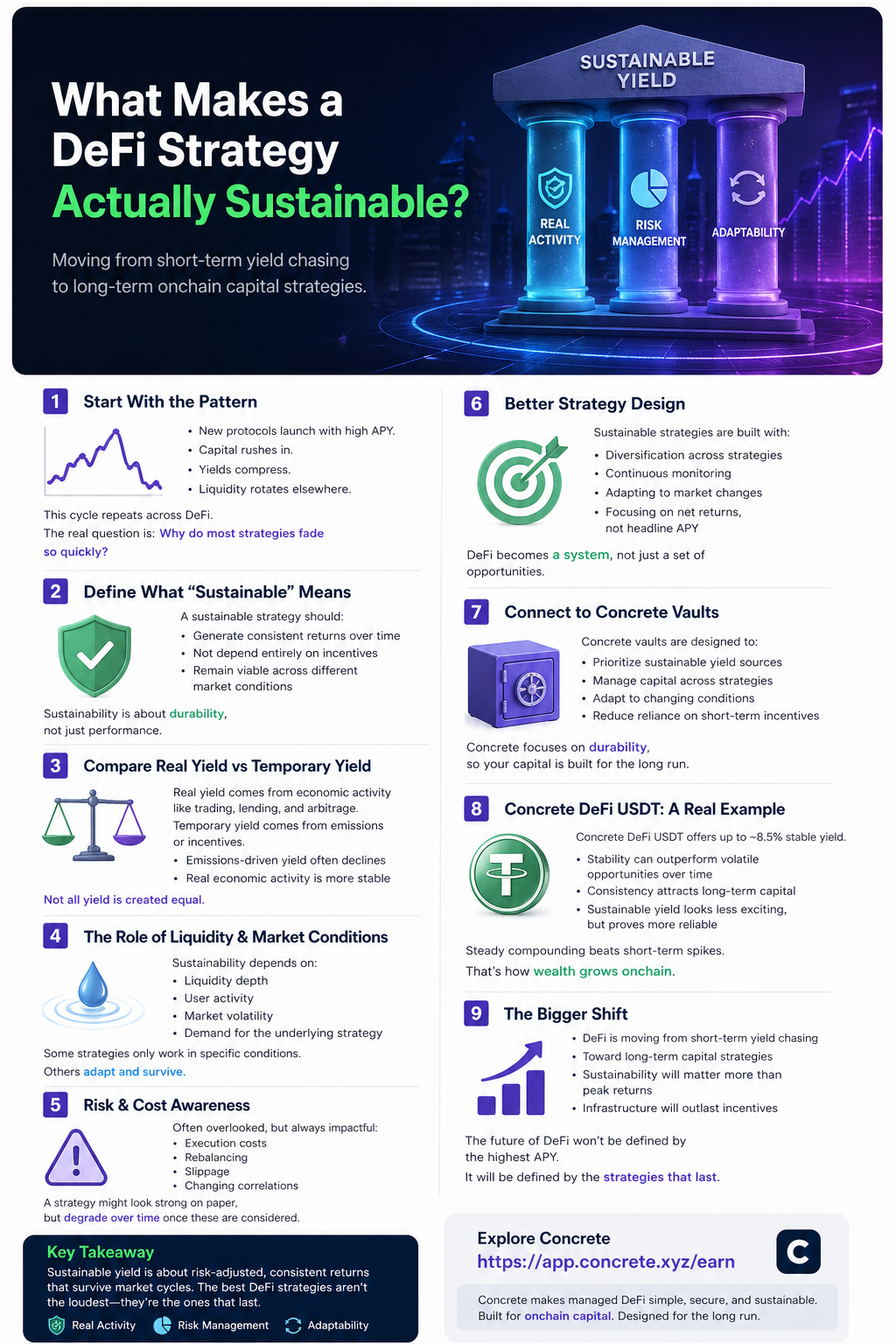
Most high-yield strategies aren’t actually generating value; they are just distributing a marketing budget. If a protocol pays you in its own native token to provide liquidity, that isn’t “yield” — it’s an emission.
The sustainability test is simple: Where does the money come from?
- If it comes from a token printer, it’s a race against the clock.
- If it comes from a borrower paying interest or a trader paying a fee, it’s a business.
Sustainable yield is an engineering problem, not a magic trick. It requires real economic activity — arbitrage, lending spreads, or liquidation fees — that exists regardless of whether a new token is being minted.
2. Robustness > Optimization
In DeFi, we often over-optimize for the “now.” We build strategies that work perfectly in a high-volatility bull market but bleed out the moment things go sideways.
A truly sustainable strategy is robust. It doesn’t just survive the “quiet” periods; it’s designed for them. This means accounting for the costs people hate to talk about:
- Slippage and Gas: The “hidden tax” that turns a 15% headline APY into 7% net.
- Impermanent Loss: The cost of being wrong about market direction.
- Protocol Risk: The reality that a high yield is often just a premium for taking on unquantified smart contract risk.
3. The Power of “Boring” Returns
There is a reason why serious capital eventually moves toward “boring” numbers.
Consistency is the ultimate alpha. An 8.5% yield that stays at 8.5% for two years will almost always outperform a 50% yield that crashes to zero in four months. Why? Because compounding requires time, and you can’t compound if you’re constantly forced to exit, re-evaluate, and pay gas fees to bridge to the next “big thing.”
Why Concrete Chose a Different Path
At Concrete, we aren’t interested in being the flashiest protocol on your Twitter feed. We’re interested in being the one that’s still there in three years.
Our USDT vault targets a consistent 8.5% yield. It doesn’t use smoke and mirrors or unsustainable “death spiral” incentives. Instead, it’s a system designed to manage capital across diversified, real-world yield sources.
We treat yield as a structural product. By automating the management and focusing on risk-adjusted returns, we’ve built a vault for capital that wants to grow, not just gamble.
The Shift is Happening
The “Degen Era” of chasing 1,000% APY was a necessary growing pain for the industry. But as DeFi matures, the winners won’t be the ones who found the highest yield for a week.
The winners will be the ones who built — and used — infrastructure that survives the cycle.
Stop chasing the peak. Start building the foundation.
Explore the future of managed DeFi at app.concrete.xyz/earn.