The Solar Panel Nobody Told You About
 Jerry Jihn3 min read·Just now
--
How Concrete Vaults quietly grow your capital while you sleep
Most people assume DeFi is all about timing the market. Buy low, sell high, pray you didn’t miss the window. But what if that entire mental model is wrong for yield?
Let me explain what’s actually happening inside a Concrete vault — and why it’s closer to installing solar panels on your roof than trading on a chart.
Your Panels, Your Output
When you deposit into a Concrete vault, you don’t just hand over tokens and hope for the best. You receive vault shares — a precise record of your ownership stake in the system.
Think of it like this: a neighborhood installs a shared solar grid. Each household contributes panels. You don’t own specific panels on a specific roof — you own a percentage of everything the grid produces. The more panels the grid has, the more energy flows. Your share stays constant; what changes is how much that share is worth.
That “worth” has a name in Concrete: the eRate. It’s the exchange rate between your shares and the underlying asset. When the vault earns yield, eRate goes up. Your share count doesn’t change — but each share buys more.
What’s the Grid Actually Worth?
The total value of everything inside a vault — all assets, all deployed capital, all accrued yield — is called the NAV (Net Asset Value).
NAV is the scoreboard. It reflects reality: what’s in the vault right now, marked at current prices, after all activity. When NAV rises, eRate rises. When you eventually redeem your shares, you’re cashing them in at whatever eRate has grown to.
No mystery. No hidden math. Just: vault is worth more → your shares are worth more.
Why Leaving Panels On Longer Matters
Here’s what surprises most newcomers: time is a core mechanism, not just a passive variable.
Yield in DeFi compounds. A vault that earns 10% annually doesn’t earn it in one lump sum on December 31st. It earns a tiny fraction every block, every hour, every day — and that yield gets redeployed. Which earns more yield. Which gets redeployed again.
A solar panel installed in January has generated 12 months of electricity by December. One installed in November has generated two. Same panel, different output — purely because of time in the system.
Early exits mean you leave compounding cycles on the table. The vault math doesn’t punish you, but the opportunity cost is real.
The Grid Operator
A solar grid without maintenance degrades. Panels need cleaning, inverters need calibration, output needs routing to where demand is highest.
Concrete vaults have an equivalent: active management. Capital isn’t just sitting idle — it’s deployed across strategies, rebalanced as conditions shift, and adjusted when better opportunities emerge onchain.
This is the layer most passive yield products skip. Concrete’s management layer monitors allocations continuously, pulling back from underperforming strategies and redirecting toward higher-efficiency ones. You don’t have to watch dashboards or time rebalances. That’s the operator’s job.
How It All Connects
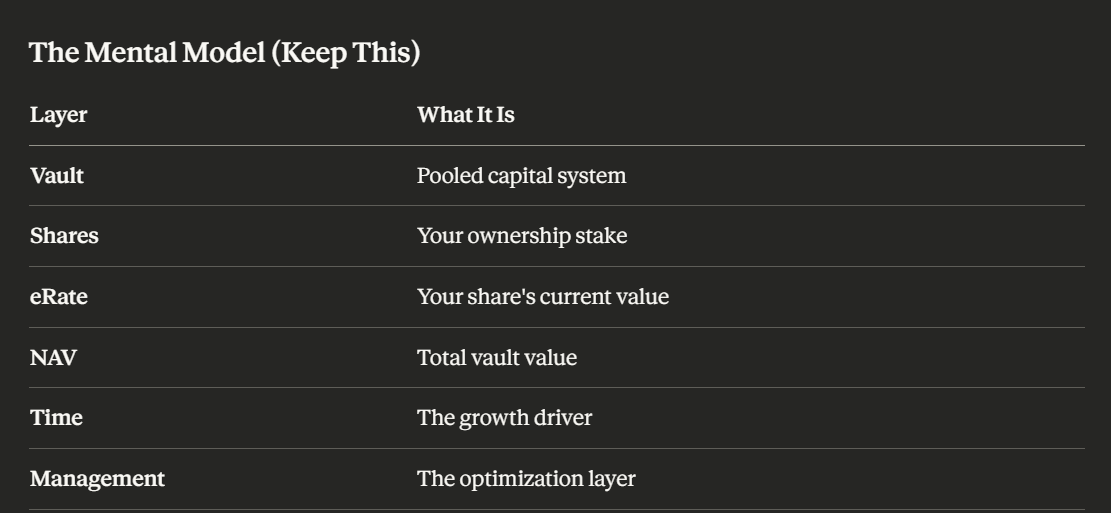
Put it together and the picture becomes clear:
- You deposit → you receive shares
- Shares have a value tracked by eRate
- eRate reflects NAV — the vault’s total worth
- NAV grows because capital is actively deployed and compounded
- Time amplifies every cycle of that compounding
- Management keeps the system optimized so yield doesn’t leak
None of these layers work in isolation. Shares without NAV tracking are meaningless. NAV without active management stagnates. Management without time can’t compound meaningfully. The whole system is designed to work as one.