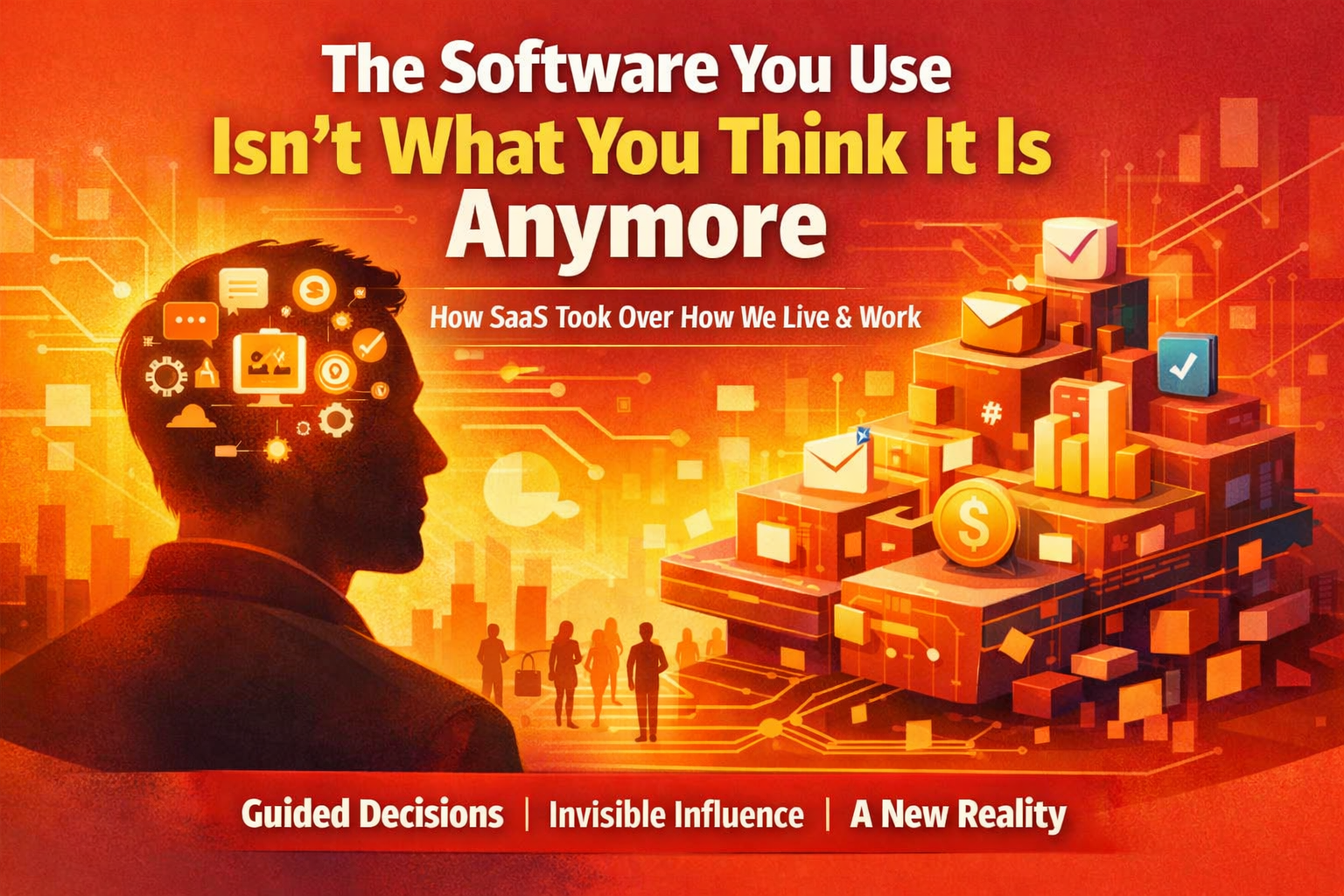
The Software You Use Isn’t What You Think It Is Anymore
How SaaS quietly stopped being a tool and became the system shaping how we live, work and decide
 Tanu | Payments & Infrastructure4 min read·1 hour ago
--
You opened an app today without thinking about it.
You clicked a button. Something updated. A task moved forward.
It felt simple. Almost invisible.
There is more to it than that. Something that most people never stop to think about.
Software is no longer software. It has quietly become the environment in which decisions are made behaviors are shaped and businesses evolve.
That shift is changing everything.
When tools stopped being tools
There was a time when software had a role. You opened it used it and then closed it. It was separate from your thinking, workflow and identity as a professional or business.
Today that boundary is gone. Modern SaaS does not wait for you to use it. It anticipates you nudges you and structures how you work before you even realize it.
Your CRM decides what you follow up on. Your analytics tool decides what you prioritize. Your finance dashboard decides what you consider growth.
You are still making decisions.. The frame around those decisions is no longer entirely yours.
The quiet shift toward infrastructure
The most powerful software today is not the one you notice the most. It is the one you barely notice all.
SaaS has evolved into something to infrastructure than a product. It runs in the background connecting workflows, syncing data, triggering actions and shaping outcomes.
You do not log into a system anymore. You exist inside it.
This shift has made software more powerful but more subtle. It is no longer about features. It is about influence.
What this means for the way we work
If software is shaping decisions then understanding SaaS is no longer about usability. It is about awareness.
The effective users are not the ones who know every feature. They are the ones who understand how the system is guiding them.
Here are a few ways to think differently about SaaS in this reality:
* See the system, not just the screen. Every dashboard is a story being told to you. Metrics are not neutral. They highlight behaviors and hide others.
* Question default workflows. Default settings are powerful. They are designed to work for people, which means they are not always designed to work for you.
* Treat automation with respect. Automation saves time. It also removes friction.. Sometimes friction is where good judgment lives.
What you actually gain from this shift
At its best this new generation of SaaS creates something
* Clarity. When systems are designed well they reduce noise. They surface what matters. They allow you to focus on decisions of processes.
* Speed. Workflows that once took hours now happen in minutes. Coordination across teams becomes seamless. Information flows of getting stuck.
* Consistency. Good systems reduce variability. They ensure that important processes happen the way every time.
The challenges we rarely talk about
For all its advantages modern SaaS introduces a set of challenges that are easy to ignore.
* The illusion of control. Dashboards give a sense of visibility. Visibility is not the same as understanding.
* Over-optimization. When every metric is tracked the temptation is to optimize everything.. Not everything should be optimized.
* Decision fatigue in disguise. Ironically more automation can lead to decisions.
A quiet shift in leadership thinking
As software becomes more embedded the way we think about building, managing and growing systems is also changing.
It is no longer about adopting the best tools. It is about designing environments where tools, people and decisions align.
What modern SaaS is really made of
If you look closely today’s SaaS platforms are not defined by their interfaces
They are defined by what happens beneath the surface.
* Data flows that connect parts of a business
* APIs that allow systems to talk to each other
* Automation layers that trigger actions without human input
* Intelligence layers that analyze patterns and suggest decisions
Where this shows up in real life
You can see this shift across almost every industry.
In finance systems categorize transactions, detect anomalies and guide spending decisions in time.
In e-commerce platforms adjust pricing personalize recommendations and optimize inventory without intervention.
The market is moving faster than we realize
The growth of SaaS is no longer about more companies adopting software.
It is about software becoming the foundation of how businesses operate.
Every industry is becoming, in some way a software-driven industry.
A thought worth sitting with
Software used to be something we interacted with.
Now it is something we live inside.
The shift happened quietly. Without announcements. Without a moment of change.
It is here.
The people who benefit the most from this new reality will not be the ones who use the most tools.
They will be the ones who understand them enough to stay human within them.
Because in a world where systems are getting smarter awareness becomes the valuable skill.
If this made you think differently follow the publication for thoughtful perspectives on technology and fintech. Applaud the story if it resonated with you. Share your perspective, in the responses section. Connect if you are exploring ideas or building in this space.. If you have a story to tell consider contributing. The best insights often come from experience.