CAD forces designers to think like computers. AI lets them design from intent.
Mechanical CAD has a problem that nobody talks about.
The software people use today to design physical objects works almost exactly the same way it did in the late 1980s.
Sketch. Constrain. Extrude. Fillet. Repeat.
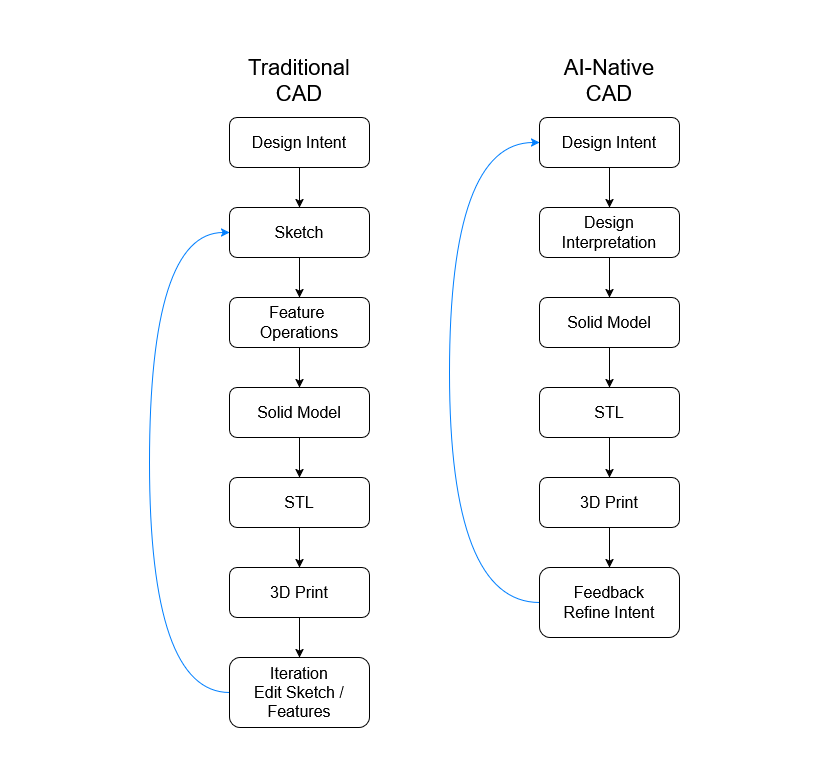
The tools got faster. The hardware got cheaper. But the core interaction has not moved.
That is not a criticism of the engineers who built those systems. Parametric feature-based modeling was a genuine breakthrough when it was introduced. But we are now building AI-native software in nearly every other domain. The way we design physical parts is still running on a 35-year-old paradigm.
That needs to change.
Here is why, and what the next architecture looks like.
The Problem With How CAD Works Today
You’re Managing Features, Not Intent
Modern CAD builds geometry step by step:
sketch, constrain, extrude, fillet, hole, chamfer.
Each feature depends on everything that came before it.
If you change something early in that sequence, everything downstream has to regenerate. And things often break.
Consider a simple example. A box with a centered hole.
In a physical workshop, making the hole larger means using a bigger drill. Simple. Independent. Done.
In a history-based CAD model, that same change can alter surrounding faces and edges. Fillets, patterns, and other features that reference those edges can fail during regeneration.
Suddenly you are not thinking about the part anymore. You are debugging a feature tree.
The system makes you think like a computer instead of a designer.
You Have to Speak the System’s Language
Before any geometry exists, you build a sketch.
That sketch only becomes stable once it is fully constrained. Every dimension must be defined. Every relationship must be encoded.
Even for something as simple as a box with a centered hole this means adding coincident constraints, symmetry references, equal distance definitions, and dimensional annotations.
All of it manually.
The system checks whether your geometry is valid.
But it does not understand what you are trying to build.
The translation from design intent to constraint language falls entirely on the designer.
For experienced CAD users this becomes routine.
For everyone else it is a wall.
CAD Still Has a Steep Learning Curve
Learning professional CAD software takes time and money. Many traditional CAD tools require expensive licenses. Even modern tools like Fusion 360 or Onshape still require understanding sketches, constraints, feature relationships, and parametric workflows before users can design parts reliably.
For experienced users this becomes routine.
For newcomers the first interaction with CAD can feel opaque and procedural. The system expects the designer to think in terms of sketches, constraints, and features before a physical idea can even take shape.
The barrier is not the precision of CAD tools.
It is the interaction model itself.
Getting to a Physical Part Is a Multi-Step Handoff
The parametric model you build in CAD is defined mathematically through surfaces, edges, and parameters.
Most fabrication systems operate on mesh geometry instead.
Because of this, the model is typically converted into a triangulated mesh such as an STL file before it can be processed by slicing software. The slicer then generates toolpaths and support structures before fabrication begins.
If you change the design, you regenerate the model, export the mesh again, and reassess slicing parameters.
Layer height. Clearances. Material compensation.
All of it again.
Design intent lives upstream. Manufacturing works on finalized geometry.
There is a gap between the two.
What an AI-Native Architecture Changes
Intent Becomes the Input
In traditional CAD you translate intent into features.
In an AI-native system, intent becomes the input.
You describe what you want in natural language. Dimensions, functional requirements, manufacturing context. The system interprets that description as a parametric definition.
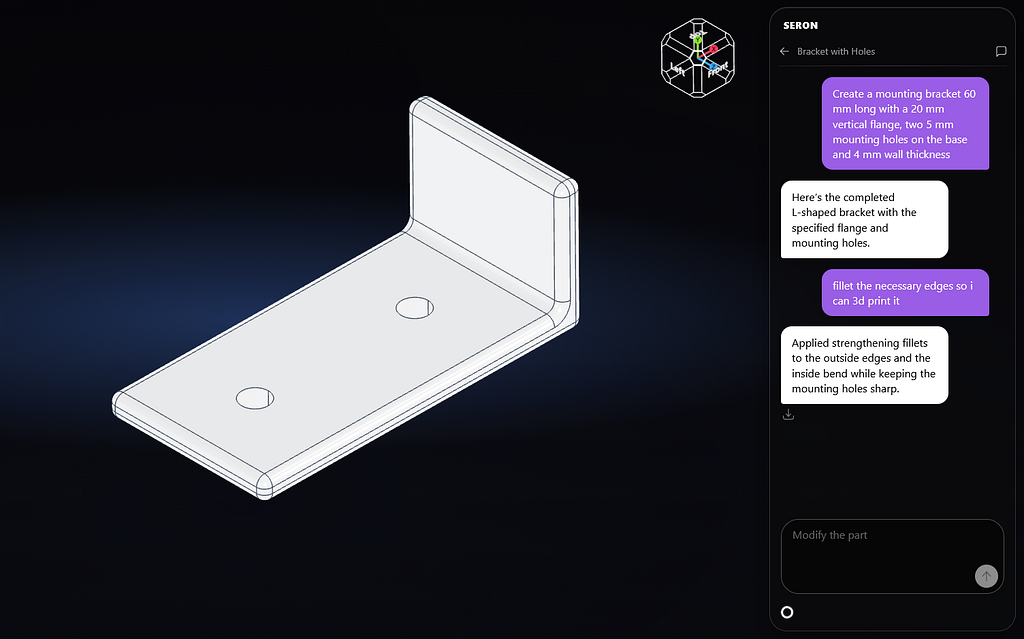
Not static geometry.
A structured, editable model.
Iteration happens at the level of intent instead of feature sequences. Changing the design means updating a requirement. You do not repair a broken feature tree.
The designer stays focused on the part, not the modeling process.
Parametric Logic Is Generated
An AI-native CAD system does not generate mesh geometry.
It generates parametric logic. In simple terms, this means the model is defined by dimensions and relationships between features, not just the shape itself.
The model remains constraint-aware and dimensionally explicit.
When requirements change, the parametric definition updates directly. There is no feature tree navigation and no manual constraint editing.
The model stays intact.
For example, imagine describing a box with a centered hole and later mentioning that the shaft it needs to fit has a larger diameter.
Instead of manually resizing geometry, the system understands the relationship between the shaft and the hole. It updates the diameter and associated clearances while preserving the rest of the model.
That is not geometry editing.
That is intent interpretation.
Fabrication Is Part of the Model
Traditional workflows evaluate manufacturing constraints after the model is exported. By then, changes are expensive.
In an AI-native architecture fabrication considerations can be incorporated during generation. The model is produced with manufacturing constraints already taken into account.
Iterations happen through updates to intent. New fabrication-ready geometry can be generated immediately.
No re-export.
No resetting slicing parameters.
The design-to-prototype cycle becomes shorter.
Why This Matters
The CAD interaction model has been expert-oriented for decades. Not because that was the best approach, but because no alternative architecture existed.
That is beginning to change.
AI-native design tools lower the barrier to creating physical objects. They shorten the gap between idea and prototype. They open mechanical modeling to anyone who can describe what they want to build.
The interaction model shifts from step-by-step feature construction to intent-driven design.
Mechanical CAD has needed this transition for a long time.
The tools to make it possible now exist.
A deeper technical discussion of this architecture is available in the full research article.
This approach is currently being explored through Seron.
The Software That Designs Physical Objects Is Stuck in the 1980s was originally published in Level Up Coding on Medium, where people are continuing the conversation by highlighting and responding to this story.