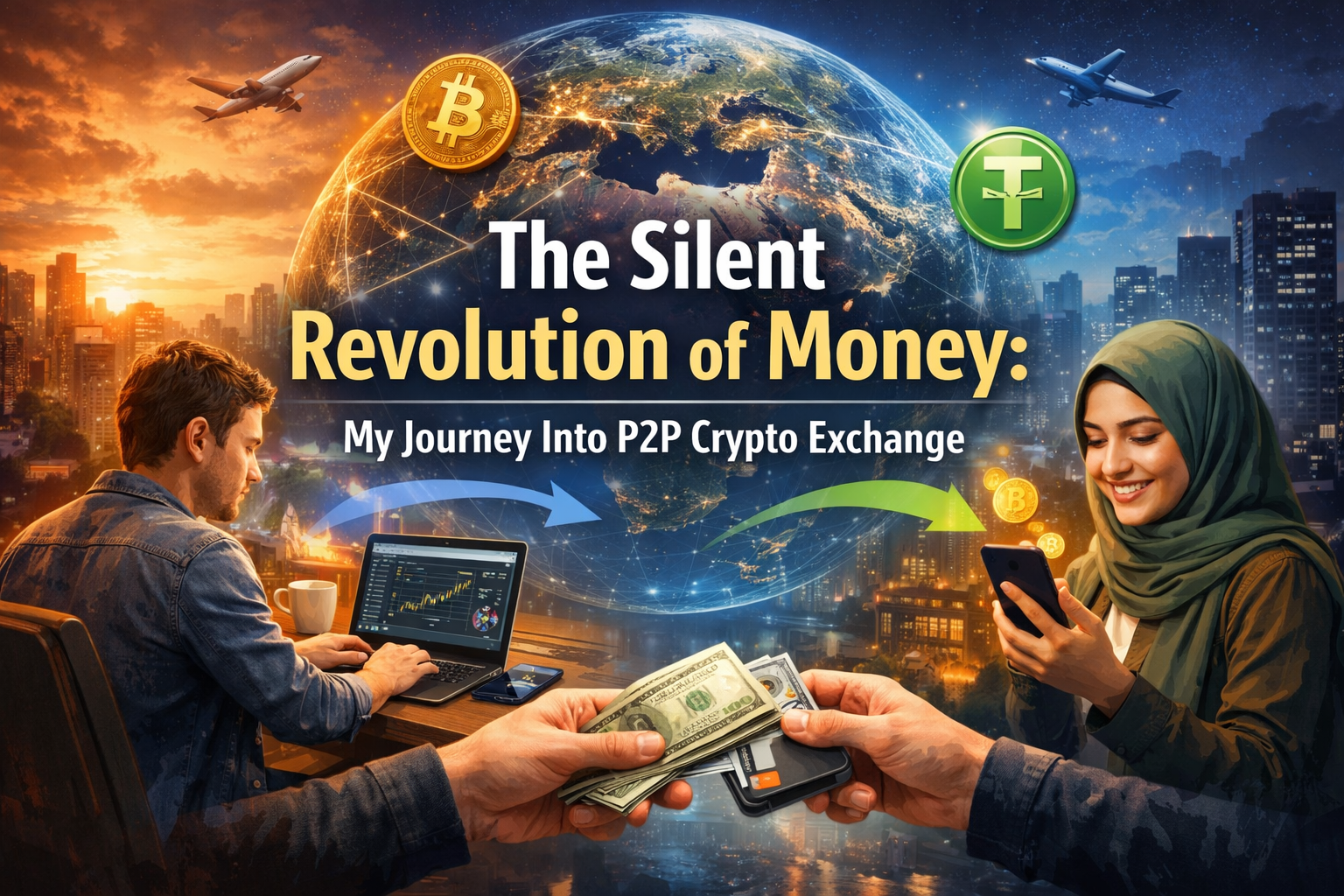
The Silent Revolution of Money: A Story About P2P Crypto Exchange
• The day I realized banks don’t control money anymore
• And how strangers across the world became my financial partners
 Antriksh Bansla5 min read·Just now
--
It Started With a Simple Problem
I still remember the frustration clearly.
It was late evening. I needed to send money urgently to a freelancer working overseas. My bank app kept loading, then rejecting the transaction. The fees were high, the delay was worse, and the uncertainty was the worst part.
“Processing may take 2–5 business days.”
That sentence felt outdated… almost insulting.
In a world where messages travel instantly, why did money still move like it was stuck in traffic?
That night, while searching for alternatives, I stumbled into something that would quietly reshape how I understood finance:
P2P Exchange (Peer-to-Peer Crypto Trading)
I didn’t know it then, but I had just opened the door to a completely different financial system.
What Is P2P Exchange, Really?
At first, it sounded complicated.
Peer-to-peer… decentralized… escrow… crypto wallets…
But the idea is surprisingly simple:
• You buy crypto directly from another person
• You sell crypto directly to another person
• A platform only acts as a middle layer of safety
No big bank deciding delays.
No central authority freezing your funds.
Just individuals exchanging value.
Think of it like this:
Instead of going to a currency exchange counter at an airport…
You’re directly meeting another traveler who already has the currency you need.
Except it’s all digital. And global. And instant.
My First P2P Transaction (And My Anxiety)
I won’t lie I was nervous.
The idea of sending money to a stranger online felt… risky.
What if they didn’t release the crypto?
What if I got scammed?
What if I made a mistake?
But curiosity won.
I started small — $50 worth of USDT (a stable cryptocurrency pegged to the dollar).
Here’s how it went:
• I selected a verified seller on the platform
• I initiated the trade
• The crypto was locked in escrow (held safely by the platform)
• I transferred payment via UPI
• The seller confirmed payment
• The crypto was released instantly into my wallet
And just like that… it was done.
No delays. No bank approval. No waiting.
Just math and trust, enforced by technology.
The Magic Behind the Scenes: Escrow
What made me feel safe wasn’t blind trust.
It was something called escrow.
In simple terms:
• The crypto is locked before the trade starts
• The seller cannot run away with it
• The buyer cannot reverse payment after receiving crypto unfairly
• The platform only releases funds when both sides confirm
It’s like a digital referee standing between two strangers saying:
“Play fair. Or no one wins.”
That changed everything for me.
Why P2P Became a Global Movement
As I explored further, I realized something important:
P2P exchange isn’t just a tool.
It’s a reaction to a broken system.
Traditional finance has limitations:
• High international transfer fees
• Slow settlement times
• Currency restrictions
• Banking hours (yes, still a thing)
• Geographic limitations
But P2P flips the model:
• Anyone can trade with anyone
• 24/7 availability
• Multiple payment methods (UPI, bank transfer, PayPal, etc.)
• No central gatekeeper deciding your access
Suddenly, a student in India could trade with someone in Europe…
or a freelancer in Africa could receive payment from the US in minutes.
Money became borderless.
The Emotional Shift: From Control to Freedom
Something unexpected happened after a few weeks of using P2P.
It wasn’t just convenience.
It was mindset.
I stopped thinking of money as something controlled by institutions.
I started seeing it as something fluid something that moves between people directly.
There’s a psychological shift when you realize:
• You don’t need permission to move value
• You don’t depend entirely on banks for access
• You can participate in a global economy directly
That realization is powerful.
And slightly unsettling at first.
Because freedom always feels unfamiliar before it feels normal.
The Learning Curve Nobody Talks About
Of course, it wasn’t all smooth.
P2P trading has its own learning curve:
• Understanding price spreads
• Choosing verified traders
• Avoiding unrealistic offers
• Reading buyer/seller reputation scores
• Managing wallet security
At one point, I made a mistake — I clicked on a low-rated seller offering a “too good to be true” rate.
Luckily, I backed out before committing.
That’s when I learned a critical rule:
In P2P, trust is data-driven, not emotional.
Ratings, trade history, completion rate — these matter more than promises.
The Real Risk (And How It’s Managed)
People often ask:
“Is P2P safe?”
The honest answer:
• It is as safe as the system you use
• And as careful as you are
Risks exist:
• Fake payment proofs
• Delayed confirmations
• Human error
• Poor platform selection
But most risks are reduced through:
• Escrow systems
• Verified traders
• Dispute resolution mechanisms
• Transaction limits
In many ways, it’s safer than random informal money transfers.
But it still demands awareness.
Why Businesses Are Quietly Adopting P2P
Something interesting is happening behind the scenes.
Small businesses and freelancers are increasingly using P2P because:
• Faster cross-border payments
• Lower transaction fees
• Easier access to stable assets like USDT
• No dependency on banking delays
Imagine a freelancer in India getting paid instantly from a client in Europe without waiting days for SWIFT transfers.
That’s not future talk anymore. That’s happening now.
The Traditional System vs P2P Reality
Here’s a simple comparison I often think about:
Traditional Banking:
• Centralized
• Slow settlement
• High fees for international transfers
• Limited operating hours
P2P Exchange:
• Decentralized peer network
• Near-instant settlement
• Lower transaction costs
• 24/7 global availability
It’s not about one replacing the other completely.
It’s about options.
And in finance, options equal power.
What P2P Taught Me About Trust
Before P2P, I thought trust meant institutions.
Banks. Governments. Systems.
But P2P taught me something different:
Trust can be:
• Algorithmic (escrow systems)
• Reputation-based (user ratings)
• Behavioral (trade history)
• Community-driven (dispute resolution feedback)
In other words, trust can be distributed.
It doesn’t need to sit in one building anymore.
The Future Feels More Connected
Today, I don’t see P2P exchange as just a crypto tool.
I see it as part of a larger shift:
• Money becoming digital-native
• Borders becoming less relevant in transactions
• Individuals gaining financial independence
• Systems becoming more peer-powered
We are moving toward a world where:
Value flows as easily as information
And that changes everything.
Final Thoughts
That first $50 transaction taught me something simple but powerful:
Finance doesn’t have to be slow.
It doesn’t have to be restricted.
And it doesn’t have to feel out of reach.
P2P exchange didn’t just change how I move money.
It changed how I think about ownership, access, and trust.
And maybe that’s the real revolution:
Not crypto itself…
But the fact that strangers can now exchange value safely, instantly, and globally — without asking permission.
• If money once belonged to institutions
• Now it slowly belongs to people again