The Seed Phrase Trap: Why Physical Storage is a Single Point of Failure.
 CryptDocker3 min read·Just now
--
I’ve spent the last decade building software, and if there is one thing I’ve learned as an engineer, it’s that any system with a single point of failure is already broken. You just haven’t realized it yet.
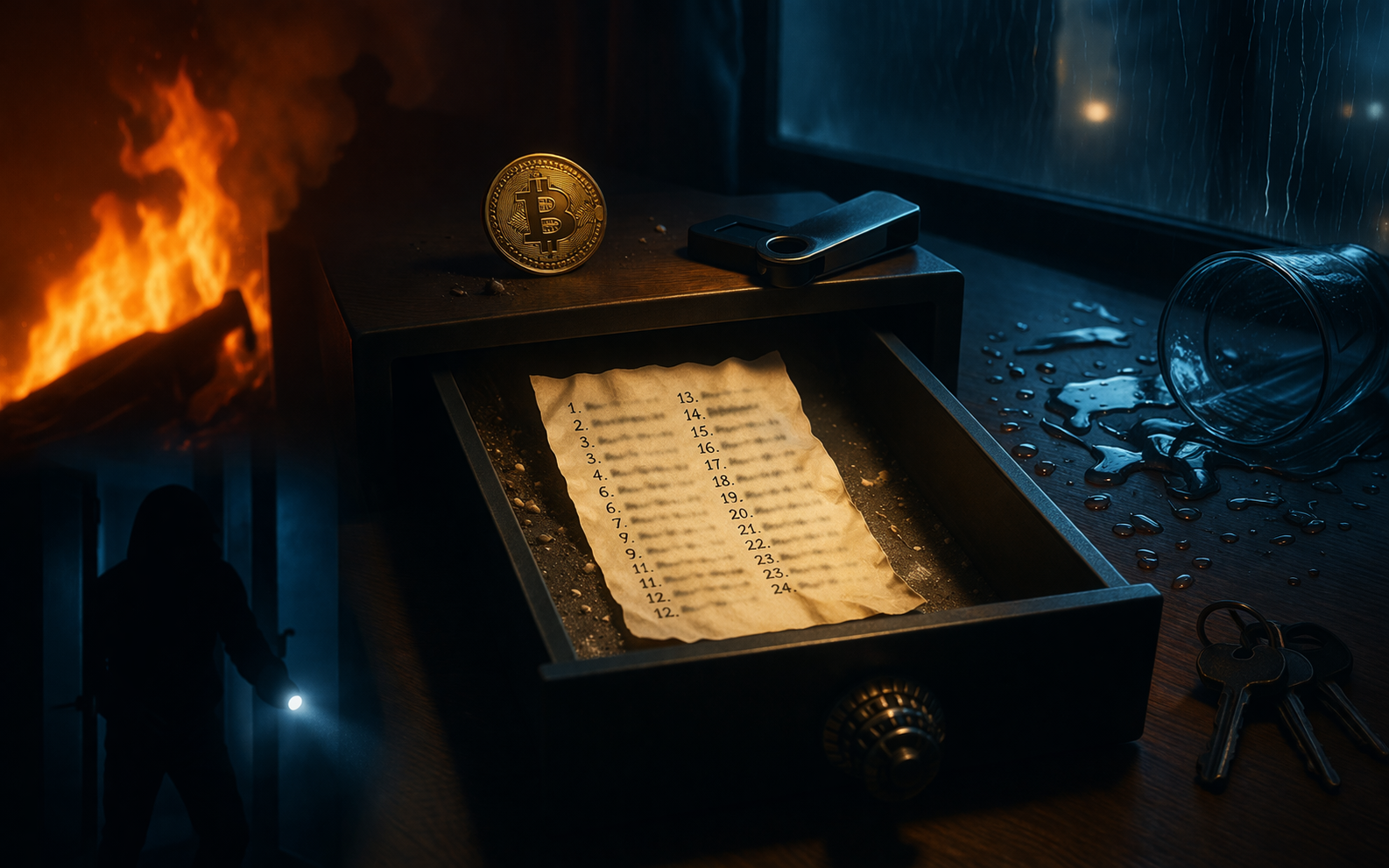
In the world of Web3, we have this obsession with “cold storage.” We’re told that the only way to be truly safe is to write down a 24-word recovery phrase on a piece of paper, put it in a drawer, and never let it touch the internet. We call it “sovereignty.” But lately, I’ve started calling it what it actually is: a trap.
I remember reading about a 70-year-old woman in Los Angeles just last year. During the devastating wildfires that swept through Southern California, she lost her apartment and her life savings. She had her private key written on a piece of paper, tucked away for safety. When the house went up in flames, her entire financial future went with it. No backups, no recovery, just ash.
It’s a heartbreaking story, but it’s not an outlier. We’ve all heard the legend of James Howells, the IT worker in Wales who accidentally tossed a hard drive containing 8,000 BTC into a landfill back in 2013. He’s spent over a decade trying to convince his local council to let him dig through millions of tons of trash. He’s technically a multi-millionaire, but he’s living a nightmare because his “physical security” became a physical prison.
The irony is staggering. We are using 21st-century cryptography — the most sophisticated decentralized tech in human history — and we are protecting it with a $0.05 piece of paper and a ballpoint pen.
As a technical founder, I look at this and see a massive architectural flaw. Paper is an terrible database. Ink fades over time; it smudges if you spill water on it; and paper itself degrades in humidity. Even if you upgrade to those fancy metal plates, you’re still dealing with a single physical object that can be lost in a move, stolen during a break-in, or buried under ten feet of floodwater.
The “standard advice” to stay 100% offline creates a different kind of risk: operational paralysis.
When you’re a power user or a trader, you’re juggling dozens of services daily. If your security model is so rigid that you’re terrified to move your assets or interact with a new dApp because you might expose your “sacred paper,” you aren’t secure — you’re stuck. Disorganized workflows and the friction of managing these physical keys lead to “inattention-based theft” like address poisoning or simple clipboard errors that cost people millions.
We need to move past the “paper or nothing” era. Security in 2026 shouldn’t be about hiding a piece of trash in your sock drawer; it should be about resilient environments.
This is exactly why I started building CryptDocker. I was tired of the anxiety that came with fragmented workflows — switching between a dozen browser tabs, worrying about which extension was tracking me, and wondering if my “cold” assets were actually safe.
I wanted a workspace where I could isolate my sessions and run my web apps in secure, containerized environments without the constant fear of a single slip-up. By creating a unified hub that handles risk analysis and session isolation natively, we can finally stop treating our private keys like fragile artifacts and start treating them like the tools they are.
Physical storage will always have its place for long-term deep-sleep assets. But for those of us actually building and trading in this space, we need a solution that doesn’t burn down with the house. It’s time to build a better vault — one that’s as smart as the assets we’re putting inside it.