The RWA Trilemma and Why Every Protocol Except One Gets It Wrong
 0xCipher9 min read·1 hour ago
--
On April 14, 2025, the MANTRA token collapsed 90% in roughly 20 minutes.
Not 20 days
Not 20 hours
just 20 minutes
MANTRA had regulatory licenses. It had exchange listings. It had high profile partnerships. It was one of the most visible RWA projects in the space and when the structure cracked, there was nothing underneath to catch it. No protocol native recovery mechanism. No accountable validator structure. No automatic floor.
Just a price chart going vertical in the wrong direction.
The collapse didn’t happen because RWA tokenization is a bad idea. It happened because the infrastructure wasn’t built to absorb failure. The project had built on top of existing rails and hoped the rails would hold.
They didn’t.
This is the core problem with how RWA protocols are being built right now. And it has a name.
The RWA Trilemma
Everyone in Web3 knows the blockchain trilemma: you can optimize for decentralization, security, and scalability but traditional wisdom says you can only pick two.
The RWA space has its own version. Call it the RWA trilemma:
Decentralization. Security. Institutional Compliance.
Build a permissionless protocol on Ethereum and you get decentralization. But compliance becomes an application-layer problem bolted on, not built in. The moment a regulator or institution asks “who is accountable if this fails,” the answer is: no one in particular.
Build a permissioned chain with institutional guardrails and you get compliance. But you sacrifice the permissionless access that makes blockchain worth using in the first place. You’ve rebuilt TradFi with extra steps.
Build for pure security and you end up with a walled garden. Fast, audited, and completely inaccessible to the businesses and investors who need it most.
Every major RWA protocol right now is quietly making this tradeoff. Most of them are making it the same way. And most of them don’t talk about it.
The Borrowed Rails Problem
Here’s what nobody in the RWA conversation is saying out loud:
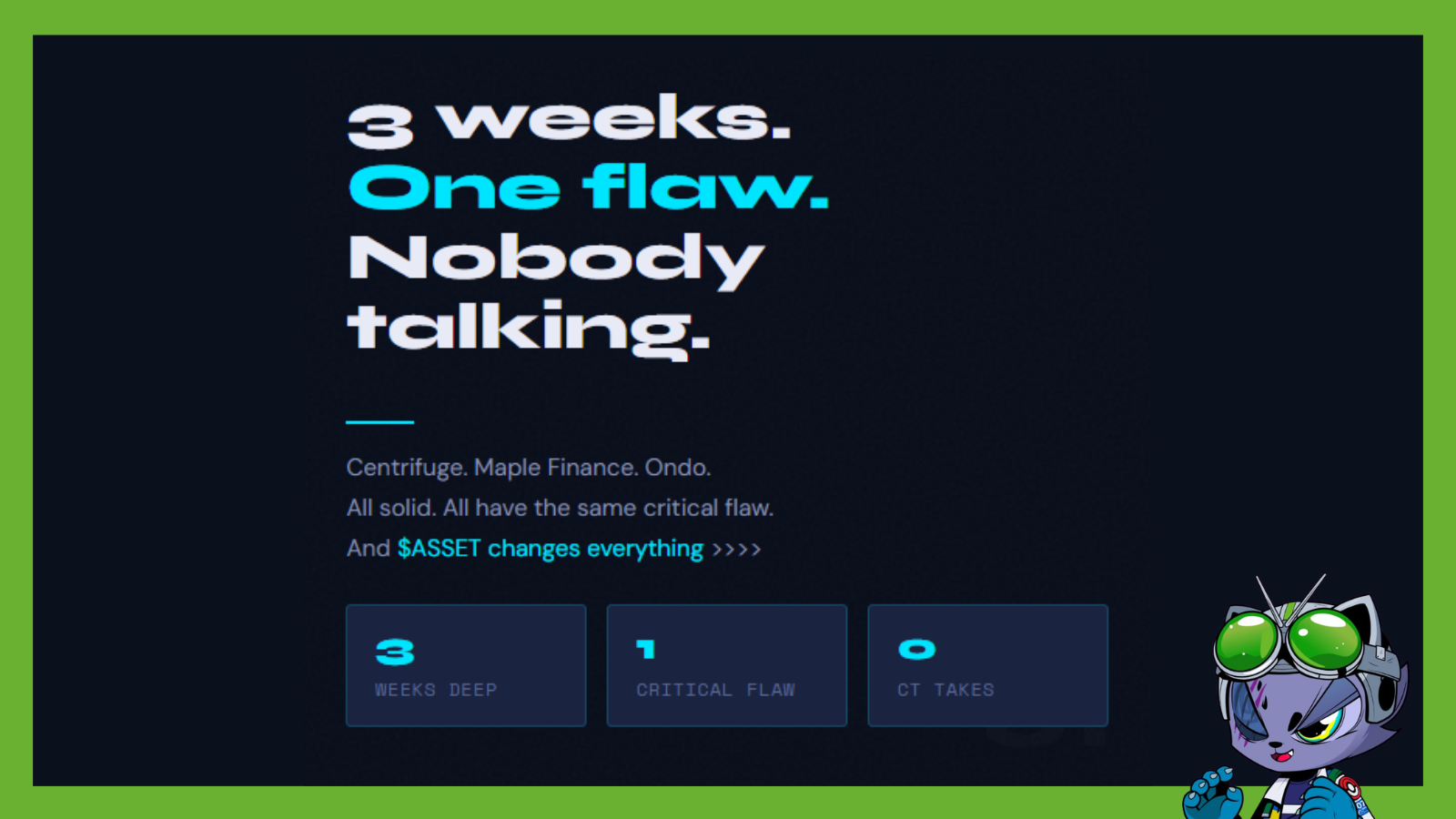
Centrifuge runs on Ethereum. Maple Finance runs on Ethereum and Solana. Ondo Finance runs on Ethereum. These are legitimate, well-built protocols doing real work in the space. Centrifuge has crossed $1 billion in TVL. Maple has grown to $700 million. Ondo leads in tokenized US Treasuries.
But all of them are tenants.
They don’t own their infrastructure. They rent space on someone else’s chain. And when the landlord has problems congestion, governance drama, gas spikes, protocol level decisions the tenant feels it. They inherit the constraints of a general purpose network that was never designed for real-world asset tokenization.
More critically: they handle risk management and compliance off chain. The entities that assess credit risk, underwrite assets, and make promises to investors operate outside the protocol. Their accountability is reputational and legal not economic and automatic.
When an insurer or originator misbehaves on these platforms, the recourse is a lawsuit. A legal process. A recovery timeline measured in months or years.
That’s not DeFi. That’s TradFi with a blockchain aesthetic.
What “Built From Scratch” Actually Means
Real Finance took a different position entirely.
Not a protocol on Ethereum. Not a layer 2. Not a fork. A sovereign Layer 1 blockchain built from genesis for one explicit purpose: tokenizing real-world assets the right way.
The distinction matters more than it sounds. When you build your own chain, you control what the chain enforces. You decide what behavior is economically rewarded and what behavior is automatically punished. You don’t inherit someone else’s design decisions. You make your own.
Real Finance’s design decision was this: every participant in the asset lifecycle tokenizers, risk scorers, insurers must have skin in the game at the protocol level. Not in a terms-of-service document. In the consensus mechanism itself.
This is the architecture that actually solves the RWA trilemma.
How the Protocol Actually Works
Real Finance runs on Cosmos Tendermint-based Proof-of-Stake consensus with adaptive staking rewards inspired by Polkadot. It’s EVM compatible, meaning existing Ethereum developers can build on it without learning new tooling. But the real innovation isn’t the tech stack. It’s the three stage asset pipeline.
Stage 1: Tokenization
An originator a business with a real cash-flow generating asset deploys a smart contract that represents that asset as a token. The token carries embedded metadata: classification, provenance, cash flow schedule, legal details. All on-chain. All readable by anyone.
Tokenization companies process these assets and stake $ASSET tokens proportional to their volume. If they misrepresent the metadata if they lie about the asset their stake gets slashed. Automatically. No lawsuit required.
Stage 2: Risk Scoring
Specialist risk scoring firms assess each asset’s probability of default and embed that score directly into the token. Not in a separate report. Not behind a paywall. Inside the token itself.
Scorers stake $ASSET tokens and face penalties if real-world defaults deviate materially from their predictions. This turns credit assessment from an opinion into an economically incentivized act of accuracy. Get it wrong consistently and you lose your stake.
Stage 3: Insurance
Insurance providers underwrite the cash flows of tokenized assets, staking both $ASSET tokens and stablecoins as collateral. They can offer full or partial coverage, which creates distinct tranches of the same underlying asset giving investors tiered exposure across risk levels.
The output of all three stages is something that doesn’t exist anywhere else in crypto: a letter grade, A through F, embedded on chain inside the token, readable by any investor, anywhere, for free.
- Grade A: 100% of principal and cash flows insured
- Grade B: ≥75% of cash flows insured
- Grade C: <75% of cash flows insured
- Grade D: No insurance, low probability of default
- Grade E: No insurance, high probability of default
- Grade F: No insurance, no risk score assigned
In traditional finance, credit ratings are locked behind Bloomberg terminals and relationship access. Real Finance just put them on-chain. Permanently. For everyone.
The Answer to Terra
The DeFi space learned a brutal lesson in May 2022. When UST depegged and LUNA collapsed 99% in 72 hours, the absence of a protocol-native recovery mechanism became the most expensive design oversight in crypto history.
Real Finance’s documentation explicitly cites the need to avoid “systemic risks similar to Terra’s collapse.” This isn’t marketing language. It’s an architectural commitment.
Here’s how it works:
If an insurance provider defaults on its obligations, affected token holders automatically receive Network Debt Tokens (NDTs) representing their realized losses at a 1:1 ratio. NDTs are redeemable monthly against the Disaster Recovery Fund (DRF) at a 1:1 ratio with $ASSET tokens.
The DRF is self-sustaining funded by redirecting inflation rewards away from misbehaving validators. No net new token issuance is required. No death spiral is possible. NDTs expire after two years to prevent open ended liability.
Compare this to how Centrifuge and Maple handle downside scenarios: legal structures and off chain collateral pools. Legitimate protections but ones that depend on traditional legal enforcement. Courts. Jurisdictions. Lawyers. Time.
Real Finance’s recovery is automatic, on-chain, and governed by the protocol. The moment a failure occurs, the mechanism activates. No human intervention required.
The Team That Actually Gets It
A lot of RWA projects are built by crypto natives who are learning finance as they go. Real Finance went the other direction.
Ivo Grigorov (Co-founder & CEO) holds an MSc in Global Banking and Finance and brings extensive banking experience to product design. He understands financial infrastructure from the inside, not from a whitepaper.
Valentin Dimitrov (Co-founder & COO) spent time as a staff member of the European Parliament’s ECON committee the committee that oversees European financial regulation. He then managed a fund with €600 million AUM. This is not a background you fake. He understands how institutions think about risk, compliance, and capital allocation.
Hristo Piyankov (Lead Economist) founded FinDaS and led over 200 tokenomics projects that raised more than $1 billion USD. He designed the $ASSET token model to be sustainable by design, not by hope.
These are finance people who chose blockchain as the solution. Not the other way around. That distinction shows in every architectural decision the protocol has made.
The Story Nobody Is Covering
Everyone frames Real Finance as an institutional play. BlackRock is tokenizing. JPMorgan is tokenizing. Franklin Templeton is tokenizing.
But read the actual documentation.
Real Finance was built for SMEs small and medium enterprises. The businesses that generate real cash flows from invoices, receivables, and loan portfolios. The businesses that currently have zero access to global capital markets because they don’t have Goldman Sachs on speed dial.
A logistics company in Nairobi with verified invoice receivables can tokenize those assets on Real Finance and reach a capital allocator in Singapore. Permissionlessly. Without a banking relationship. Without a credit rating agency account. Without an investment bank taking a 5% cut.
The institutional partnerships Wiener Privatbank, Experian, the Oman Investment Authority are the credibility layer that makes the protocol trustworthy for everyone. The SME access is the actual revolution.
The global debt market is $253 trillion. Most of it is inaccessible to most of the world. That’s not a feature of how finance works. It’s a bug. And Real Finance is writing the patch.
The Traction Is Real
This is not a whitepaper project.
Real Finance has raised $29 million led by Nimbus Capital ($25 million), with participation from Magnus Capital and Frekaz Group. It has $500 million in assets already committed for onboarding at mainnet launch. Not promised. Committed.
Wiener Privatbank SE FMA-regulated, listed on the Vienna Stock Exchange under ticker WPB, over a century of banking history is operating as a business consensus validator on the network. This means a 100 year old Austrian private bank is literally running a node.
Experian the global credit scoring and identity verification company is a native KYC/AML partner, embedding compliance directly into the protocol layer.
The Oman Investment Authority, a sovereign wealth fund, is participating as a business validator. A government’s investment arm is operating infrastructure on a permissionless blockchain.
The April 2026 mainnet is live. The $ASSET TGE is approaching.
What the Tokenomics Signal
Token distribution is one of the most honest signals a project sends. Real Finance’s $ASSET tokenomics say something clear.
Total supply is 1,000,000,000 $ASSET. The public/IDO allocation is 1%. The treasury holds 53.5% locked for 36 months. The team holds 15% also locked for 36 months. Every major allocation carries a cliff and a multi year vesting schedule.
When insiders are locked for three years, that’s not a promise. That’s skin in the game. The same principle that governs every business validator on the network governs the team itself.
First-year inflation is ~5% (~52.5 million tokens), decreasing annually. That inflation is split 50/50 between normal validators and business enablers creating aligned incentives at every layer of the network.
The token is called $ASSET. The tokenomics are structured like one.
The Infrastructure Bet
Real Finance is making a specific architectural bet: that the future of RWA tokenization requires a dedicated Layer 1 one where the rules of tokenization, risk scoring, and investor protection are part of the network itself, not bolted on after the fact.
That bet is either right or wrong. But it’s the only bet that actually solves the trilemma.
Every other major RWA protocol has chosen to build on borrowed rails and handle accountability off-chain. Real Finance has chosen to build the rails and embed accountability in the consensus mechanism.
The MANTRA collapse showed what happens when infrastructure isn’t designed to absorb failure. The Terra collapse showed what happens when recovery mechanisms don’t exist at the protocol level. Real Finance looked at both of those events and made different design choices.
The $ASSET TGE is the earliest access point to infrastructure that may underpin trillions in tokenized assets over the next decade. This is not speculation about price. This is an observation about timing.
The rails are being built right now. The question is which ones the world will run on.
This article is for informational purposes only and does not constitute financial advice. All research sourced from public documentation at realfinance.gitbook.io/docs, real.finance, and publicly available press materials. DYOR 🌱
Follow @RealFinOfficial for official updates.
Contest entry submitted under #UCCC.