Finance is entering a shift that feels subtle on the surface but fundamental underneath.
For decades, digital finance has been “interactive”: users log in, check balances, approve payments, place trades, and manually move money between accounts.
But a new model is emerging agentic finance, where AI doesn’t just assist financial decisions, but actively executes them within predefined rules set by users or institutions.
This is not just automation. It is the transition from software that responds to software that acts.
What is Agentic Finance?
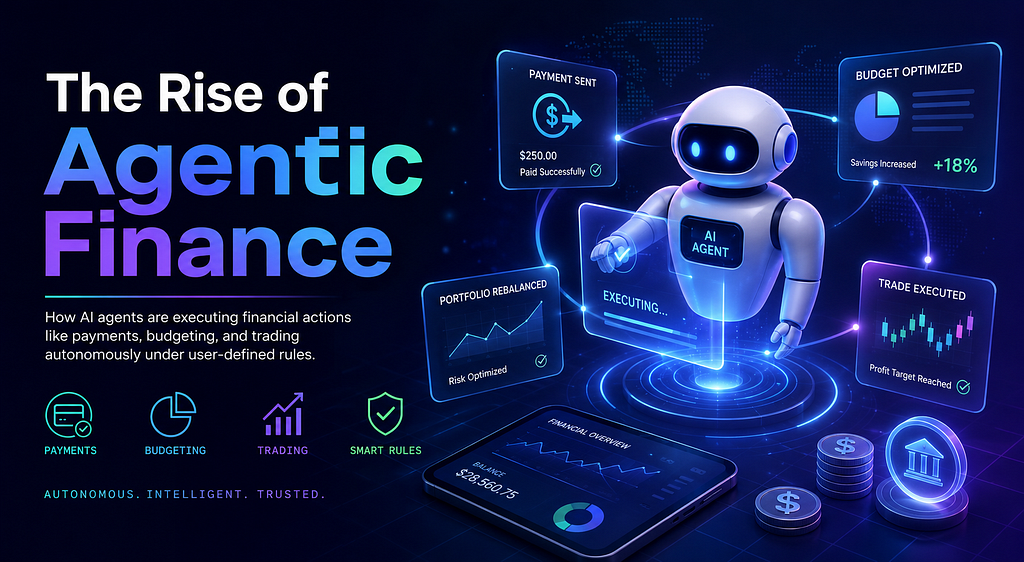
Agentic finance refers to financial systems powered by AI agents that can independently perform financial tasks such as:
- Making payments
- Managing budgets
- Optimizing savings and cash flow
- Executing trades or investment strategies
- Handling invoices and business expenses
- Moving funds across accounts or wallets based on conditions
The key difference is autonomy. Traditional fintech tools wait for user input. Agentic systems operate continuously within guardrails.
For example:
- “Move 20% of monthly income into stablecoins every payday”
- “Pay all SaaS invoices under $500 automatically”
- “Rebalance my portfolio if crypto exposure exceeds 15%”
- “Find and execute the best FX conversion rate under a defined threshold”
The user doesn’t perform the action. The agent does.
From Automation to Autonomy
Finance has already seen waves of automation:
- Standing bank transfers
- Robo-advisors in investing
- Automated payroll systems
- Scheduled bill payments
However, these systems are rule-based and static. They cannot interpret context, adapt dynamically, or make decisions beyond predefined logic.
Agentic finance introduces something new: context-aware decision-making.
Instead of rigid “if-this-then-that” logic, AI agents can:
- Analyze real-time market data
- Interpret user intent
- Adjust behavior based on changing conditions
- Coordinate across multiple financial systems
This moves finance closer to a delegation model rather than a tool-based model.
How AI Agents Actually Work in Finance
An agentic financial system typically combines three layers:
1. Intelligence Layer (LLMs + Financial Models)
This layer interprets instructions like:
- “Keep my risk low”
- “Optimize for monthly liquidity”
- “Avoid unnecessary fees”
It converts human intent into structured financial rules.
2. Decision Engine (Rules + Risk Controls)
Here, the system evaluates:
- Budget constraints
- Compliance rules
- Risk thresholds
- User-defined guardrails
This ensures the AI does not act outside acceptable boundaries.
3. Execution Layer (Payments + Banking APIs)
This is where actions happen:
- Bank transfers via APIs
- Crypto transactions via wallets or stablecoin rails
- Trading execution via broker integrations
- Invoice settlements via payment gateways
This layer connects AI reasoning to real financial infrastructure.
Real Use Cases Emerging Today
Agentic finance is not theoretical anymore. Early versions already exist across fintech ecosystems.
1. Autonomous Personal Finance Management
AI agents can:
- Track spending across accounts
- Suggest or execute savings allocations
- Reduce unnecessary subscriptions automatically
Instead of “budgeting apps,” users get “budgeting systems that act.”
2. Business Cash Flow Automation
For SMEs and startups:
- Pay vendors automatically based on invoice verification
- Move surplus cash into yield accounts
- Trigger payments only when revenue thresholds are met
This reduces manual finance operations significantly.
3. Algorithmic Investing 2.0
Unlike traditional robo-advisors, agentic systems can:
- Adjust strategies based on macroeconomic signals
- React to volatility events in real time
- Diversify dynamically across asset classes
The key shift is reactive → proactive execution.
4. Cross-Border and Stablecoin Payments
AI agents can optimize:
- FX rates
- Transfer routes
- Settlement speed
In stablecoin-based systems, agents can even route payments across multiple liquidity paths automatically.
Why Now? The Timing Behind Agentic Finance
Three major forces are converging:
1. Mature AI Models
Large language models can now understand intent, not just commands. This enables financial reasoning at a usable level.
2. API-Driven Financial Infrastructure
Modern fintech systems expose:
- Banking APIs
- Payment rails
- Crypto wallets
- Compliance APIs
Without this infrastructure, agents would have no “hands” to act with.
3. Rise of Stablecoins and Digital Money Rails
Stablecoins reduce friction in:
- Cross-border settlement
- 24/7 transactions
- Programmable payments
They are becoming the execution layer for autonomous finance.
The Risk Question: Should Money Be Autonomous?
The biggest concern is obvious: control.
If AI is handling money, what happens when:
- It misinterprets intent?
- Markets behave unpredictably?
- Fraud attempts manipulate decision logic?
This is why agentic finance must be built with strict guardrails:
- Spending caps
- Approval thresholds
- Human override systems
- Audit logs for every transaction
- Explainability of decisions
The future is not “fully autonomous finance,” but bounded autonomy.
Humans define the boundaries. Agents operate inside them.
What This Means for the Financial Industry
Agentic finance will reshape fintech infrastructure in several ways:
1. Banks Become Execution Rails
Banks will increasingly act as infrastructure providers, not user interfaces.
2. Fintech Apps Become Agent Platforms
Instead of dashboards, fintech products will become “agent control centers.”
3. APIs Become the Core Product
The value shifts from UI/UX to:
- reliability of execution
- compliance frameworks
- real-time decision infrastructure
4. Compliance Becomes Real-Time
Instead of post-transaction checks, compliance will need to operate continuously alongside AI decisions.
The Bigger Shift: From Users to Delegators
The psychological change is just as important as the technical one.
Today:
- “I send money”
- “I invest manually”
- “I approve payments”
Tomorrow:
- “My system handles money under my rules”
This is a shift from doing finance to designing financial behavior.
Final Thoughts
Agentic finance represents a turning point where financial systems begin to behave less like tools and more like intelligent participants.
It sits at the intersection of:
- AI reasoning
- financial infrastructure
- programmable money
- real-time decision systems
The result is not just faster finance it is delegated finance, where humans define intent and machines execute outcomes.
The Rise of Agentic Finance: When AI Starts Acting on Your Money was originally published in Coinmonks on Medium, where people are continuing the conversation by highlighting and responding to this story.