THE RIGHT BUYER
 VICTOR RAPHAEL3 min read·Just now
--
Price Is What You Negotiate. Buyer Is What You Choose. Only One of Those Determines What You Actually Walk Away With.
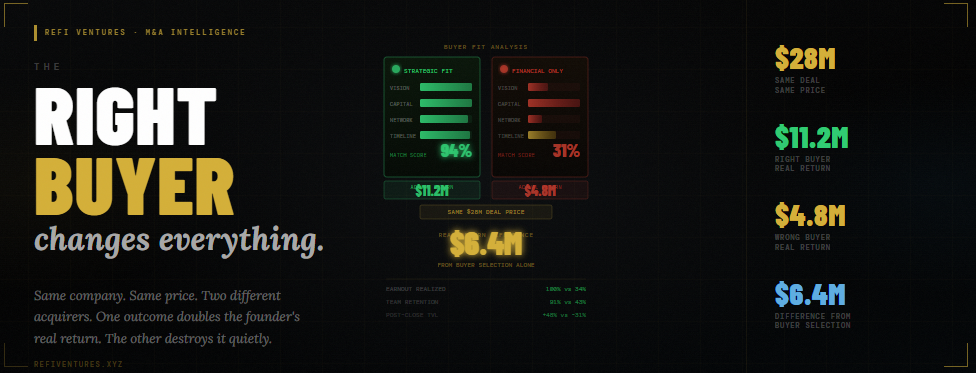
Two founders. Same protocol type. Same $28 million deal.
One walked away with $11.2 million. The other walked away with $4.8 million.
The difference had nothing to do with the headline number. It had everything to do with who was on the other side of the table.
Most founders treat an acquisition as a price negotiation. Get the number up. Protect the earnout. Watch the waterfall. All of that matters. But underneath every number in an acquisition agreement is an assumption that rarely gets examined: the assumption that the acquirer will do what they said they would do after the deal closes.
That assumption is not always wrong. But it is never guaranteed. And the buyer you choose determines whether it is likely.
The first founder sold to a strategic acquirer with genuine infrastructure needs. The buyer had existing distribution in markets the protocol had not reached. Their team included engineers who understood on-chain architecture. Their incentives aligned with the protocol’s continued growth because the protocol was foundational to a product line they were expanding. When the earnout milestones came due, the acquirer had actively worked to hit them because the earnout metrics were their metrics too. Ninety-one percent of the original team was still in place eighteen months later. TVL was up 48 percent.
The second founder sold to a financial buyer who priced the deal correctly but had no operational thesis for what they had acquired. They paid $28 million because the model said $28 million. They had no view on how to grow it. They installed a financial operator who understood returns but not protocols. Key engineers left within six months. The earnout structure required revenue milestones that the new management had no roadmap to deliver. TVL dropped 31 percent as the community sensed the transition had no direction. The founder collected 34 percent of their contractually entitled earnout before the milestones expired.
Same $28 million. Different buyers. $6.4 million difference in what the founder actually received.
The right buyer is not the highest bidder. The right buyer is the one whose operational interests align with the performance targets embedded in your deal structure. In Web3 and AI acquisitions specifically, that alignment is rare and valuable and worth far more than an extra million dollars on the headline price.
Before you evaluate any acquisition offer, evaluate the acquirer. What have they done with comparable assets after acquiring them? Do they have operators who understand the specific technology stack you have built? Are the earnout milestones in their term sheet things they have a genuine incentive to help you hit, or are those milestones purely your problem to solve after close? Does their existing portfolio create distribution advantages for your protocol, or does it create conflicts that will quietly starve your product of resources?
PE firms vary enormously on this dimension. A sector-focused PE firm with a portfolio of complementary Web3 infrastructure companies and a dedicated technical team is a categorically different acquirer than a generalist fund that bought your protocol because it fit a return profile. Both will write the same check. Only one will be genuinely invested in what happens after.
For founders, the buyer selection process should begin before the first term sheet arrives. Know which acquirers in your space have a track record of growing what they buy. Know which ones extract and rationalize. The acquisition market in Web3 and AI is still small enough that this information is accessible. The deals that have already closed tell you everything about how an acquirer behaves after close.
For buyers, this is the other side of the same truth. The protocols that perform best post-acquisition are the ones where the acquirer had a genuine operational thesis before they made the offer. Financial engineering on a Web3 protocol without operational conviction produces the same result every time.
The headline number gets announced.
What happens after close determines what both sides actually got.
Find the right buyer or the right deal at refiventures.xyz