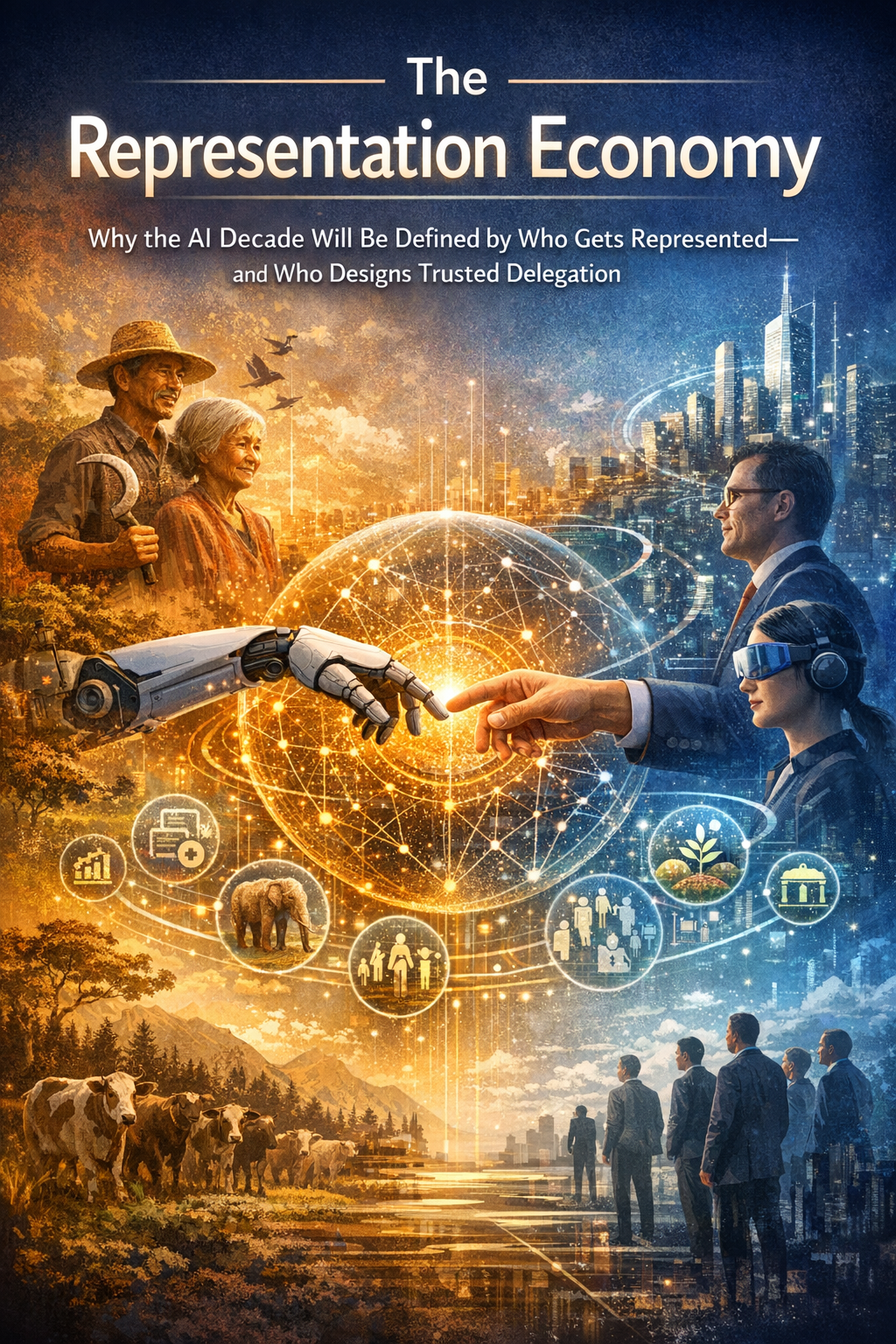
The Representation Economy: Why the AI Decade Will Be Defined by Who Gets Represented — and Who Designs Trusted Delegation
What Is the Representation Economy in AI?
The Representation Economy is the emerging economic layer where artificial intelligence systems model, interpret, and increasingly act on behalf of individuals, communities, assets, and ecosystems that cannot digitally self-advocate — transforming silent signals into accountable, decision-grade intelligence.
For most of economic history, intelligence was scarce.
Judgment was concentrated.
Analysis required teams.
Forecasting was slow.
Coordination required hierarchy.
That constraint is collapsing.
AI is driving the marginal cost of cognition toward zero. Research is instant. Pattern recognition is automated. Simulation is continuous.
When a foundational input becomes abundant, markets do not merely become more efficient — they reorganize.
But here is the shift most leaders are missing:
As intelligence becomes infrastructure, representation becomes the new scarcity.
The defining question of the AI decade will not be:
Who can think?
It will be:
Who gets represented — and by whom?
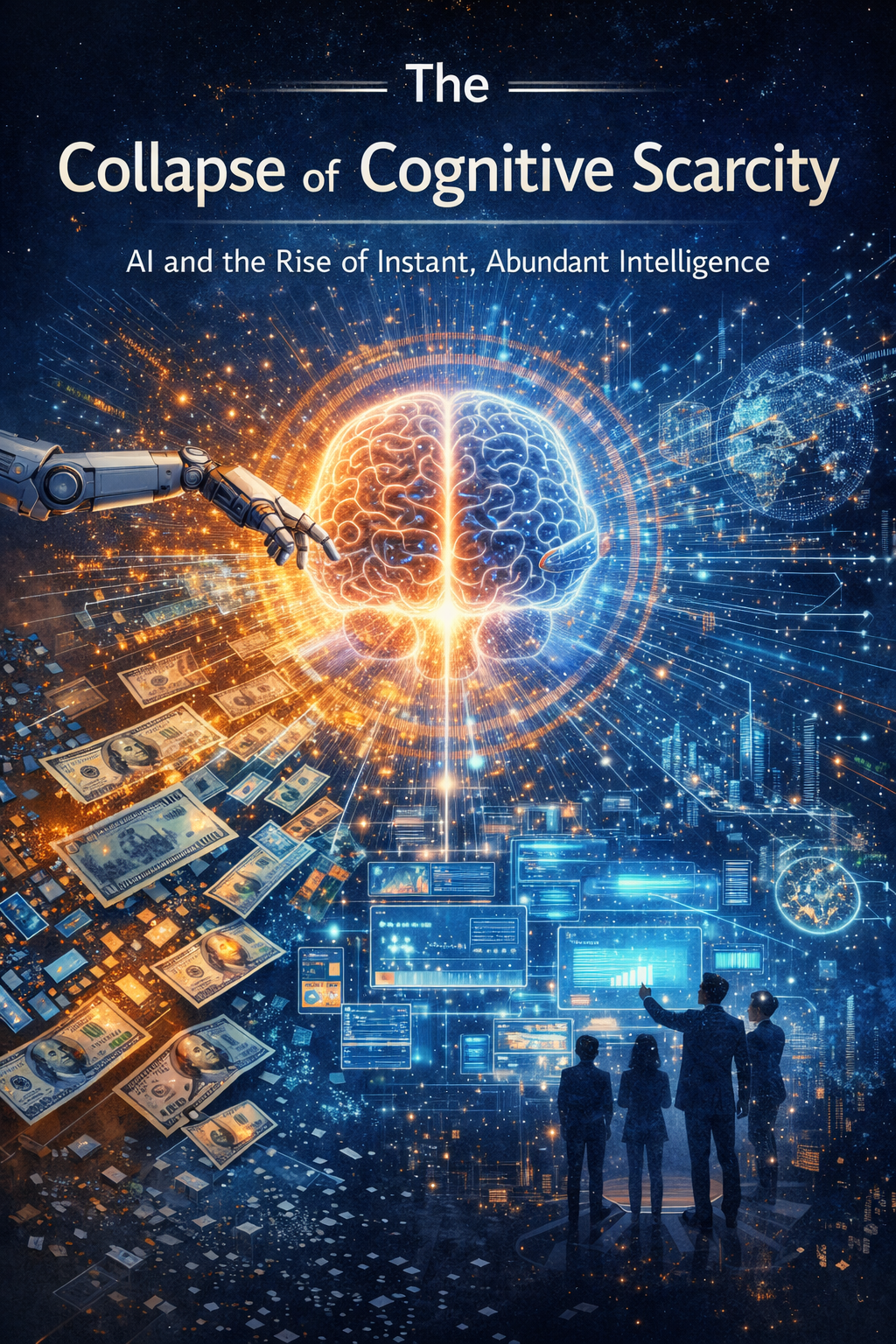
The Collapse of Cognitive Scarcity
The first wave of AI adoption has been framed as productivity:
Automate tasks.
Reduce cost.
Accelerate throughput.
That is real — but it is not structural.
The deeper shift is this:
• Knowledge work becomes programmable
• Pattern recognition becomes commoditized
• Simulation becomes cheap enough to run continuously
• Language ceases to be a barrier
• “Best practice” becomes widely replicable
When intelligence becomes abundant, competitive advantage shifts toward what cannot be easily replicated:
• legitimate representation
• trusted delegation
• accountable execution
• real-time governance
That is where the Representation Economy begins.
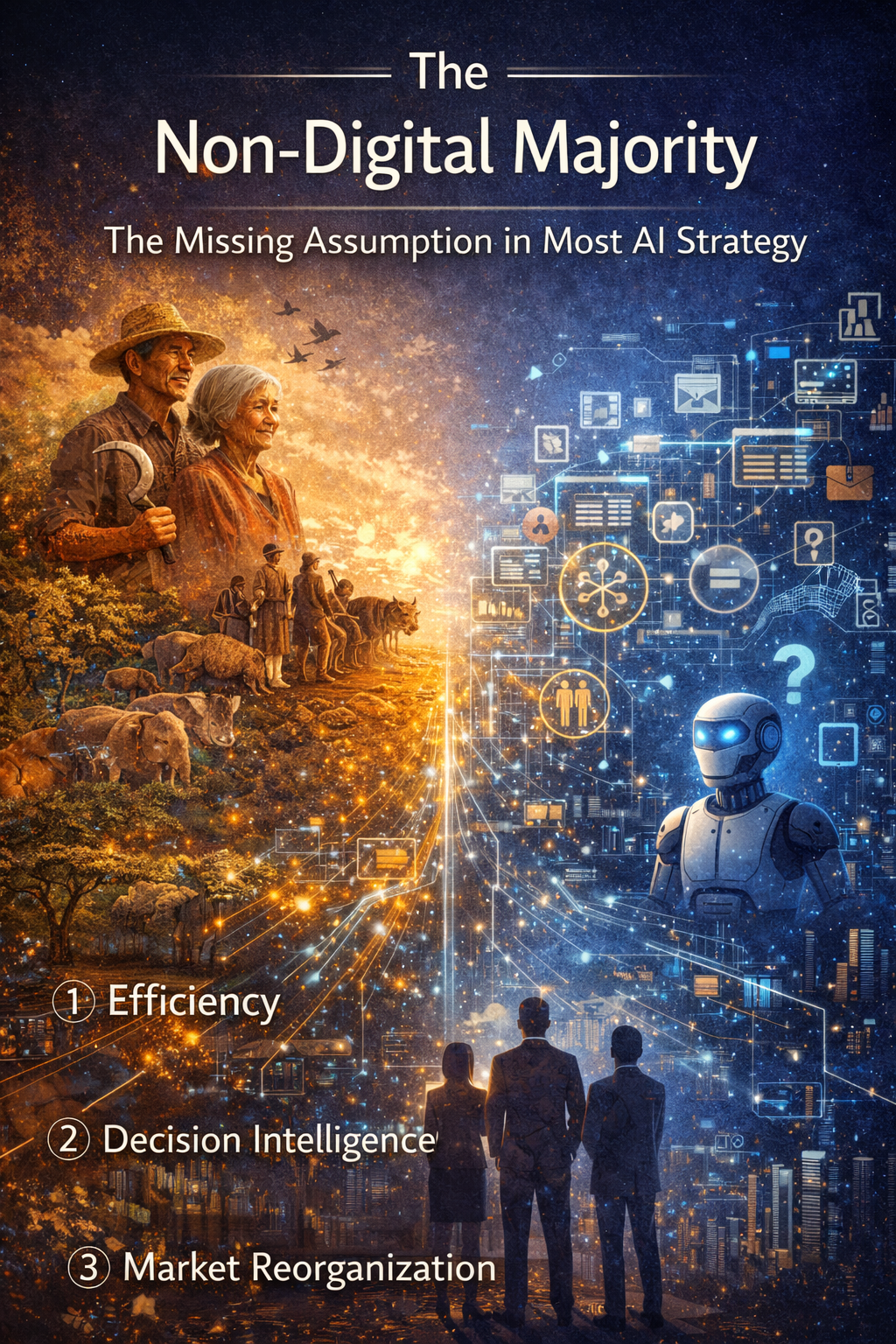
The Non-Digital Majority
Most AI strategies assume digitally fluent actors:
Users who can articulate needs.
Organizations with instrumented processes.
Customers who can specify preferences.
Systems generating structured data.
But vast portions of the world — and nearly all biological and ecological systems — cannot digitally self-advocate.
They often do not know what is possible.
They cannot articulate optimization goals.
They cannot translate context into data queries.
They don’t know what they don’t know.
In the Representation Economy, value is not created primarily by responding to explicit demand.
It is created by making silent systems legible.
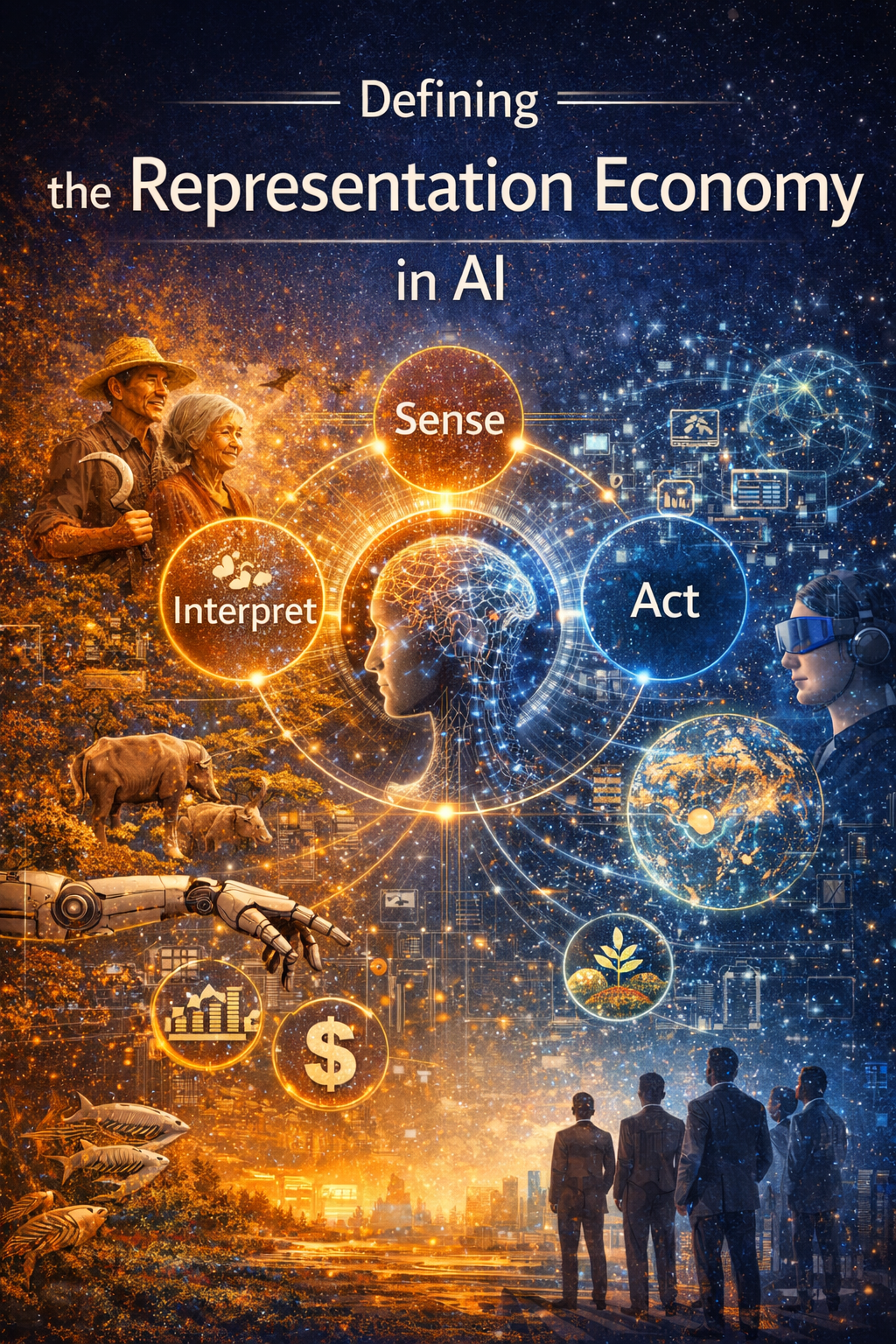
Representation Precedes Delegation
Delegation assumes an actor can authorize action.
Representation is required when an actor cannot express intent digitally.
If representation is inaccurate → delegation becomes dangerous.
If representation is extractive → delegation becomes exploitative.
If representation is legitimate → delegation becomes enabling.
This is why governance architecture becomes strategic infrastructure.
As AI shifts from recommendation to execution, execution introduces:
• authority
• liability
• irreversibility
• accountability
In a world of abundant intelligence, trust becomes scarce.
Trust becomes the currency of delegation.
Judgment becomes the boundary-setting function.
Governance becomes a competitive capability.
The Governance Architecture: C.O.R.E.
To make representation legitimate, institutions require operational architecture:
C — Capture Context
Permissioned meaning: constraints, preferences, intent, risk boundaries.
O — Orchestrate Decisions
When to act, when to ask, when to delay, when to escalate.
R — Regulate Action
Executable policy: guardrails, reversibility, liability clarity.
E — Evolve with Evidence
Auditability, post-action review, continuous calibration.
C.O.R.E. converts AI from a reasoning tool into an accountable system of representation and action.
Third-Order Implications: New Business Categories
As representation becomes strategic, new categories emerge:
- Context vaults
• Representation agents - • Delegation contracts
• Proof and trust layers
• Delegation insurance
These businesses do not compete on model quality alone.
They compete on trusted representation + safe execution.

Fourth-Order Implications: Institutional Redesign
When representation integrates with identity, liability, and sovereign infrastructure, AI becomes economic architecture.
Nations and institutions that design credible delegation frameworks will compound advantage — not because of superior models, but because of legitimacy and trust.
The Board Mandate
Most boards are asking:
“How do we deploy AI inside our enterprise?”
The better questions are:
• Which parts of our ecosystem cannot digitally represent themselves?
• What latent value remains dormant because cognition used to be expensive?
• Who will represent these actors — us, a platform, or a competitor?
• What is our delegation infrastructure strategy?
• Is our governance real-time or retrospective?
Intelligence is commoditizing.
Representation is differentiating.
In a world of cheap cognition, trust becomes the pricing power.
The Representation Economy is not a trend.
It is the next layer of global economic organization.
And the leaders who design legitimate representation — and trusted delegation — will define the architecture of value creation in the AI decade.
The Intelligence-Native Enterprise Doctrine
This article is part of a larger strategic body of work that defines how AI is transforming the structure of markets, institutions, and competitive advantage. To explore the full doctrine, read the following foundational essays:
1. The AI Decade Will Reward Synchronization, Not Adoption
Why enterprise AI strategy must shift from tools to operating models.
https://www.raktimsingh.com/the-ai-decade-will-reward-synchronization-not-adoption-why-enterprise-ai-strategy-must-shift-from-tools-to-operating-models/
2. The Third-Order AI Economy
The category map boards must use to see the next Uber moment.
https://www.raktimsingh.com/third-order-ai-economy/
3. The Intelligence Company
A new theory of the firm in the AI era — where decision quality becomes the scalable asset.
https://www.raktimsingh.com/intelligence-company-new-theory-firm-ai/
4. The Judgment Economy
How AI is redefining industry structure — not just productivity.
https://www.raktimsingh.com/judgment-economy-ai-industry-structure/
5. Digital Transformation 3.0
The rise of the intelligence-native enterprise.
https://www.raktimsingh.com/digital-transformation-3-0-the-rise-of-the-intelligence-native-enterprise/
6. Industry Structure in the AI Era
Why judgment economies will redefine competitive advantage.
https://www.raktimsingh.com/industry-structure-in-the-ai-era-why-judgment-economies-will-redefine-competitive-advantage/
Originally published at https://www.raktimsingh.com on February 27, 2026.
The Representation Economy: Why the AI Decade Will Be Defined by Who Gets Represented — and Who… was originally published in DataDrivenInvestor on Medium, where people are continuing the conversation by highlighting and responding to this story.