The Recovery Cycle: What We’ve Proven About Trading After Losses, and the One Claim We Won’t Make Yet
--
A data-driven look at how high win-rate systems behave after a loss, why the instinct to flinch can be costly, and where the evidence actually stops.
Most traders spend their careers trying to avoid losses. We did too. What years of strategy development taught us is that in a high win-rate system, the more useful question is not how to avoid losses but how to understand them. This article lays out what our data supports, what it doesn’t yet, and the one finding that changed how we evaluate a strategy more than win rate ever did.
We’re going to be precise about the line between what’s confirmed and what’s still being tested, because that line is the whole point.
What most traders do after a loss
The instinct is universal. A loss hits, and the reaction is immediate: cut size, pause, wait for confirmation. It feels like prudence.
In a high win-rate system, reflexively abandoning a validated strategy after a single loss can be the wrong move, because in that kind of system a loss is a statistically expected event, not a signal that something has broken. The system is supposed to lose sometimes. Stepping away every time it does means stepping away from the trades that follow, which in a high-win-rate system are usually winners simply because most trades are winners.
That is a real point about discipline. It is not the same as the much stronger claim that a loss is itself a buy signal. We’ll come back to that distinction, because it matters more than anything else here.
What the Recovery Cycle actually is
The Recovery Cycle is not a signal or an indicator. It is the structural rhythm of how a high win-rate system breathes: long runs of wins, interrupted by occasional losses, followed by more wins. Loss, snap-back, more wins, over and over.
Here is the part most write-ups skip. In a system that wins 90% of the time, long winning streaks are the mathematical default after almost any trade, not just after a loss. The expected length of a win run following any given trade in a 90%-win system is roughly nine. So the fact that you see long streaks after losses is exactly what you’d expect even if the loss told you nothing at all about what comes next.
That leaves an honest, open question, and it is the question our current research is built around:
Does a loss actually raise the probability of the trades that follow it, above the system’s normal baseline? Or do streaks after losses just look special because streaks are everywhere in a high win-rate system?
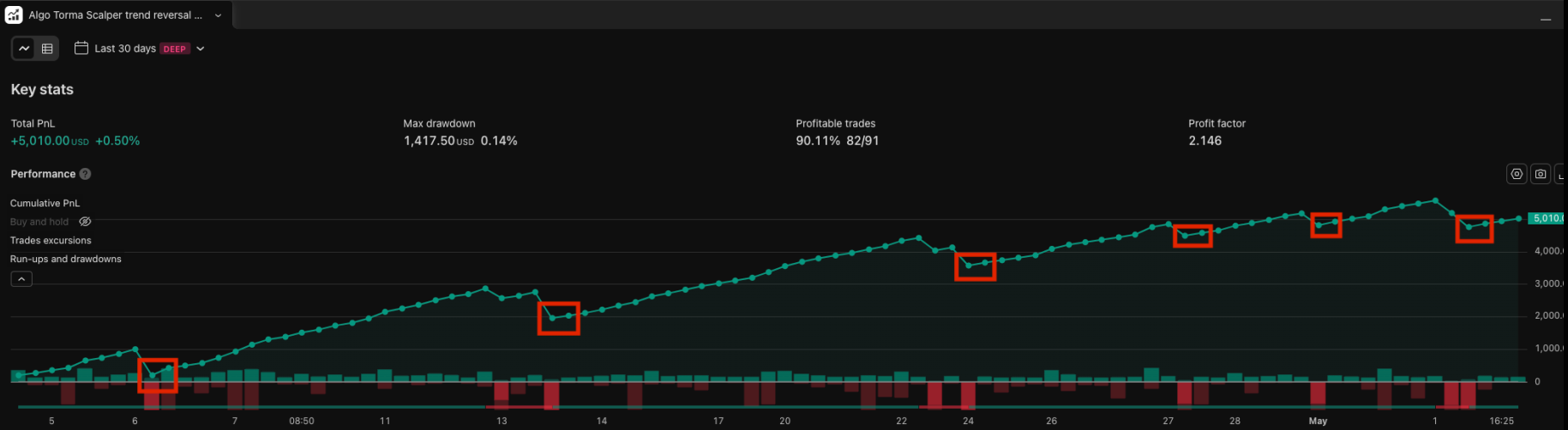
Our deep backtests and live evaluation accounts confirm the first half of the picture: the recovery structure is real and it reproduces in live conditions. In one live week, a clean seven-trade winning run followed a major stop. What the data does not yet establish is the second half, that the loss predicts the run. We are testing that claim formally rather than asserting it (more on this below).
An analogy, not evidence
It’s tempting to point at how institutional capital operates and say the pros do this already. Event-driven and distressed funds buy sharp sell-offs in fundamentally sound assets, the idea being that the asset hasn’t broken, the price has. Convertible arbitrage desks position into volatility during recovery windows rather than waiting for calm.
The Recovery Cycle rhymes with that logic: the strategy hasn’t broken, a single trade has. But this is an analogy for intuition, not proof. Those desks are pricing fundamentals and dislocations on individual assets; we’re talking about the order of wins and losses in an automated trade sequence. Useful as a mental model, not as validation. The validation has to come from the trade data itself.
The finding that actually changed how we evaluate a strategy
This is the part we’d put above win rate, and it’s the most directly useful thing we’ve learned.
Net profitability in live trading is governed by whether per-trade edge clears per-trade cost, not by win rate. We ran the same family of logic on MNQ in two configurations:
- A high-frequency configuration: 105 trades, about two minutes average hold, 80% win rate, and it still lost money net after commissions. Gross was +$84, fees were $218.40, net was -$134.40. The per-trade edge was below the round-trip cost, so the win rate didn’t save it.
- A lower-frequency configuration: 35 trades, about ten minutes average hold, 91% win rate, net +$178.36 after fees, with per-trade expectancy of $7.06.
Same instrument. Same kind of strategy. Opposite outcomes. The lever was frequency and cost, not win rate. An 80% win rate that loses money is not a paradox once you see that commissions are a fixed tax on every trade, and a thin per-trade edge gets eaten fastest when you trade fastest.
The practical takeaway: a high win rate is not enough. The deployable edge is making sure your per-trade edge consistently exceeds your transaction costs in live conditions. This also reframes risk. These are negative-skew systems, many small wins and a few larger losses, so expectancy, cost efficiency, and how the loss tail behaves matter more than the headline win-rate number.
What the verified data shows
From our TradingView deep backtests on MNQ over a 30-day window:
- Strategy 1 (Scalper Reversal Pro): 717 trades, 92.47% profitable, profit factor 1.673, max drawdown 0.25% of account.
- Strategy 2 (Scalper Trend Reversal): 91 trades, 90.11% profitable, profit factor 2.146, max drawdown 0.14%.
From live evaluation accounts on MNQ, the two configurations above, plus a documented seven-trade win run following a major stop, and, honestly, a day where two maximum stops landed back to back with no recovery between them. That last detail matters: losses do not always arrive as isolated singles, and a stop is sometimes the first of a cluster, not a green light.
A note on the bigger numbers. [If you publish figures from the larger multi-year dataset, this is where they go, but only with the source attached and only after the pre-registered test below has been run. Until then, leave them out. Publishing post-loss percentages before the test contradicts the pre-registration and is the fastest way to lose a skeptical reader.]
What we’re not claiming yet
Following the original framework, AlgoTorma Research Volume II separated two claims that are easy to blur:
- The recovery-cycle structure exists and reproduces in live conditions. Supported by both backtest and live evidence.
- Hard-stop events themselves predict above-baseline future performance. Not yet established.
The second claim is under active validation through a pre-registered permutation test that compares post-stop performance against the system’s unconditional baseline, on the full trade log and replicated out-of-sample. We pre-registered it specifically so the result counts whether it confirms the pattern or kills it. No predictive claim here is considered validated until those tests are complete. If you want to follow that work, the registration and the research paper are linked at the end.
We’re telling you this on purpose. A framework written so that no outcome could disprove it isn’t research, it’s a slogan. This one can be proven wrong, and we’d rather find that out than sell it.
How to test this in your own data
The honest version of “apply this” is “go verify it for yourself,” and the steps are the same ones we use.
- Check your win rate across a meaningful sample. A 90% win rate over 50 trades is noise. You want 500 trades at minimum, ideally over 1,000, before you trust any pattern in the sequence.
- Map your loss distribution. Export your trade history and look at what happens immediately after every loss. How often is a loss followed by another loss versus by a win?
- Find where your streaks begin. Sort your winning streaks of five or more and note what preceded each. But hold the result loosely: remember that at a high win rate, long streaks appear after ordinary trades too, so “streaks often start after losses” is only meaningful if the post-loss rate beats your baseline.
- Mind the clusters. The real risk to any “trade after the loss” idea is the loss that’s the first of two or three. Measure how often a loss is followed by another loss within the next few trades. If clustering is common, a reflexive re-entry after every loss walks you into the next one.
- Track expectancy and cost, not just win rate. Compute your per-trade expectancy net of commissions and slippage. If it’s below your round-trip cost, the strategy bleeds regardless of win rate. This is the number that decides whether you’re actually profitable.
Where this is most and least relevant
The structural pattern shows up wherever a high win-rate system is applied with a large enough sample, across futures, equities during the NY open, major FX and CFD instruments, and crypto with a larger sample to cut through the noise. The common thread is never the asset, it’s the win rate and the sample size.
It is least relevant to lower win-rate systems (50 to 55%), where losses are routine and no clustering structure exists, and to trend-following, low-frequency swing trading, and discretionary approaches with small samples. Applying high-win-rate logic to a low-win-rate system would be a mistake.
The psychological edge
Knowing your system’s behavior in backtest is not enough. The value is internalizing your own data deeply enough that when a loss hits in live trading, at the worst possible moment, you respond with your plan rather than your nervous system. The discipline is not “add risk after a loss.” It’s “don’t impulsively abandon a system you’ve validated because it did the expected thing.” Those are very different, and only the first one would be reckless.
Final thought
A loss in a high win-rate system is not, by itself, a crack in the foundation. It’s part of the rhythm. Whether it’s also the trade before the streak, in any predictable sense, is the exact thing we’re measuring rather than assuming. That’s the difference between a strategy you can trust and a story you happen to like.
All performance figures referenced are from backtested and live evaluation-account results on AlgoTorma’s MNQ strategies. Backtested and simulated performance is not indicative of future live results. This content is strictly educational and is not financial or investment advice. Never trade with money you cannot afford to lose.
Research paper and pre-registration: [link to AlgoTorma Research Vol. II] | [link to OSF pre-registration]