The Real Reason DeFi Users Are Moving Toward Vaults
 Sarma3 min read·Just now
--
As DeFi becomes more complex, the advantage is shifting from constant manual management to systems built for coordination, automation, and capital efficiency.
There’s a version of DeFi that sounds exciting in theory.
You actively manage your positions.
You hunt for the best yields.
You move liquidity between protocols before everyone else does.
At first, it feels productive — almost like an edge.
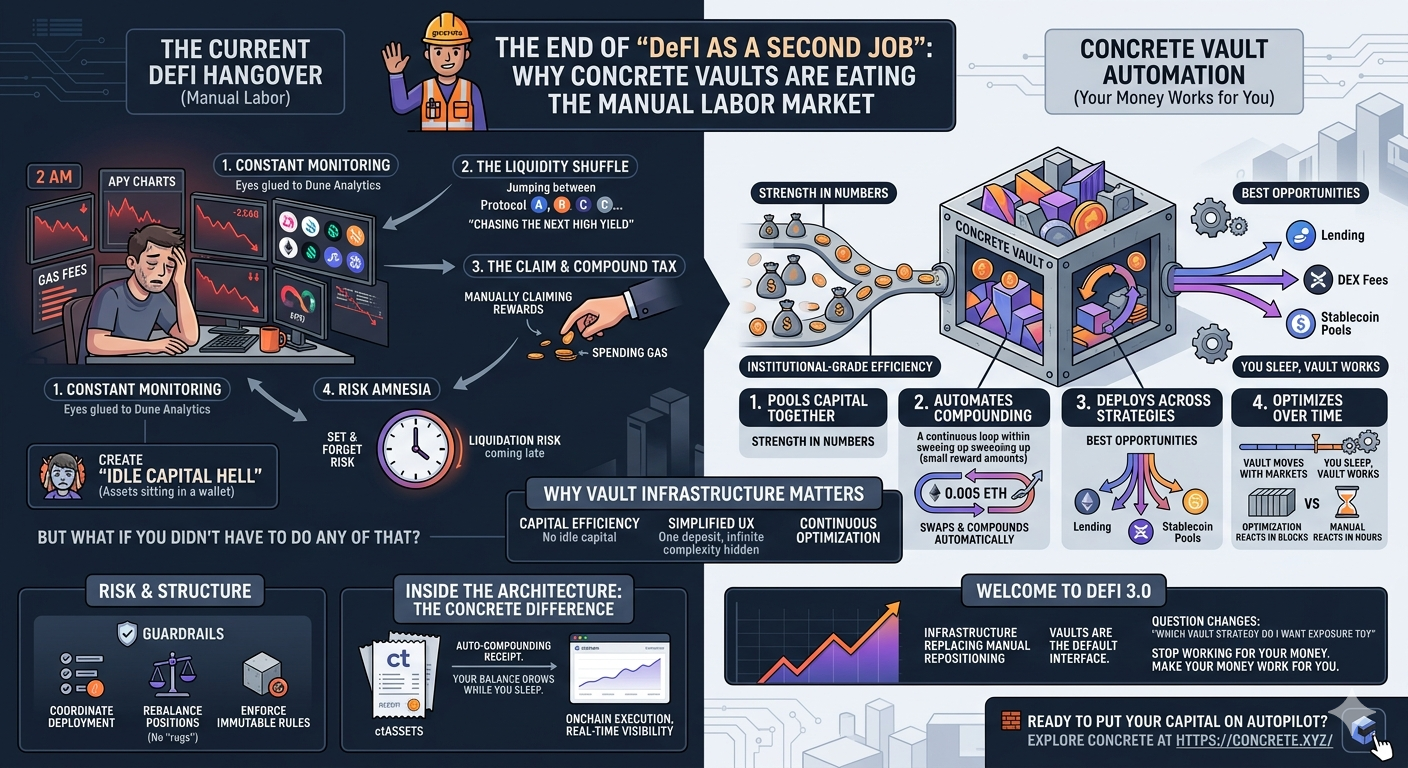
But after a while, most users run into the same reality: Managing capital manually in DeFi becomes exhausting. Not because the opportunities disappear. But because the amount of coordination required keeps increasing.
The Hidden Cost of “Active” DeFi
To stay competitive today, users often need to:
- Monitor APYs across multiple protocols
- Move liquidity when incentives change
- Claim and compound rewards manually
- Rebalance positions as markets shift
- Track risk exposure across assets and chains
None of this happens once. It happens continuously and every action introduces friction:
Transaction costs.
Execution delays.
Missed timing.
Human error.
Ironically, a system designed to improve financial efficiency often creates operational inefficiency for the user. That’s the gap vault infrastructure is starting to solve.
What a Concrete Vault Actually Does
At a basic level, a vault simplifies coordination.
Instead of every user managing positions independently, capital is pooled into a structured system designed to optimize strategy execution over time. Within Concrete Vaults, users gain exposure to infrastructure that can:
- Automate compounding
- Allocate capital across opportunities
- Reposition strategies when conditions change
- Reduce idle capital
- Simplify ongoing management
The goal isn’t just convenience, It’s consistency. Because in practice, many DeFi losses don’t come from choosing the wrong opportunity. They come from managing the right opportunity inefficiently.
Why Vault Infrastructure Matters
One of the biggest shifts happening in DeFi is that infrastructure is becoming more important than interfaces.
Early DeFi focused heavily on access. Now the focus is shifting toward coordination.
Who can deploy capital more efficiently?
Who can maintain positions more consistently?
Who can optimize without constant manual intervention?
This is where DeFi vaults become valuable.
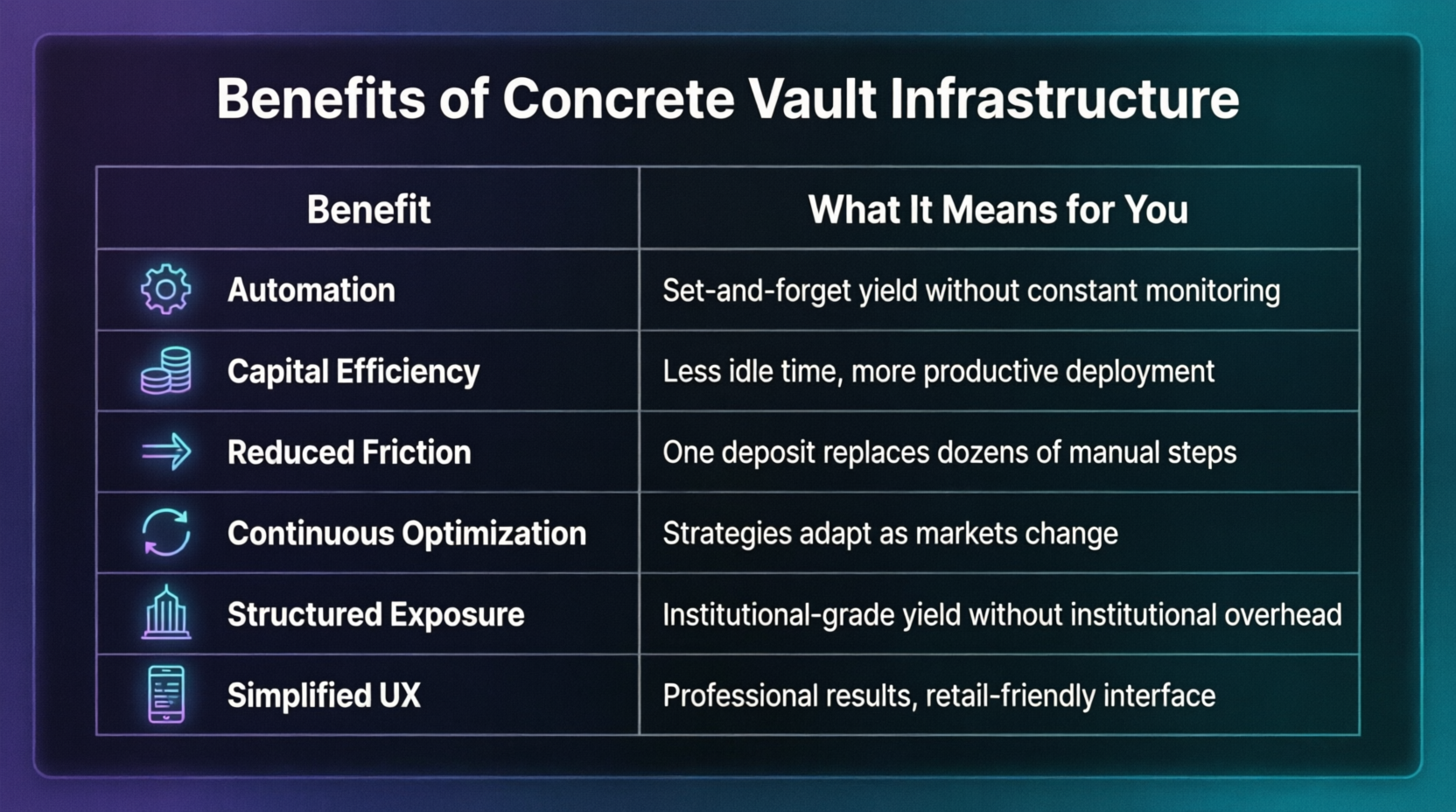
Not because they magically remove risk — but because they reduce operational burden while improving execution quality over time. A well-designed vault system can provide:
- Automated compounding
- More efficient capital deployment
- Reduced inactive or idle liquidity
- Structured exposure to yield opportunities
- Continuous optimization without constant user involvement
In other words, vaults allow users to spend less time reacting — and more time participating strategically.
Vaults Are More Than “Yield Wrappers”
There’s a misconception that vaults are simply passive containers for yield farming, but modern vault architecture is much more structured than that.
A vault is not just holding assets, It is coordinating them. That means systems need to:
- Deploy capital efficiently
- Rebalance positions dynamically
- Enforce strategy constraints
- Adapt to changing market conditions
- Manage execution across multiple layers
This turns vaults from simple tools into operational infrastructure and as DeFi grows more sophisticated, that infrastructure layer becomes increasingly important.
How Concrete Approaches Vault Design
Concrete approaches vaults as coordinated systems — not isolated positions.
Its architecture is designed around structured onchain capital deployment, where assets can move efficiently across strategies without requiring constant manual management from users. This includes components like:
- ctAssets, which help structure exposure within the ecosystem
- Automated compounding mechanisms
- Onchain execution systems
- Structured vault coordination across opportunities
The emphasis is not just on maximizing yield in the short term. It’s on building systems that can manage capital more intelligently over time.
That distinction matters. Because sustainable performance in DeFi often comes down to execution quality — not just opportunity selection. Explore Concrete at https://concrete.xyz/
The Bigger Transition Happening in DeFi
As the ecosystem evolves, one thing is becoming increasingly clear:
Manual strategy management does not scale.
Not for individuals.
Not for institutions.
Not for increasingly fragmented onchain markets.
The future of structured DeFi is likely moving toward systems that coordinate capital automatically rather than relying on constant user repositioning.
This is especially important as institutional DeFi continues to grow.
Larger participants are not looking to manually chase APYs across dozens of protocols every day. They’re looking for infrastructure. Systems that can:
- Allocate efficiently
- Respond consistently
- Manage complexity at scale
And that is exactly where vault architecture becomes valuable.
The Future May Belong to Coordination
There was a time when the most active user had the advantage. The user constantly switching pools, moving liquidity, and optimizing manually often outperformed everyone else. But DeFi is changing.
Complexity is increasing faster than humans can manage consistently by hand and because of that, the edge is shifting away from constant clicking — toward systems designed to coordinate capital intelligently.
That’s what vault infrastructure represents. Not the removal of participation. But the evolution of how participation happens onchain.