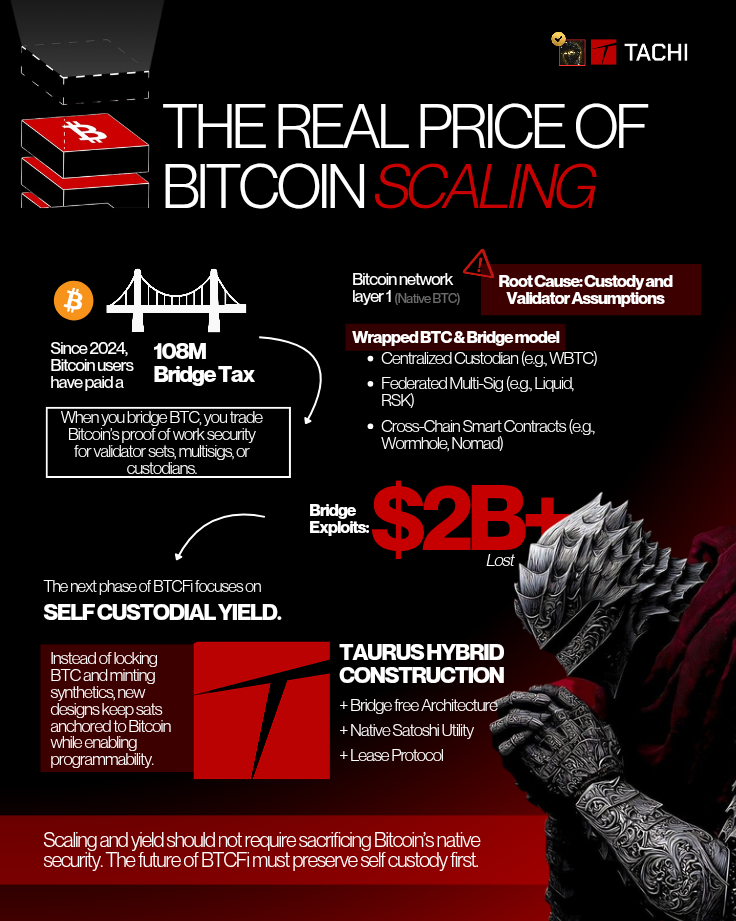
THE REAL PRICE OF BITCOIN SCALING
 Princeblog3 min read·Just now
--
The 108M Bridge Tax is not a headline grab. It is a receipt.
Since 2024, over 108 million dollars has been lost from Bitcoin users through lock and mint bridges.
Now this is not coming from random bad luck or isolated black swan events, rather from a design model that forces you to give up Bitcoin’s native security just to earn yield or access DeFi.
tachi btc broke this down clearly, and the more I looked into it, the more obvious it became. This is structural.
Here is the core problem.
WHY BRIDGES CREATES UNAVOIDABLE TRUST TRADE OFF
Every lock and mint bridge follows the same playbook.
① You deposit native BTC into a wallet controlled by a federation, multisig, or validator set.
② The bridge mints a wrapped version of BTC on another chain like Ethereum, Base, Solana, or an L2.
③ Your real BTC gets locked.
④ Your new token moves around elsewhere.
At that moment, your security model changes.
Your Bitcoin is no longer protected purely by SHA 256 proof of work and Bitcoin’s economic finality. It is now protected by human key management, validator honesty, operational security, and smart contract assumptions.
Bitcoin has never been 51% attacked in 17 years because attacking it costs billions in hardware and energy with no guaranteed upside. If you fail, you lose everything.
Here’s where a bridge comes in, it does not require billions to break. It requires one compromised key, one insider, one mistake.
Historical bridge losses across crypto exceed 2.9 billion dollars.
Bridges dominate the largest exploits. In 2024 and 2025 alone, Bitcoin focused or BTC wrapped bridge incidents contributed to the cited 108 million figure discussed by TACHI
Examples follow the same pattern
- Force Bridge lost millions through a compromised validator key.
- IoTeX ioTube suffered private key exploits.
- Multisig failures and validator collusion show up again and again.
Reports from chainalysis and TRM Labs consistently flag bridges as top exploit and laundering vectors.
Bridges make it harder to follow the steps and put all the control in one place, and that’s risky.
THE RISK OF SYNTHETIC BTC MODELS
When you hold WBTC, cbBTC, or similar assets, you are not holding Bitcoin. You start holding a claim.
+ WBTC relies on custodians. Mint and burn flows require approval.
+ cbBTC relies on Coinbase custody.
+ Even threshold or decentralized variants depend on signer sets not colluding or losing keys.
Core risks are simple
① Counterparty failure. If the custodian fails, redemptions halt.
② Minting exploits. Unauthorized wrapped tokens appear without backing.
③ Regulatory seizure. Custodians are legal entities. They answer to governments.
④ No native Bitcoin finality. Disputes resolve off chain.
This is why the self custodial yield conversation matters.
Bitcoin’s killer feature has always been: self custody. People hold it because they do not want to trust intermediaries. That is why trillions sit idle.
This is where Tachi takes a different path.
Tachi doesn’t use a bridge to move Bitcoin. Instead it uses TAURUS, which lets users keep their Bitcoin on the Bitcoin network while still using it.
Now new primitives are shifting this without bridges or wrappers.
The direction is clear.
> Yield strategies run anchored to Bitcoin blocks.
> Funds remain in self custody.
> No synthetic tokens.
> No validator sets holding your base asset hostage.