The Power of a Trading Journal: Why Serious Traders Track Every Trade
--
In trading, most beginners focus on the market. They study charts, indicators, and strategies, constantly searching for the next opportunity. However, very few take the time to study something far more important — their own behavior. This is where a trading journal becomes essential.
A trading journal is not just a record of trades. It is a structured process of self-analysis. It captures decisions, emotions, execution quality, and outcomes. While strategies help you enter the market, a journal helps you understand how you operate within it. Over time, this understanding becomes one of the most powerful advantages a trader can develop.
One of the main reasons traders struggle to improve is the absence of feedback. Without proper tracking, mistakes are repeated without awareness. A trader may believe they are following their plan, but in reality, small deviations occur frequently — entering early, exiting late, moving stop-losses, or overtrading during volatile sessions. These patterns often go unnoticed because they are not documented.
A trading journal brings clarity. By recording each trade in detail, a trader begins to see patterns that are otherwise invisible. It becomes possible to identify which setups perform well, which conditions lead to losses, and how emotions influence decisions. This level of insight cannot be achieved through memory alone. It requires consistent documentation and honest review.
Beyond technical analysis, a journal also captures psychological behavior. Trading is inherently emotional, even for experienced participants. Fear, greed, hesitation, and overconfidence can all influence execution. By writing down thoughts and emotions during or after a trade, a trader creates a record of their mental state. Over time, this reveals triggers and tendencies that can be managed and improved.
Another important benefit of journaling is accountability. When trades are documented, there is a clear distinction between following a plan and acting impulsively. It becomes difficult to justify poor decisions when they are written down. This creates a sense of responsibility and encourages disciplined behavior. The trader is no longer operating based on assumption, but on evidence.
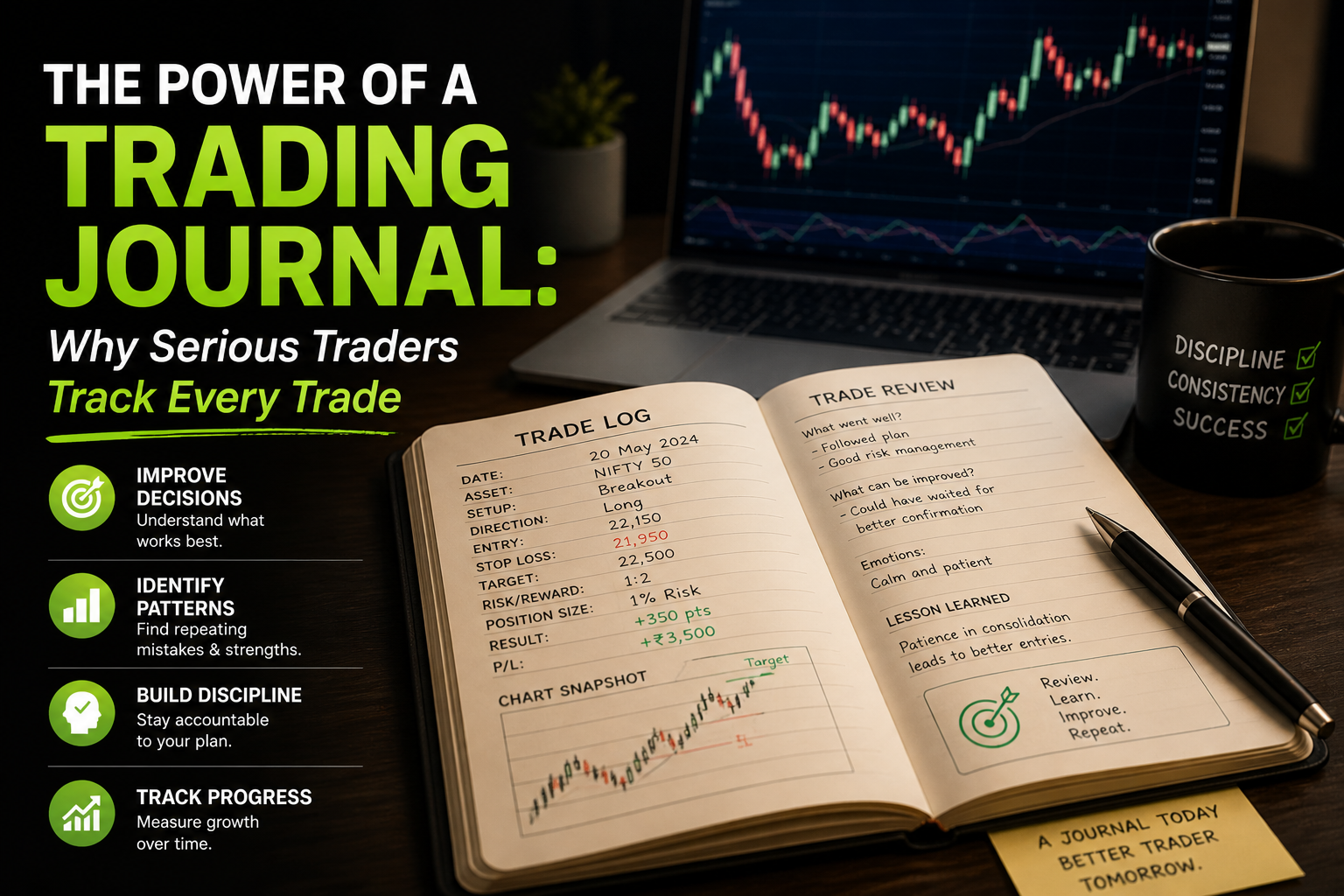
A well-maintained trading journal typically includes key details such as entry and exit points, position size, risk taken, market conditions, and the reasoning behind the trade. Screenshots of charts can further enhance the analysis by providing visual context. However, the value of a journal does not come from the amount of data recorded, but from the consistency with which it is reviewed.
Reviewing past trades is where real improvement occurs. By analyzing both winning and losing trades, a trader can refine their strategy and execution. Winning trades reveal what works, while losing trades highlight areas that need correction. Over time, this process leads to a more structured and reliable approach to trading.
It is important to note that journaling does not produce immediate results. Like any discipline, its benefits compound over time. Many traders abandon the practice because they do not see instant improvement. However, those who remain consistent begin to notice a shift — not only in their results, but in their decision-making process. Trading becomes less reactive and more intentional.
Professional traders understand that success is not built on isolated trades, but on continuous improvement. A trading journal serves as a personal feedback system, allowing them to adapt, refine, and evolve. It transforms trading from a series of random outcomes into a measurable and controllable process.
In a market where uncertainty is constant, self-awareness becomes a critical edge. Strategies can be learned, and tools can be acquired, but understanding one’s own behavior requires deliberate effort. A trading journal provides that structure.
Ultimately, the difference between a struggling trader and a consistent one is not just knowledge — it is the ability to learn from experience. And experience, without documentation, is often lost.
Start Building Discipline
Track your trades, refine your process, and develop real consistency.
Trade With Market
Capital protection first