The Original Mesh Network Was A Pigeon
--
Anonmesh is the latest version of an idea humans have been refining for 5,000 years.
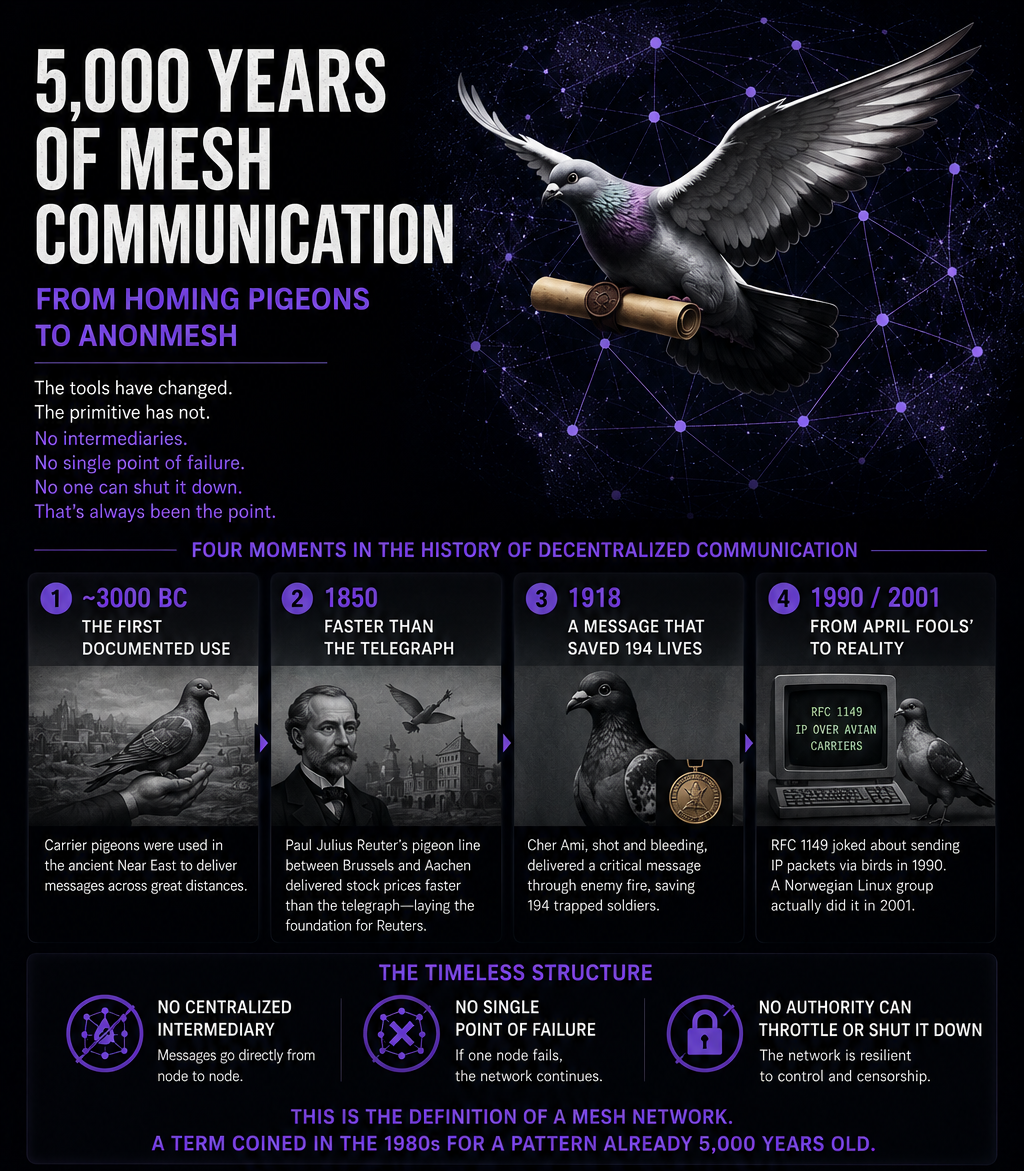
In 3000 BC, somewhere between the Nile and the Euphrates, a person tied a small note to the leg of a homing pigeon. The bird flew home. The note arrived.
That was the first documented use of carrier pigeons as a messaging system. It worked because of three properties that have stayed remarkably stable across five thousand years of communication infrastructure: point to point, no third party in the middle, and routes that fail gracefully.
In 1850, Paul Julius Reuter built a pigeon network between Brussels and Aachen, the gap in Europe’s telegraph at the time. Stock prices flew faster than the wires. The agency he founded the year after, Reuters, is now the world’s largest news organization. It started as a flock.
In October 1918, an American battalion was trapped behind German lines in the Argonne Forest. Their previous pigeons had been shot down. The last one, Cher Ami, was released with their position taped to his leg. He was hit in the breast, blinded in one eye, and lost a leg. He delivered the message anyway. 194 soldiers walked out alive.
In April 1990, an internet engineer named David Waitzman wrote RFC 1149, “A Standard for the Transmission of IP Datagrams on Avian Carriers.” It was an April Fools’ joke. In April 2001, the Bergen Linux Users Group in Norway actually implemented it. They sent 9 IP packets over 5 kilometers, with 4 successful replies, latencies between 50 and 100 minutes, and a famously formatted first response:
64 bytes from 10.0.3.1: icmp_seq=0 ttl=255 time=6165731.1 ms
The protocol worked. RFC 6214 ported it to IPv6 in 2011.
What the Pigeon Was Not
What is striking about the pigeon, across all four of these moments, is what it was not.
It was not a centralized service. It was not a regulated carrier. It was not a platform that could be subpoenaed, throttled, or shut down. It was a peer-to-peer transport, with the message authenticated by whoever wrote and sealed it, routed by an animal that knew its way home, and resistant to every single point of failure that has plagued centralized communications since the first telegraph wire.
That is the definition of a mesh network. The word itself was coined in the 1980s for self-organizing radio networks. The pattern was already five thousand years old.
Anonmesh Is the Same Primitive
anonmesh is the latest version of the same idea, with three modern upgrades.
Bluetooth Low Energy between phones replaces the bird itself: any device near another device becomes a relay. LoRa radios extend the range, the way pigeon lofts extended a single flight into a chain of routes. Solana, Arcium, and stealth addresses replace the wax seal. The message and the payment are encrypted. Arcium’s multi-party computation guarantees that no single node ever sees the plaintext, even when the bird (the phone) is doing the carrying.
The result is the same primitive that ran from Cairo to Brussels to the Argonne to a Norwegian Linux meetup, now rebuilt for a phone in your pocket and a payment on Solana.
The bird is the message. The mesh is the bird.
It worked for pigeons. It will work for anonmesh.
For more about Arcium, you can follow and join their official social accounts links below:
https://x.com/Arcium
https://discord.com/invite/arcium
https://x.com/anon0mesh
Follow me on X:
https://x.com/leosereinn
Sources
- Cher Ami biography and “194 men” figure: Smithsonian National Museum of American History, “Cher Ami Fact Sheet” at americanhistory.si.edu
- Reuter’s 1850 Brussels to Aachen pigeon line: Britannica, “Paul Julius, baron von Reuter” at britannica.com
- RFC 1149: David Waitzman, April 1, 1990, full text at datatracker.ietf.org/doc/html/rfc1149
- RFC 1149 implementation by Bergen Linux Users Group, April 28, 2001: blug.linux.no/rfc1149/writeup
- 9 packets, 4 returned, latencies 3,211 to 6,389 seconds, 55% loss: Wikipedia, “IP over Avian Carriers” at en.wikipedia.org/wiki/RFC_1149