The One-Click DeFi Economy: Why Users Were Never Meant to Be Fund Managers
--
DeFi promised financial freedom.
What it accidentally created was millions of unpaid fund managers.
Think about what participating in DeFi actually looks like today.
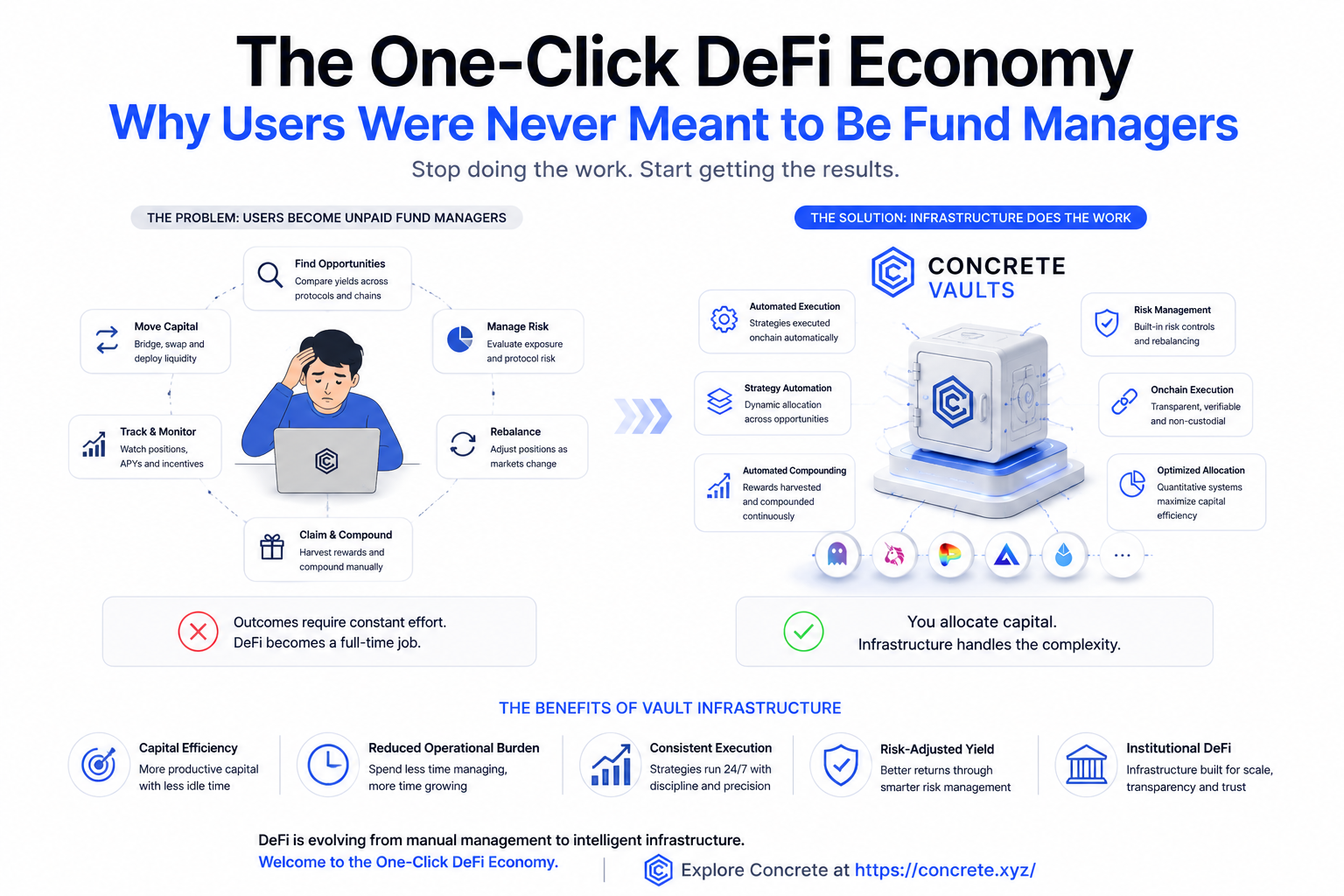
Users compare yields across protocols. They evaluate risk. They monitor incentives. They rebalance positions. They move liquidity between chains. They decide when to compound rewards and when to rotate capital elsewhere.
None of this sounds like the experience of an average investor.
It sounds like the daily workflow of a professional asset manager.
And that raises an important question:
Why did using DeFi become a full-time job?
When Opportunity Creates Complexity
The complexity of DeFi did not appear by accident.
It emerged because the ecosystem became increasingly effective at creating opportunities.
New protocols launched.
New chains emerged.
New strategies appeared.
Capital became more mobile than ever before.
At first, this looked like progress.
More opportunities meant more ways to generate yield.
But there was a hidden cost.
Every new opportunity created another decision.
Which protocol offers the best return?
Which chain should capital be deployed on?
When should positions be rebalanced?
How should changing risks be managed?
As DeFi expanded, users found themselves responsible for answering all of these questions.
The result was an ecosystem where success often depended less on capital and more on constant attention.
The Execution Problem
Most users enter DeFi for outcomes.
They want growth.
They want yield.
They want efficient deployment of capital.
What they do not want is to spend hours every week acting as their own execution layer.
Yet that is precisely what many participants have become.
Every position requires monitoring.
Every strategy requires adjustment.
Every opportunity requires action.
The irony is difficult to ignore.
DeFi was designed to remove intermediaries.
Instead, it turned users into operators.
The system became permissionless, but participation increasingly required professional-level engagement.
This model works for specialists.
It does not scale for everyone else.
Why Infrastructure Matters
Every mature industry eventually separates decision-making from execution.
The internet did not scale because users became network engineers.
Cloud computing did not scale because businesses learned how to manage data centers.
Infrastructure emerged to handle complexity on behalf of users.
Finance follows the same pattern.
As systems grow larger and more sophisticated, infrastructure absorbs operational burden so participants can focus on outcomes.
DeFi is now reaching that stage.
The question is no longer how many opportunities exist.
The question is how efficiently capital can access them.
The Rise of One-Click DeFi
This is where the idea of one-click DeFi becomes important.
One-click DeFi does not mean eliminating complexity.
It means relocating complexity.
Users should not be responsible for every operational decision required to maintain a strategy.
Infrastructure should.
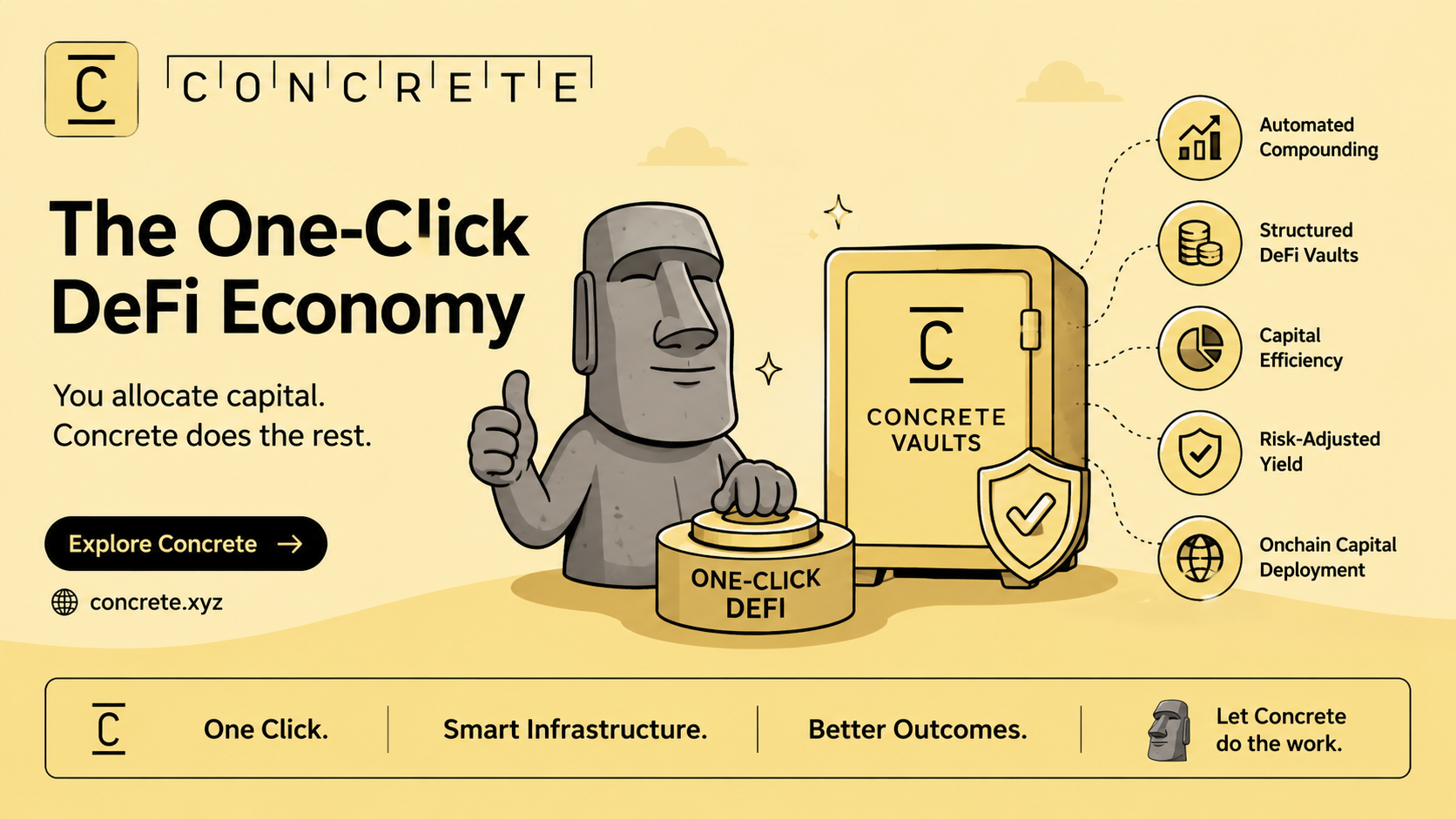
The user allocates capital.
The system manages execution.
The user chooses exposure.
The system handles coordination.
This is a fundamentally different model from the early days of DeFi, where every participant was expected to act as a strategist, trader, and risk manager simultaneously.
How Concrete Vaults Change the Experience
Concrete Vaults are built around this shift.
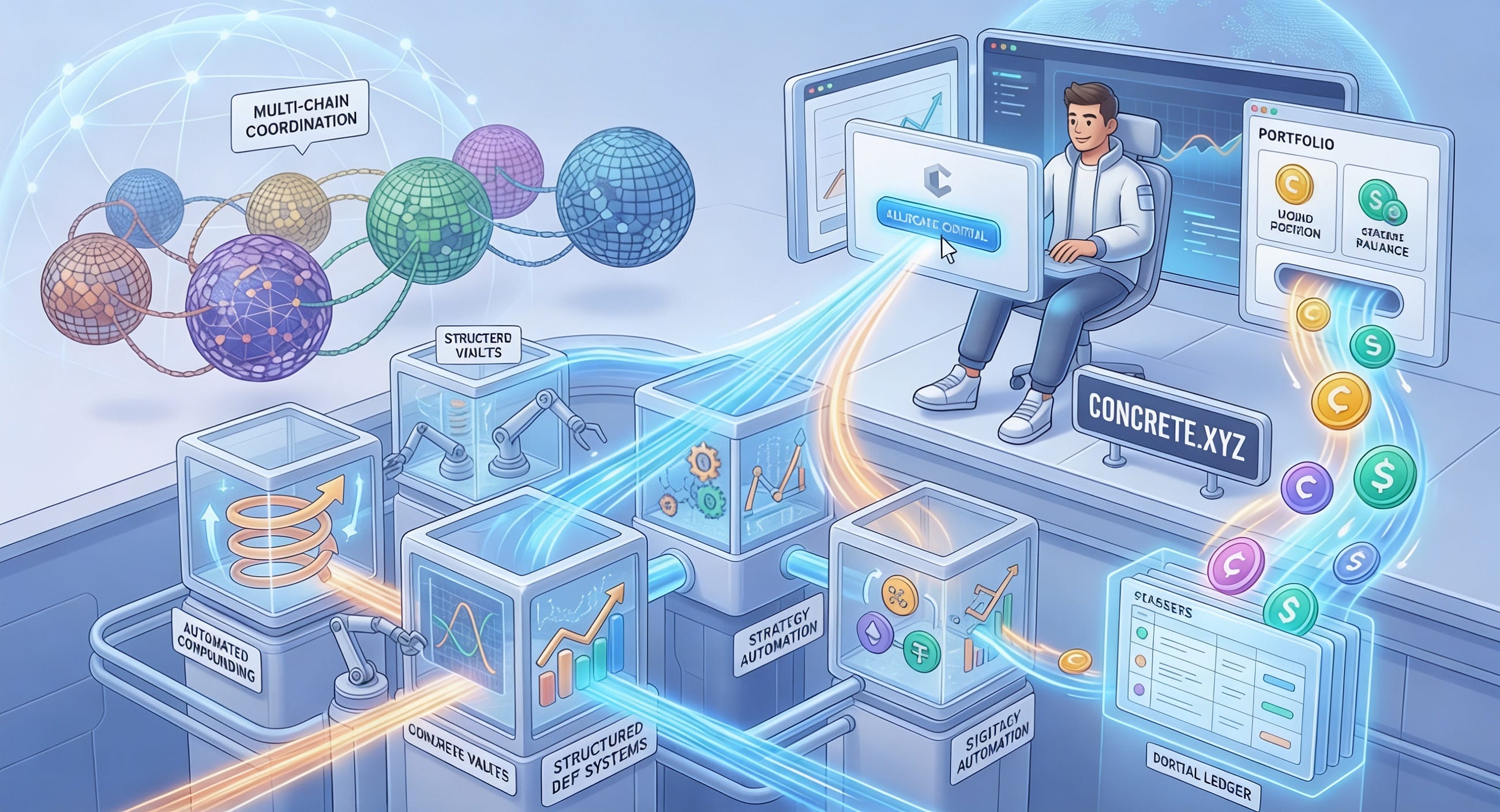
Rather than requiring users to continuously reposition capital themselves, the vault infrastructure coordinates much of that complexity through structured systems.
Users gain access to:
- Automated compounding
- Strategy automation
- Onchain execution
- Continuous optimization
- Structured exposure across opportunities
The objective is not simply convenience.
The objective is better capital coordination.
As markets evolve and conditions change, infrastructure can continue executing within predefined frameworks while reducing the operational burden placed on individual users.
This transforms participation from active management into structured access.
ctAssets and Coordinated Capital
A key component of this architecture is the use of ctAssets.
Instead of treating capital as isolated positions scattered across the ecosystem, ctAssets help integrate assets into a broader system designed for efficient onchain capital deployment.
This allows capital to remain productive while reducing the need for constant manual intervention.
The result is greater capital efficiency, improved consistency, and a more scalable approach to participating in DeFi.
Importantly, it shifts focus away from endless position management and back toward investment outcomes.
The Institutional Direction of DeFi
The importance of this shift becomes even clearer when considering institutional DeFi.
Large pools of capital do not scale through constant manual decision-making.
They scale through systems.
Institutions value repeatability, operational efficiency, and risk-adjusted yield.
Infrastructure enables all three.
This is why vault systems are increasingly becoming more than yield products.
They are becoming the operational layer through which capital interacts with decentralized markets.
The Future Is Not More Decisions
Many people assume the future of DeFi means more tools, more dashboards, and more options.
But history suggests the opposite.
The most successful technologies tend to reduce the number of decisions users need to make.
They hide complexity without removing capability.
They make powerful systems feel simple.
That is the promise of one-click DeFi.
Not a future where users work harder.
A future where infrastructure works harder.
The future of DeFi may not belong to the people spending all day moving liquidity between protocols.
It may belong to the systems that coordinate capital more efficiently than any individual ever could.
Explore Concrete at https://concrete.xyz/