The One-Click DeFi Economy
--
DeFi promised a future where anyone could access financial opportunities without permission.
In many ways, it delivered.
But it also created something unexpected: a world where every user is expected to act like a portfolio manager.
Want better yield?
Compare protocols.
Want better returns?
Monitor incentives.
Want to stay competitive?
Move liquidity, compound rewards, rebalance positions, track risk, and repeat.
The irony is hard to miss.
The more opportunities DeFi created, the more work it created alongside them.
And that’s where the next evolution begins.
Most Users Want Outcomes, Not Operations
There is a difference between participating in finance and operating finance.
Most people don’t wake up excited to compare liquidity pools across multiple chains.
They don’t want to spend their weekends calculating whether a new farm justifies migration costs.
What they actually want is simple:
Put capital to work.
Manage risk intelligently.
Earn sustainable returns.
The outcome matters.
The operational burden does not.
Yet much of DeFi still asks users to become the execution layer.
Every decision, every rebalance, every adjustment falls on the individual.
That model works for enthusiasts.
It doesn’t scale for everyone else.
Why DeFi Became So Complex
Complexity wasn’t designed into DeFi intentionally.
It emerged from growth.
New chains appeared.
New protocols launched.
New strategies became available.
Every innovation created more opportunity — but also more decisions.
A single yield strategy can involve multiple protocols, multiple assets, and multiple layers of execution.
To access that opportunity efficiently, users often need to behave like professional allocators.
The problem is obvious:
Most users aren’t trying to run a hedge fund.
They’re simply trying to grow capital.
The Rise of the Infrastructure Layer
Every mature system eventually separates decision-making from execution.
The same thing is happening in DeFi.
Instead of requiring users to manage every operational detail themselves, infrastructure can absorb that complexity.
The user allocates.
The system executes.
This is the foundation of the One-Click DeFi economy.
A world where capital deployment becomes simple while the underlying machinery becomes more sophisticated.
Not because opportunities disappear.
But because infrastructure learns how to coordinate them.
How Concrete Vaults Fit Into This Future
This is where Concrete Vaults become interesting.
Rather than treating users as operators, they treat them as capital allocators.
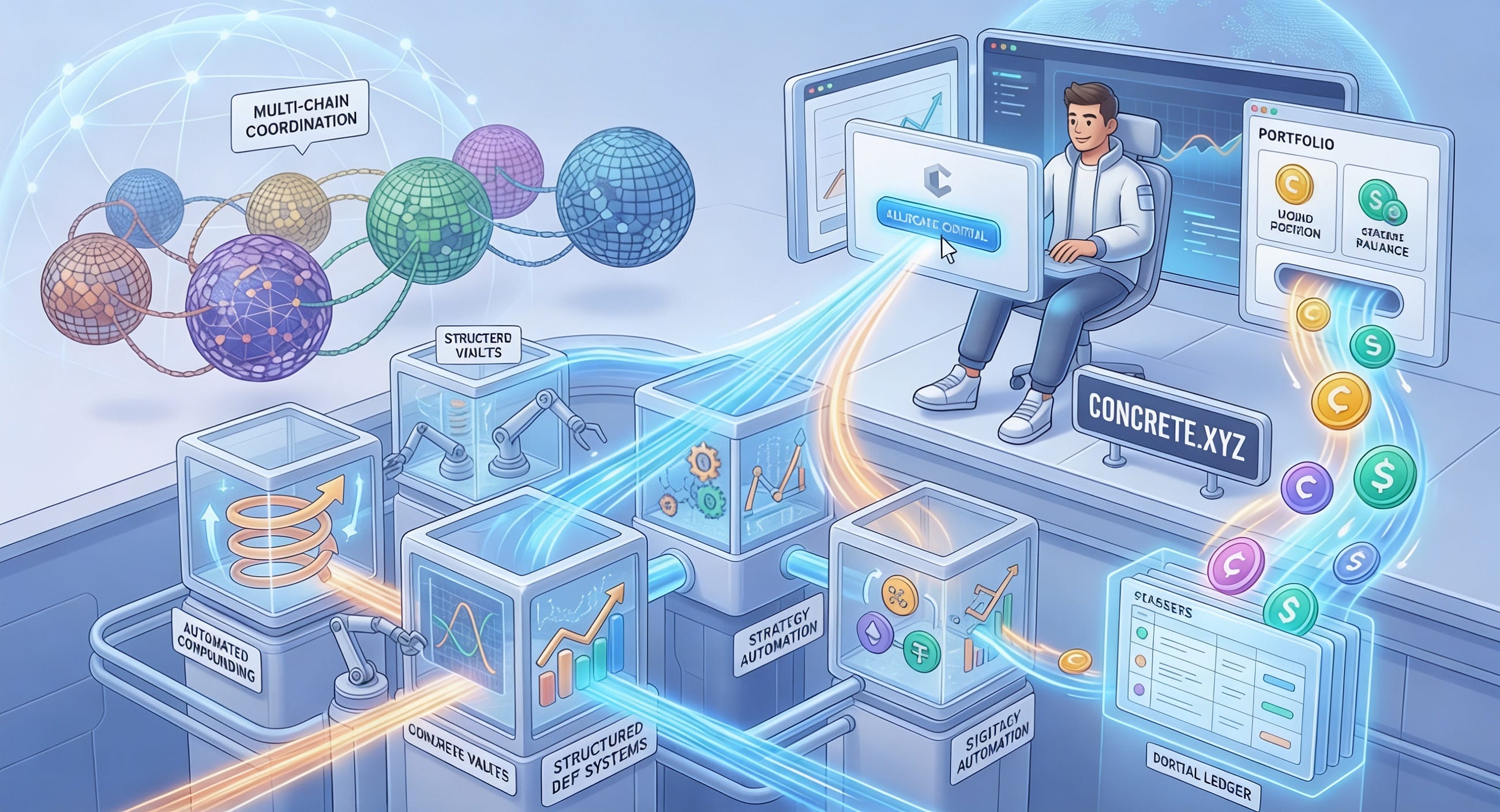
Users deposit capital into structured vault systems.
Behind the scenes, the infrastructure handles:
- Automated compounding
- Strategy execution
- Capital coordination
- Position management
- Onchain deployment
Instead of manually managing a collection of positions, users receive exposure through ctAssets, which represent their participation in the vault system.
The experience becomes dramatically simpler.
One action.
Continuous execution.
Structured exposure.
That’s a very different model from traditional yield farming.
Better Infrastructure Creates Better Outcomes
The biggest benefit isn’t convenience.
It’s consistency.
When execution becomes systematic:
- Capital efficiency improves
- Idle capital decreases
- Operational mistakes decline
- Rebalancing becomes disciplined
- Risk-adjusted yield becomes easier to pursue
This is why institutions care so much about infrastructure.
Not because infrastructure is exciting.
But because infrastructure scales.
The best financial systems are often the ones users barely notice.
The Future Is Fewer Decisions
For years, DeFi focused on giving users more control.
The next phase may focus on giving users fewer decisions.
Not fewer opportunities.
Fewer operational burdens.
The question is no longer whether users can manually manage capital across dozens of protocols.
The question is whether they should.
As DeFi grows more complex, infrastructure becomes more important.
And as infrastructure improves, vaults increasingly become the default interface for deploying capital onchain.
The future of DeFi may not be about finding the next opportunity.
It may be about building systems that can find, manage, and optimize those opportunities for you.
That’s what one-click DeFi really means.
Not less finance.
Just less work.
Explore Concrete at https://concrete.xyz/