The One-Click DeFi Economy
 Beanie3 min read·1 hour ago
--
The Evolution of DeFi: From Manual Operations to Infrastructure-Led Growth
The landscape of decentralized finance is shifting. As the ecosystem matures, the transition from manual management to infrastructure-driven automation is becoming the definitive path toward mass adoption.
The Reality of Today: The User as an Operator
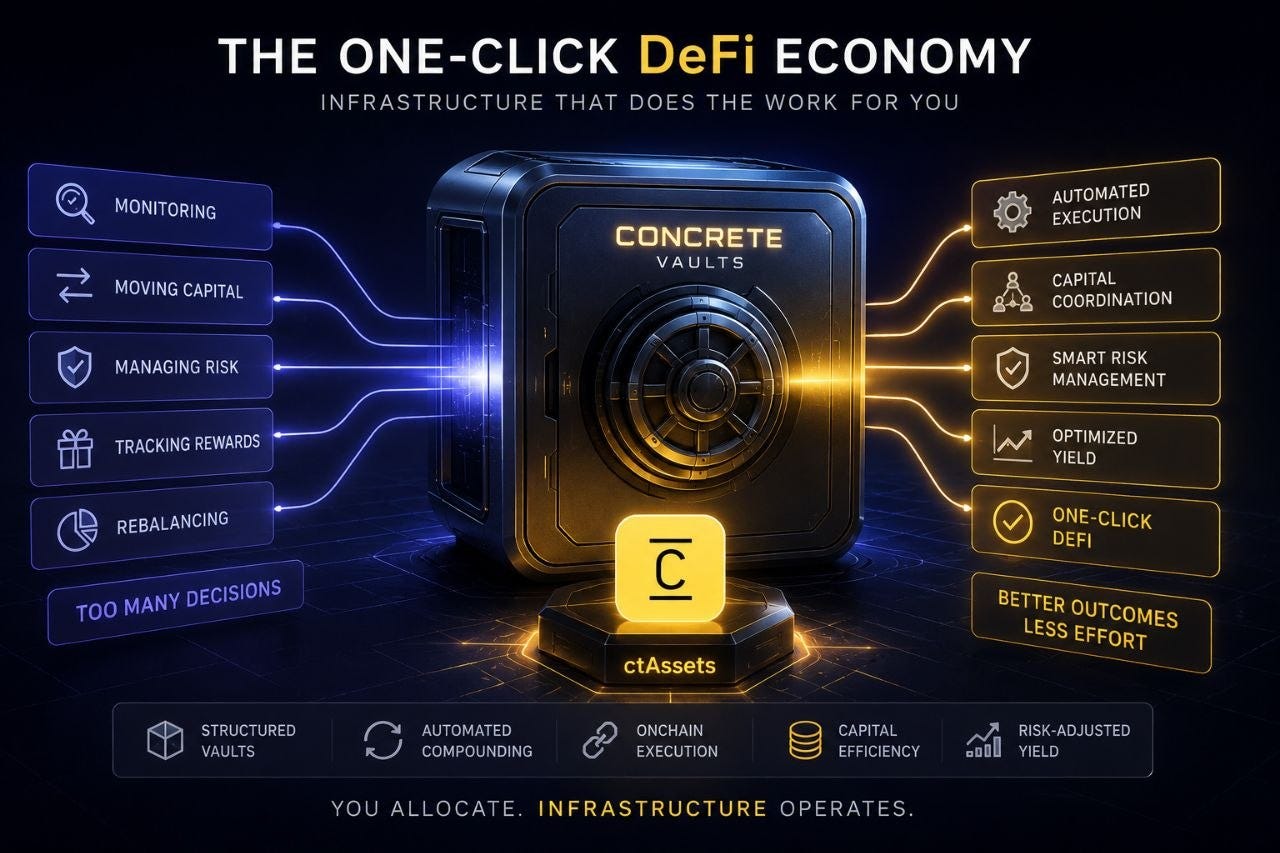
Currently, participating in DeFi is a labor-intensive endeavor. Users are forced to act as professional portfolio managers, burdened with constant operational overhead:
- Constant Monitoring: Tracking volatile market opportunities around the clock.
- Capital Fragmentation: Moving assets manually across multiple protocols and chains.
- Manual Risk Management: Assessing and rebalancing positions as market conditions fluctuate.
- Reward Harvesting: Tracking and claiming complex incentive structures.
This creates significant friction. The fundamental issue is a misalignment of goals: most users want financial outcomes, not operational tasks.
Why Complexity Exists: The Burden of Execution
DeFi’s complexity is a byproduct of its modular, permissionless nature. To maximize yield, one often must navigate a web of interconnected protocols and cross-chain environments. When users are required to serve as the “execution layer,” they are exposed to human error, missed opportunities, and “decision fatigue.” Accessing yield should not require a full-time job; yet, today, the architecture of DeFi forces exactly that.
The Infrastructure Layer: Shifting the Paradigm
The solution lies in shifting the burden from the user to the infrastructure. By introducing automated systems — such as quantitative allocation engines, capital coordination protocols, and structured DeFi systems — we can separate the role of the investor from the role of the operator.
The new paradigm is simple: The user allocates capital; the infrastructure handles the operations.
Concrete Vaults: Simplifying Capital Deployment
Concrete Vaults exemplify this shift by abstracting away the technical complexities of onchain participation. Through strategy automation and ctAssets, these systems transform cumbersome manual processes into seamless experiences:
- Automated Compounding: Eliminating the need to claim and reinvest rewards manually.
- Onchain Execution: Using smart contracts to rebalance positions instantly, ensuring strategies remain optimal.
- Structured Systems: Providing a simplified interface where complex, multi-protocol strategies are packaged into a single, accessible product.
The Benefits: A Better User Experience
This infrastructure-first model is essential for the growth of the industry. By moving away from manual management, we unlock:
- Increased Capital Efficiency: Strategies can execute faster and more precisely than humanly possible.
- Reduced Operational Burden: Users are freed from the constant need to monitor the screen.
- Consistent Execution: Removing human emotion and hesitation from strategy management.
- Scalable Infrastructure: Allowing institutional-grade strategies to be accessed by a broader user base.
The Bigger Shift: The Future of DeFi
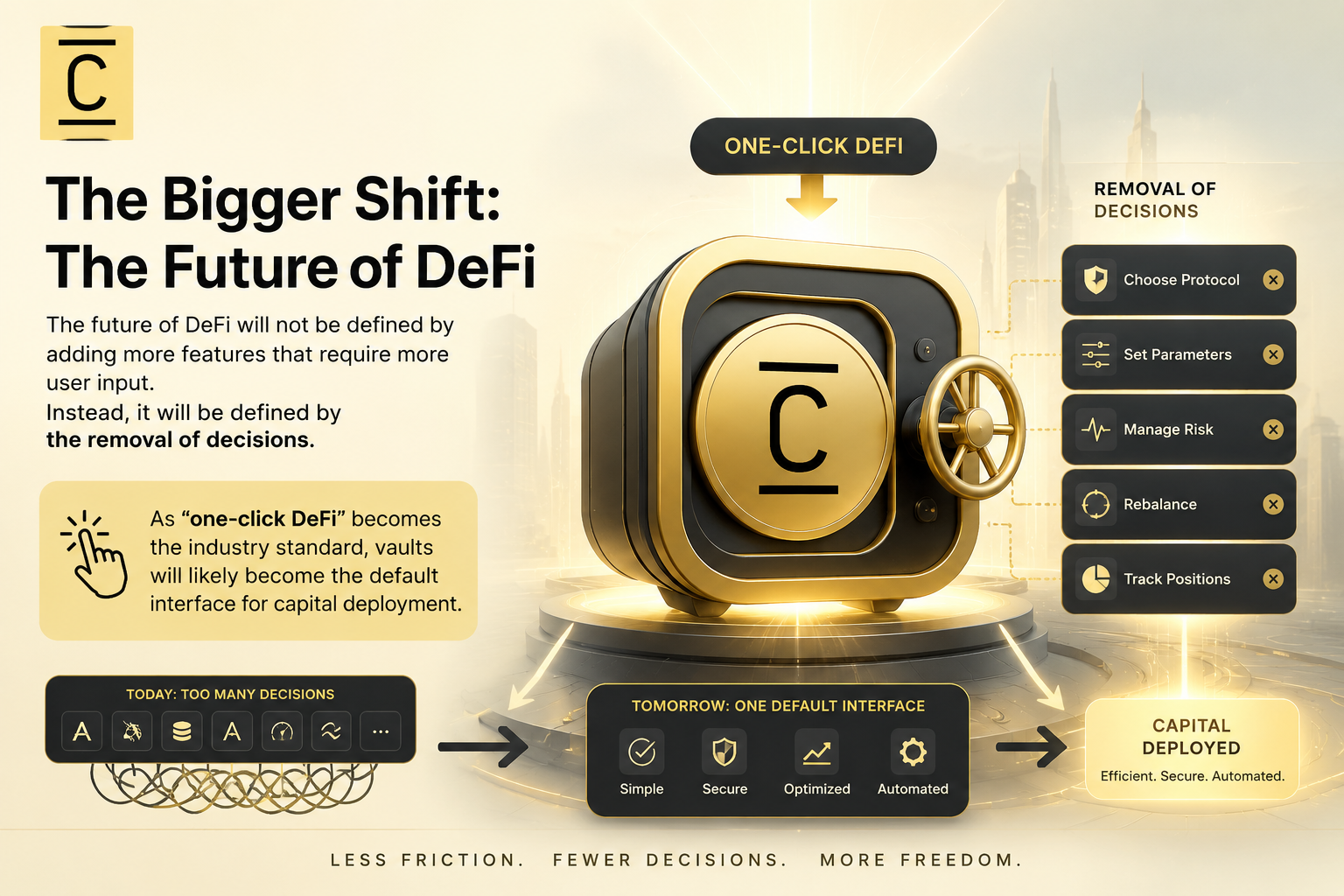
The future of DeFi will not be defined by adding more features that require more user input. Instead, it will be defined by the removal of decisions. As “one-click DeFi” becomes the industry standard, vaults will likely become the default interface for capital deployment.
Ultimately, the goal is not to give users more work it is to build the invisible infrastructure that does the work for them.
Start your journey with Concrete today:
- 🚀 Launch Concrete App: app.concrete.xyz
- 📚 Explore Documentation: docs.concrete.xyz
- 🦺 Review Audits: halborn.com/audits/concrete
- 🐦 Follow Updates: @ConcreteXYZ