The One-Click DeFi Economy
 Olatunde Micheal Olalekan6 min read·Just now
--
DeFi was supposed to make finance more accessible.
It promised open markets, permissionless access, and new ways for anyone to put capital to work without relying on banks, brokers, or traditional financial institutions. In theory, users should be able to access yield, deploy capital, and participate in onchain opportunities with ease.
But in practice, DeFi often feels like a full-time job as users are constantly forced to make decisions like;
Which protocol offers the best yield right now? Which chain should the capital be on? When should positions be rebalanced? How should risk be managed? What happens when incentives dry up?
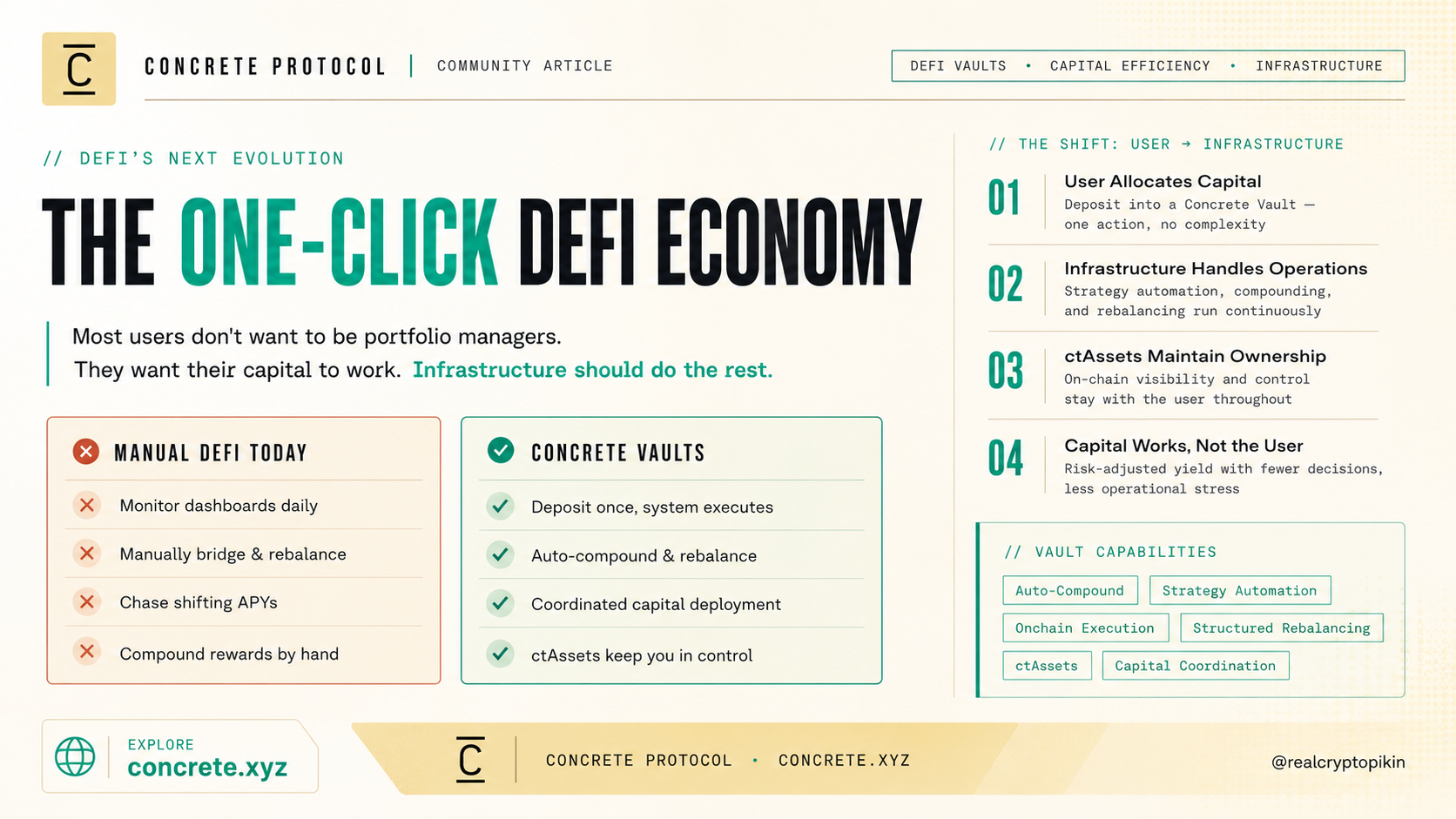
Instead of simply participating in an open financial system, many users become unpaid portfolio managers. They monitor dashboards, move liquidity, claim rewards, bridge assets, adjust strategies, and manually track risks.
This creates friction, wastes time, increases mistakes, leaves capital underutilised, and makes DeFi harder to use than it should be.
Most users do not want more operations; they want better outcomes, which is the core idea behind the one-click DeFi economy.
The Problem With Manual DeFi
Participating in DeFi today requires constant attention.
A user may deposit into a pool because the APY looks attractive. A few days later, the yield changes. Another protocol begins offering better returns. Incentives shift. Liquidity rotates. Market conditions change. Suddenly, the original position may no longer be efficient.
To keep up, users need to monitor opportunities constantly, compare yield across protocols, move capital when conditions change, claim and compound rewards, track incentives, and rebalance positions as markets evolve.
Every step adds friction, as moving capital between protocols incurs gas fees. Bridging across chains exposes you to risk. On the other hand, manual compounding can be delayed or forgotten because rebalancing requires timing and discipline, as risk management demands attention and understanding.
The result is an environment where the complexity of participation often eats into the returns from participation, whereas DeFi offers yield, but capturing that yield efficiently is the real challenge.
Why DeFi Became So Complex
DeFi is not complicated by accident; it was deliberate to benefit a very smart few.
High-performing opportunities often depend on multiple moving parts. A single strategy may involve lending markets, liquidity pools, derivatives, incentives, bridges, or several chains at once. Yield may come from trading fees, borrowing demand, arbitrage, emissions, or market inefficiencies.
To access these opportunities properly, users often need to understand how different protocols interact, how incentives change, how risk moves across positions, and when capital should be reallocated.
This forces users to become the execution layer, as they are responsible for timing entries, moving funds, managing exposure, compounding returns, and reacting to market changes. That may work for a small group of highly active DeFi users, but it creates a high barrier for everyone else.
Most people do not want to spend their day managing vaults, bridges, APY dashboards, and risk alerts. They want a simple way to allocate capital and let the system do the work — like me.
The Infrastructure Layer
The solution is not to give users more dashboards, more alerts, and more buttons to click. The solution should be better infrastructure.
Modern DeFi infrastructure can absorb complexity behind the scenes through automation, capital coordination, quantitative allocation, and structured execution. Instead of forcing users to manually manage every position, the infrastructure can handle the operational layer.
This changes the user’s role, as he/she just allocates capital; the infrastructure handles operations.
That is what makes one-click DeFi powerful. It does not mean the strategies are simple. It means the user experience becomes simple because the complexity is handled by the system underneath.
This is where structured DeFi systems become important, as they turn fragmented opportunities into coordinated capital deployment. They reduce the need for constant repositioning. They allow users to access more advanced strategies without manually managing every step.
How Concrete Vaults Enable One-Click DeFi
Concrete Vaults are built for this exact shift, because they simplify onchain capital deployment by turning complex DeFi strategies into structured, easy-to-use products. Instead of manually moving between protocols and chains, users can deposit into a vault and gain exposure to strategies managed through the vault’s infrastructure.
Concrete Vaults help users move from manual execution to coordinated capital deployment.
They support automated compounding, strategy automation, onchain execution, structured rebalancing, and efficient capital allocation. This means rewards can be reinvested automatically, positions can be adjusted as conditions change, and capital can be deployed across opportunities without requiring the user to manage everything manually.
Concrete also uses ctAssets, which represent a user’s position within the vault system. These assets make it easier for users to hold exposure to optimised vault strategies while the infrastructure manages what happens underneath.
The user keeps visibility and onchain ownership, while the vault handles the operations. This is the practical meaning of one-click DeFi.
Why This Model Matters
The one-click DeFi model matters because better infrastructure creates better outcomes.
First, it improves capital efficiency. Capital spends less time sitting idle and more time deployed into productive opportunities. In DeFi, idle capital has a cost, and infrastructure helps reduce that leakage.
Second, it reduces the operational burden. Users no longer need to monitor every dashboard, manually compound rewards, constantly rebalance positions, or make frequent emotional decisions based on changing APYs.
Third, it creates more consistent strategy execution. Structured vault systems follow defined logic and rules, reducing the inconsistency that often comes from manual management.
Fourth, it supports risk-adjusted yield. Instead of chasing the highest headline APY, vault infrastructure can focus on more sustainable strategies, better allocation, and more disciplined execution.
Finally, it makes DeFi more scalable. The same infrastructure that helps individual users can also support institutional DeFi capital. Institutions do not want chaotic manual execution. They need structured systems, transparent processes, and scalable capital deployment.
This is why DeFi vaults matter. They are not just convenience tools. They are infrastructure for a more efficient onchain economy.
From More Features to Fewer Decisions
As DeFi grows, the ecosystem will only become more complex, as there will be more chains, more protocols, more strategies, more risks, and more opportunities, because manual strategy management will become increasingly unsustainable.
The future of DeFi will not be about giving users more work to do. It will be about building infrastructure that does the work for them, because users do not necessarily need more features.
In many cases, they need fewer decisions. They need cleaner entry points, better capital coordination, and systems that can operate continuously in the background.
The best infrastructure should allow users to access advanced strategies without becoming full-time operators. It should make DeFi easier without making it weaker. It should simplify participation while improving capital efficiency and maintaining visibility.
Concrete Vaults represent this shift, which is the big shift upon us.
They combine automated compounding, ctAssets, structured vault systems, onchain execution, and strategy automation into a cleaner model for onchain capital deployment.
The result is a more efficient user experience and a more scalable DeFi economy.
Final Thought
DeFi already has numerous opportunities, but the challenge is making those opportunities accessible, efficient, and sustainable for more users.
The one-click DeFi economy is the next evolution of that idea. It moves users away from constant monitoring, manual execution, and fragmented decision-making. It replaces operational stress with structured infrastructure.
Most users do not want to become portfolio managers. They just want their capital to work, which is why infrastructure matters. That is why vaults matter, and that is why Concrete Vaults are important.
Experience how Concrete Vaults are making one-click DeFi a reality here at: concrete.xyz