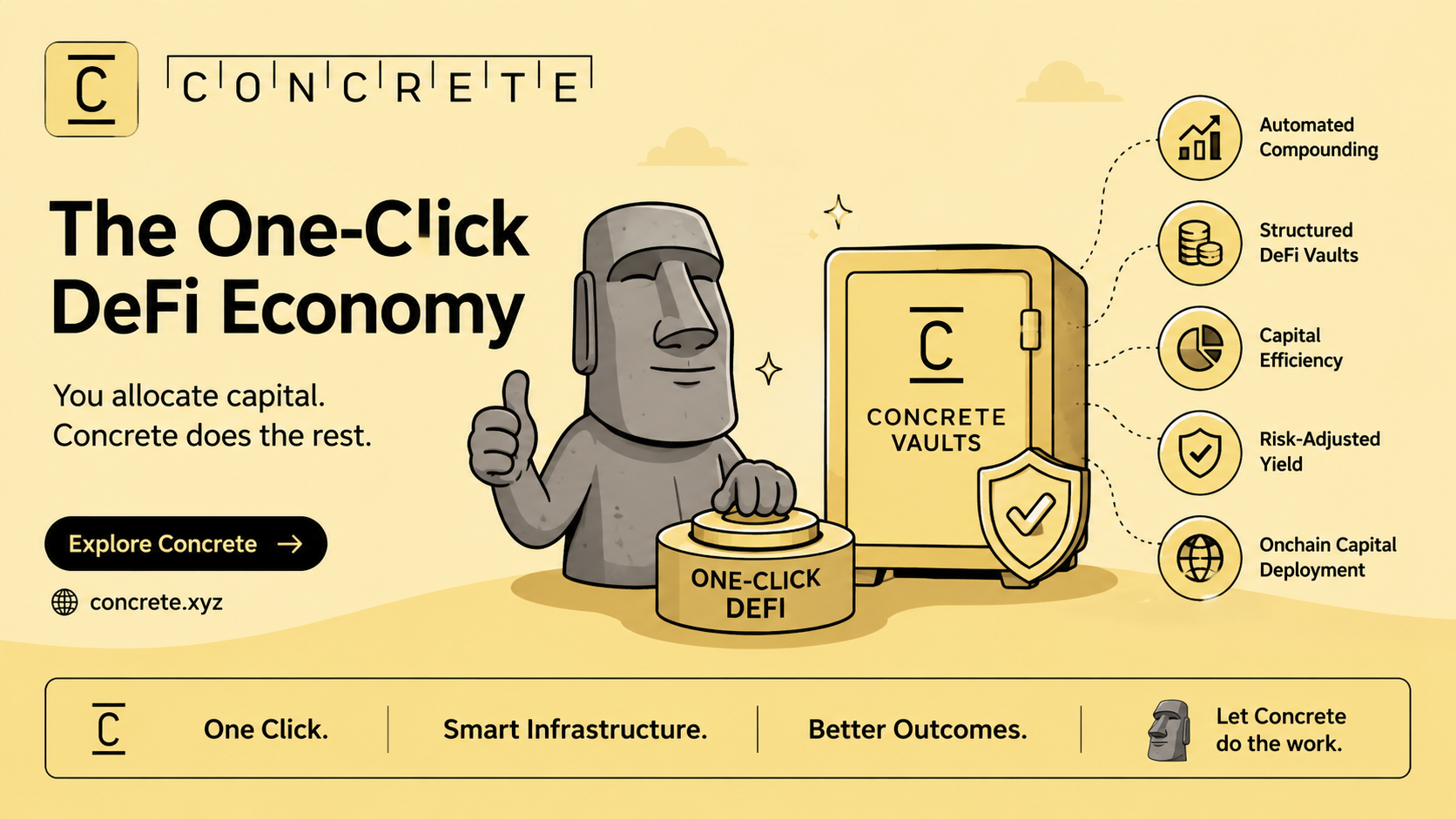
The One-Click DeFi Economy
 NafaniaAV6 min read·Just now
--
DeFi was supposed to make finance more open. And to be fair, it did.
Today, anyone with a wallet can lend assets, provide liquidity, farm rewards, use vaults, move between chains, and access opportunities that were impossible to reach through traditional finance. But there is another side of the story. DeFi is open, but it is not always simple.
If you have ever tried to seriously manage capital onchain, you know the problem. There are too many things to check, too many protocols to compare, and too many decisions to make.
Which protocol has the best yield right now? Which chain should the capital be on? Are the rewards still worth it? Should I rebalance? Is the risk still acceptable?
At some point, DeFi can start to feel less like passive investing and more like a second job. This is why the idea of one-click DeFi is becoming more important. Not because one click removes all risk. It does not. But because users should not have to manually operate every small part of a strategy just to access onchain yield.
Most users do not want more operations. They want better outcomes.
The Problem With Manual DeFi
Manual DeFi gives users freedom, but it also gives them a lot of work. To stay active, users often need to monitor opportunities constantly, move capital between protocols, manage risk manually, track rewards, claim incentives, compound yield, and rebalance positions when market conditions change.
For very advanced users, this can be interesting. Some people enjoy chasing the next opportunity and optimizing every detail. But most users are not trying to become full-time portfolio managers. They want to deploy capital, understand the risk, and get exposure to opportunities without checking dashboards all day. This is one of the biggest frictions in DeFi.
The opportunities exist, but accessing them efficiently is still too complicated for many people.
Why DeFi Became So Complicated
DeFi is complicated because the ecosystem itself is fragmented.
Liquidity is spread across many protocols. Yield opportunities change quickly. Incentives come and go. Some strategies work better on one chain, while others require several steps across multiple platforms.
As a result, users often become the execution layer.
They are not only choosing where to allocate capital. They are also responsible for timing, transactions, compounding, rebalancing, and risk monitoring. That may work for a small group of very active users. But it does not scale for everyone else.If DeFi wants to become more useful for regular users and larger capital allocators, the experience has to become less manual. This is where infrastructure becomes important.
The User Should Allocate. Infrastructure Should Operate.
In my view, this is the simplest way to think about the next phase of DeFi:
The user should decide where to allocate capital.
Infrastructure should handle the repetitive work.
That means execution, compounding, rebalancing, strategy management, and capital coordination should not always be pushed onto the user. This is the real idea behind one-click DeFi. It is not just about making a nicer button. It is about moving operational complexity away from the user and into systems built to manage it.
That is also why Concrete Vaults are interesting.
Concrete is building DeFi vaults that are designed to make onchain capital deployment more structured. Instead of asking each user to manually chase yield across different protocols, Concrete Vaults can help coordinate capital through automated strategies. From a user’s perspective, this makes the experience much cleaner.
How Concrete Vaults Fit Into This
A Concrete Vault can be understood as a structured DeFi system where users deposit assets and receive a vault position in return.
The important part is what happens after the deposit.
Instead of the user manually farming, claiming, compounding, and rebalancing, the vault infrastructure can automate many of these actions. Capital can be deployed across strategies. Rewards can be compounded. Allocations can be adjusted as conditions change.
The user still needs to understand the vault, the strategy, and the risks. But they do not need to manually perform every action themselves.
That is a big difference.
Concrete also uses ctAssets, or ct[asset] tokens, as part of its vault model. In simple terms, these tokens represent a user’s exposure to a yield-bearing vault position. This is useful because the position becomes easier to track and potentially more composable inside DeFi.
Instead of thinking only about one deposit inside one protocol, the user has a clearer representation of their vault exposure.
Why Automated Compounding Matters
Automated compounding may sound like a small feature, but in practice it matters a lot. Compounding is easy to understand: earn rewards, reinvest them, and grow the productive base of capital.
But doing it manually in DeFi is often annoying.
You need to claim rewards, check gas costs, swap tokens if needed, redeploy capital, and repeat the same process later. Many users delay it. Some forget. Others decide it is not worth the effort unless the position is large.
Vault infrastructure can make this process more consistent.
If rewards are handled and reinvested automatically, users do not need to manage every small step. This can reduce idle capital and improve capital efficiency over time. Of course, this does not mean yield is guaranteed. But it does mean the process becomes less messy.
Better Infrastructure, Better User Experience
The main value of vault infrastructure is not only higher yield.
It is a better user experience.
A good vault should reduce the operational burden on the user. It should make strategy execution more consistent. It should help capital move more efficiently. It should make DeFi feel less like a collection of manual tasks and more like a usable financial system.
This is especially important for people who want exposure to DeFi but do not want to spend every day managing positions.
It also matters for institutional DeFi.
Larger allocators need more than attractive APYs. They need structure, transparency, execution logic, accounting, and risk controls. They cannot rely on someone manually clicking between protocols every few hours. For DeFi to mature, infrastructure has to become stronger.
Concrete Vaults are part of this bigger shift toward structured DeFi and scalable onchain capital deployment.
Risk Still Exists
It is important to say this clearly: One-click DeFi does not mean risk-free DeFi.
Concrete Vaults still operate in DeFi, and DeFi always carries risk. Smart contract risk, strategy risk, liquidity risk, slippage, market risk, and risks related to underlying protocols can still exist.
The better argument for vaults is not that they remove risk completely.
The better argument is that they can make participation more structured.
Instead of every user managing everything alone, a vault can operate within defined strategy rules, allocation logic, and execution systems. That does not make DeFi perfectly safe. But it can make the process more organized and less dependent on constant manual decisions.
For serious users, that matters.
What One-Click DeFi Really Means
One-click DeFi does not mean users should stop learning.
Users still need to do research. They should understand what they are depositing into. They should look at the strategy, the risks, the asset, and the protocol. But there is a difference between understanding a system and manually operating every part of it. A person can understand how a car works without rebuilding the engine every time they want to drive. DeFi should move in the same direction.
Users should be able to understand the opportunity, choose the exposure, and let infrastructure handle the repetitive execution.
That is what makes vaults powerful.
They turn complex DeFi strategies into something more usable.
The Bigger Shift
DeFi is not getting simpler.
There are more protocols, more chains, more yield markets, and more strategies every year. So the question is not whether complexity will disappear.
It will not.
The real question is where that complexity should live. Should every user manage it manually? Or should infrastructure handle more of the work?
I think the second answer is more realistic.
The future of DeFi may not be about giving users more dashboards, more buttons, and more decisions. It may be about building systems that help capital move, compound, rebalance, and adapt more efficiently.
That is why Concrete Vaults are worth paying attention to.
They represent a more practical direction for DeFi: structured systems, automated compounding, risk-adjusted yield, and better capital efficiency without forcing every user to act like a full-time operator.
One-click DeFi does not mean there is no complexity.
It means the complexity is handled by infrastructure instead of being pushed onto every individual user.
And that may be exactly what DeFi needs next.
Explore Concrete at https://concrete.xyz/