The One-Click DeFi Economy
 Dyrus5 min read·Just now
--
The promise of decentralized finance has always been financial democratization—giving anyone with an internet connection access to the world’s most sophisticated yield engines. But if you look at the daily reality of the average user, that promise comes with a massive asterisk.
1. The Problem
Participating in DeFi today doesn’t feel like investing; it feels like running a high-frequency trading desk from a web browser. To stay competitive and keep capital from stagnating, users are forced to:
- Monitor opportunities constantly: Yields flash and fade across a dozen dashboards in a matter of hours, demanding ceaseless attention.
- Move capital between protocols: Manually un-staking, bridging, swapping, and re-depositing assets while bleeding funds to transaction costs.
- Manage risk manually: Constantly tracking collateralization ratios, smart contract security updates, and broader market volatility.
- Track incentives and rewards: Manually claiming micro-rewards and calculating volatile token values.
- Rebalance positions as markets change: Shifting positions by hand to keep liquidity within optimal, yield-generating ranges.
This operational overhead creates immense friction. The truth is simple: Most users want outcomes, not operations. They want their wealth to grow securely without having to spend hours acting as administrative executors.
2. Why DeFi Complexity Exists
This complexity isn’t an accident or a design flaw; it is a structural byproduct of an early-stage, fragmented ecosystem. Accessing premium yields inherently requires interacting with:
- Multiple protocols: Combining lending markets, decentralized exchanges, and liquid staking derivatives to create a single strategy.
- Multiple chains: Navigating a fractured multi-chain landscape filled with bridge vulnerabilities and fluctuating gas costs.
- Active management: Constantly deciding when to take profit, cut losses, or rotate capital as protocol rates decay.
- Constant decision-making: Forcing users to understand every underlying smart contract risk and structural variation.
When accessing yield requires users to act like full-time portfolio managers, the user becomes the execution layer. This creates a severe bottleneck. Manual human execution cannot scale in a 24/7, programmatically fast financial ecosystem.
3. Introduce the Infrastructure Layer
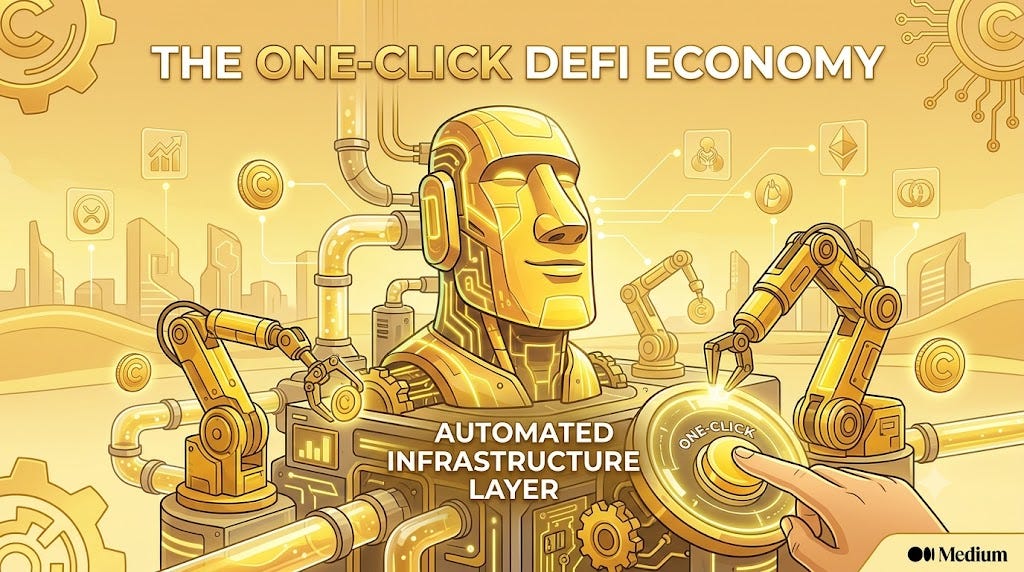
To fix this structural flaw, the complexity of the ecosystem must be absorbed by a dedicated infrastructure layer rather than being passed directly down to the end-user. Instead of building superficial dashboards that simply list complex options, the next generation of protocols focuses on deep integration and automated execution. By utilizing structured DeFi networks, the infrastructure layer acts as an automated buffer between raw on-chain data and the user:
- Concrete Vaults: Purpose-built smart contract suites designed to act as institutional-grade, risk-managed holding structures for pooled capital.
- Automated Execution: Replacing manual individual transactions with programmatic loops that harvest, route, and swap assets instantly based on real-time data feeds.
- Capital Coordination: Moving massive tranches of liquidity collectively, allowing users to bypass individual gas penalties and access institutional scale.
- Quantitative Allocation: Utilizing advanced risk algorithms to score yield sources dynamically and balance asset weights according to strict safety parameters.
- Structured DeFi Systems: Shifting the industry paradigm from a chaotic "do-it-yourself" toolkit to a cohesive, automated financial layer.
The key idea: The user should allocate capital. Infrastructure should handle operations.
4. Connect This to Concrete Vaults
Concrete transforms this architectural philosophy into a practical reality, simplifying onchain capital deployment into a unified, secure point of entry. When you deposit into a Concrete Vault, the system strips away the friction of manual management via a highly specialized engine:
- Automated Compounding: Instead of letting rewards sit idle or forcing you to harvest them manually, the vault continuously re-invests profits right back into the principal pool, maximizing your compound interest automatically.
- ctAssets: Upon depositing, you receive a tokenized receipt called a ctAsset (Concrete Tokenized Asset). These are composable, yield-bearing assets that grow in value relative to the vault’s underlying gains, letting you maintain liquidity while your position grows.
- Strategy Automation: The underlying system is constantly evaluating the broader lending and fee-generation landscape, pivoting capital away from decaying opportunities and into safer, more lucrative sectors.
- Onchain Execution: Every rebalance, capital call, and settlement happens directly on-chain under immutable security constraints, ensuring complete transparency without requiring any action on your part.
- Structured Vault Systems: Operating under a role-based permissions architecture, capital moves exclusively along pre-vetted, audited paths, eliminating manual user error entirely.
5. Explore the Benefits
When a system is built to absorb operational friction, the entire nature of onchain capital deployment changes. Shifting to this framework unlocks profound benefits:
- Capital Efficiency: Idle capital is eradicated. Funds are programmatically funneled into the most optimal strategies the moment conditions shift.
- Reduced Operational Burden: Users make a single transaction and can confidently walk away, letting the system manage the micro-movements.
- Consistent Strategy Execution: Algorithms don’t get tired, emotional, or miss market shifts. Execution happens perfectly according to protocol guardrails.
- Risk-Adjusted Yield: Concrete focuses on durability, balancing return with safety to protect the base principal.
- Institutional DeFi Infrastructure: Bringing the security, risk-modelling, and execution standards of traditional finance directly to public blockchains.
- Scalable Capital Deployment: Creating environments where millions of dollars can enter strategies seamlessly without triggering severe market slippage.
Ultimately, better infrastructure creates a vastly superior user experience, turning a high-stress chore into a reliable wealth engine.
6. The Bigger Shift
The evolution of on-chain finance is moving rapidly toward abstraction. The days of expecting individual users to act like full-time algorithmic traders are coming to an end. As we peer into the future of web3, several tectonic shifts are becoming obvious:
- Will users continue managing strategies manually? No. The math of gas costs, slippage, and time constraints makes manual rotation unsustainable for anyone who values their time.
- Do DeFi users want more features or fewer decisions? They want fewer, higher-conviction decisions. Complexity is no longer a feature; it is an onboarding obstacle.
- Are vaults becoming the default interface for deploying capital? Absolutely. Just as the traditional financial world relies on mutual funds, indexes, and ETFs, on-chain capital is defaulting to institutional-grade DeFi vaults.
- What does "one-click DeFi" actually mean? It means that the entire backend infrastructure of web3—bridges, smart contracts, oracles, and rebalancing loops—is condensed into a single, seamless intent.
The future of DeFi may not be giving users more work. It may be building infrastructure that does the work for them.
Step into the automated economy.
Explore Concrete at: https://concrete.xyz/