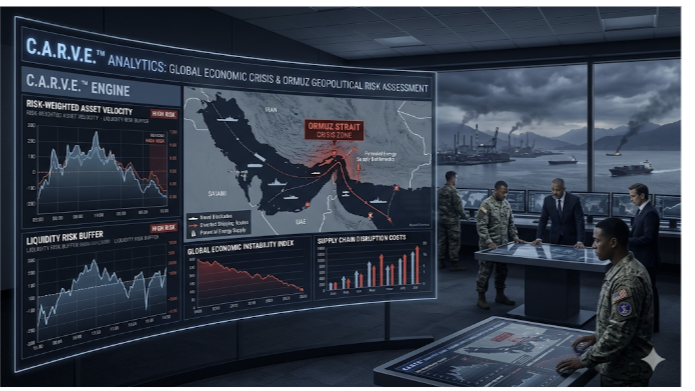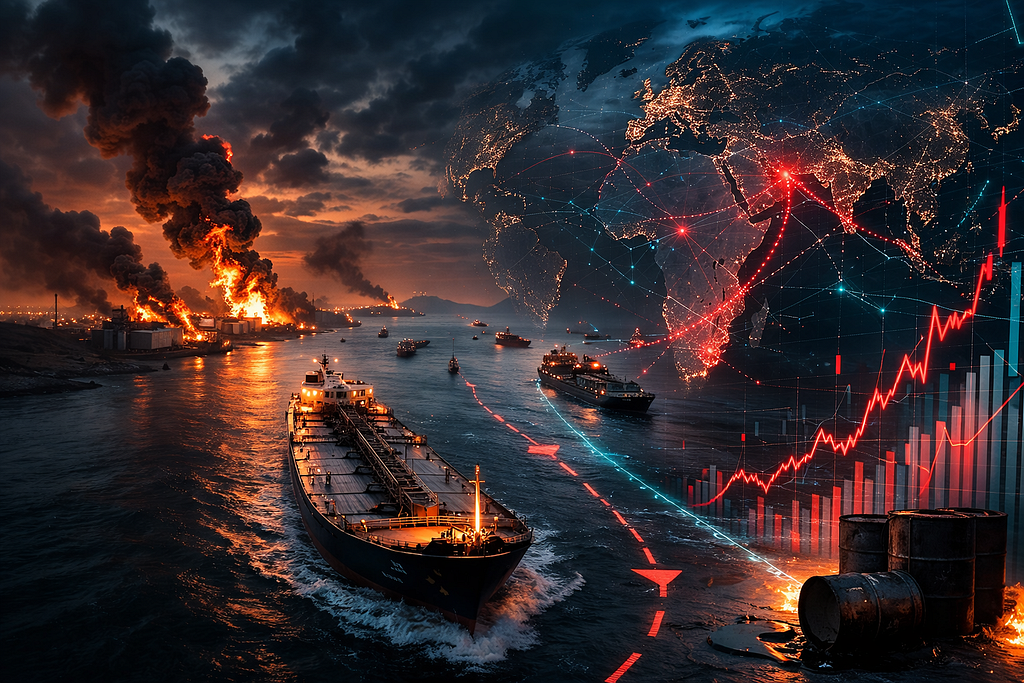
People keep talking about oil.
The real shock starts when ships stop moving normally.
That is the point most commentary still misses. War in the Gulf does not just threaten supply. It threatens movement. Once movement becomes slower, riskier, and more expensive, the crisis stops being an energy story and becomes an economic one.
The Strait of Hormuz is not just another chokepoint. In 2024, around 20 million barrels a day moved through it, equal to about 20 percent of global petroleum liquids consumption. In the same period, around one fifth of global LNG trade also passed through the same corridor.[1]
That alone should end the lazy assumption that disruption in the Gulf stays in the Gulf.
But there is a second layer that receives far less attention.
Global shipping is itself a vast fuel consumer. The International Energy Agency estimates the sector used 4.2 million barrels of oil a day in 2023.[2] So the system carrying the world economy is directly exposed to the same shock hitting the cargo it transports.
When conflict raises fuel prices, stretches routes, pushes insurance costs higher, and disrupts tanker scheduling, shipping absorbs the blow and then passes it on.
That is what is happening now.
Reuters reports that Middle East supertanker rates surged above $400,000 a day during the crisis. LNG freight rates jumped by more than 40 percent as Gulf traffic came under pressure.[3][4]
These are not side effects.
They are the transmission mechanism.
This is how an energy shock becomes an inflation shock.
Not in one dramatic instant at the bowser.
But through freight.
Through insurance.
Through route extension.
Through delayed cargoes.
Through higher bunker costs.
Through disrupted diesel flows.
Through more expensive fertiliser.
Through aviation fuel.
Through the simple fact that almost every physical good in the economy touches shipping at some point in its journey.
That is why the retail fuel price is a lagging indicator, not the first warning sign.
The first warning sign is whether shipping remains cheap, fast, and reliable.
Once it does not, the system starts repricing everything.
This is also why domestic reserve numbers can create false comfort. Counting days of stock on paper is useful, but it does not tell you whether the surrounding transport system is still functioning at the speed a modern economy expects. If freight friction rises sharply, inventory arithmetic starts colliding with a different problem, throughput.
The real test is not only how many days of fuel a country can theoretically count.
It is whether ships can still move, unload, insure, refuel, and turn around at a pace that keeps the wider economy supplied.
Once that rhythm starts breaking down, the pressure moves quickly.
Import costs rise.
Refiners and traders hedge more aggressively.
Industrial users pay more.
Agriculture feels it through fertiliser and transport.
Retail feels it through logistics.
Consumers feel it last, but by then the transmission has already happened.
That is why Saudi Aramco’s warning that the consequences of a prolonged Hormuz closure could be catastrophic should be read in a much wider frame.[5]
The issue is not only missing barrels.
It is that the economic machine built around moving energy becomes less efficient, less predictable, and more expensive at the same time.
This is where strategic complacency becomes dangerous.
Countries that think they are insulated because they are far from the battlefield are reading the map too narrowly. If Hormuz disruption persists, the shock will not arrive as a dramatic declaration. It will arrive as tightening constraints across freight, shipping schedules, LNG pricing, insurance, manufacturing inputs, and food distribution.
That is how wars in one region begin charging costs into economies far beyond it.
The next fuel shock will not start at the pump.
It will start offshore.
It will start when shipping markets stop functioning as if peace still exists.
It will start when a tanker route becomes a war risk premium.
It will start when LNG cargoes cost more to move before they even reach the buyer.
It will start when bunker fuel, insurance, delay, and rerouting begin feeding into everything else.
Once that begins, the argument changes.
The real question is whether the world economy can absorb a maritime fuel shock at the same time as it is already carrying fragile supply chains, politically constrained central banks, and thin industrial buffers.
That is the more serious question.
Because modern economies do not break only when supply disappears.
They also break when movement stops being cheap enough, fast enough, and reliable enough to hide the system’s dependence on flow.
The fuel crisis is not simply about what is pumped.
It is about what still moves.
And right now, that is the pressure point.
Footnotes
[1] U.S. Energy Information Administration, “Amid regional conflict, the Strait of Hormuz remains critical oil chokepoint,” June 16, 2025.
[2] International Energy Agency, “How the shipping sector could save on energy costs,” March 28, 2025.
[3] Reuters, “Global oil and gas shipping costs surge as Iran vows to close Strait of Hormuz,” March 2, 2026.
[4] Reuters, “Daily LNG freight rates jump over 40% amid Mideast strikes, Spark Commodities says,” March 3, 2026.
[5] Reuters, “Aramco sees catastrophic consequences for oil markets if Hormuz strait remains blocked,” March 10, 2026.
The Next Fuel Shock Will Not Start at the Pump was originally published in DataDrivenInvestor on Medium, where people are continuing the conversation by highlighting and responding to this story.