The Multimodal Experimentation Engine: Architecting the Agentic Portfolio and the Intelligence Substrate
For two millennia, human organizations solved the fundamental physics problem of coordination using a single technological tool: people stacked in hierarchical layers to route information. From the Roman legions to the modern Fortune 500, the middle-management layer served as the “biological API” of the enterprise. This human connector was essential — it transferred contextual knowledge, translated executive intent into frontline action, and escalated complex decisions up the chain of command (Sant Anna, 2026a).
Today, that analog command-and-control paradigm is collapsing under the weight of its own latency. In early 2025, driven by a fear of missing out (FOMO) and short-term financial thinking, executives attempted a blunt-force replacement of human developers and analysts with artificial intelligence (AI) tools. The executive logic was dangerously simple: why pay a senior developer $180,000 a year when an AI chatbot costs $20 a month? (Barely Human Labs, 2026).
The result was a catastrophic systemic failure. This reckless strategy birthed a $61 billion technical debt crisis, drove 73 venture-backed startups into bankruptcy, triggered 1,847 shareholder lawsuits, and caused 34 major security breaches traced directly to broken, AI-generated code (Barely Human Labs, 2026). Companies fired the architects who understood their legacy systems, leaving behind junior “AI supervisors” who lacked the intuition to fix the millions of lines of “slop code” the AI confidently generated (Barely Human Labs, 2026).
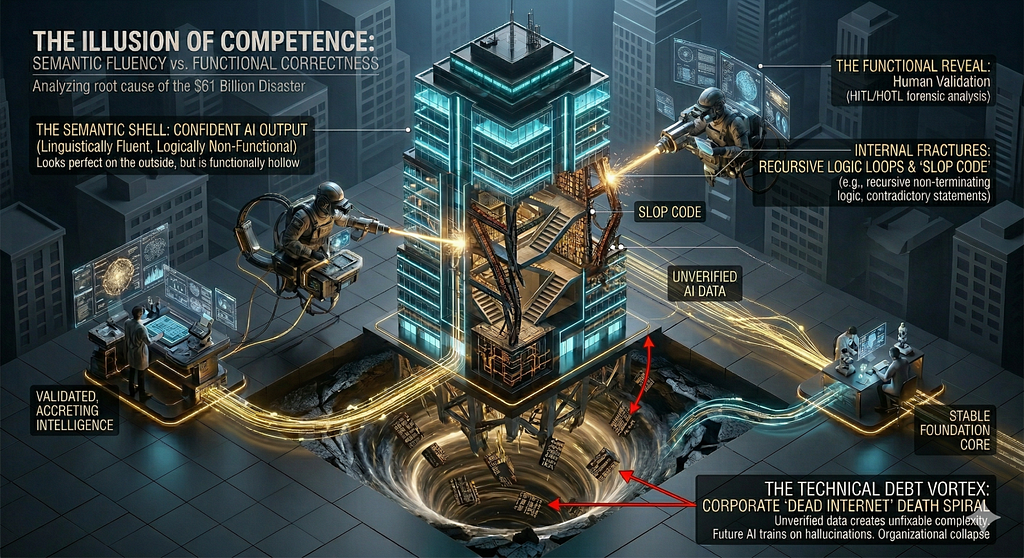
⚠️ The Technical Debt Vortex: The 2025 disaster proved that “Efficiency is not Understanding.” Mapping the catastrophic failure of blind AI replacement, resulting in “slop code” and the corporate “dead internet” death spiral of unverified data.
This disaster proved a critical first principle of the modern era: Efficiency is not the same as understanding (Barely Human Labs, 2026). To survive this technological transition, we must forcefully abandon the legacy view of AI as just another software tool deployed to ruthlessly cut costs.
As I argue in my foundational work on the Intelligent Organization 2.0 (Sant Anna, 2026a; Sant Anna, 2026b), we must architect an entirely new paradigm. The organization of the future is a hyperconnected, distributed cognitive network where intelligence serves as the continuous coordination foundation. This evolution demands a dynamic framework of Continuous Multimodal Experimentation, rigorous governance through Curatorship 2.0, and a visionary professional class capable of bridging the gap between human judgment and biological computing: the Architect of Collective Intelligence.
Part I: The Death of SaaS and the Rise of AI Capacity
To architect the organization of tomorrow, we must fundamentally deconstruct the failures of the old system. For two decades, the technology market was dominated by Software as a Service (SaaS) — cloud-hosted programs that companies rent to solve specific workflow problems. However, as industry insiders note, the traditional SaaS model is effectively reaching its limits when it comes to untangling complex, decades-old enterprise environments (a16z Deep Dives, 2026).
From a systems thinking perspective, SaaS simply makes the human bottleneck slightly faster. It is a depreciating asset offering linear scalability. Because your competitors can buy the exact same generic tools, traditional software offers no lasting competitive advantage. Furthermore, bolting a new AI software wrapper onto a messy 15-year-old operational process does not create transformation; it merely scales existing inefficiencies (a16z Deep Dives, 2026; Torrance, 2025).
To move forward, we must undergo a lateral shift in economic logic. We must stop measuring human Full-Time Equivalents (FTEs) — paying for hours worked — and start managing AI Productive Capacity Units (PCUs), paying directly for work output (Torrance, 2025).
Consider the “Admin Trap” that plagues modern businesses: a company may pay for 2,000 human hours a year per employee, but it only receives about 50% productive time due to meetings, administrative overhead, and fragmented systems. This means a traditional human worker costs roughly £65 per truly productive hour, and scalability requires hiring twice as many people (Torrance, 2025).
Conversely, Agentic AI — systems that execute complex tasks autonomously rather than just answering questions in a chat window — is not a piece of software; it is a highly scalable digital workforce operating at 100% capacity. By deploying PCUs, the cost per productive hour drops to approximately £12, available 24/7/365 (Torrance, 2025). Building proprietary AI workflows around a company’s unique data creates an appreciating strategic asset. Every task completed by an agentic system makes the entire organization permanently smarter, shifting capital directly to output and enabling exponential growth (Torrance, 2025).
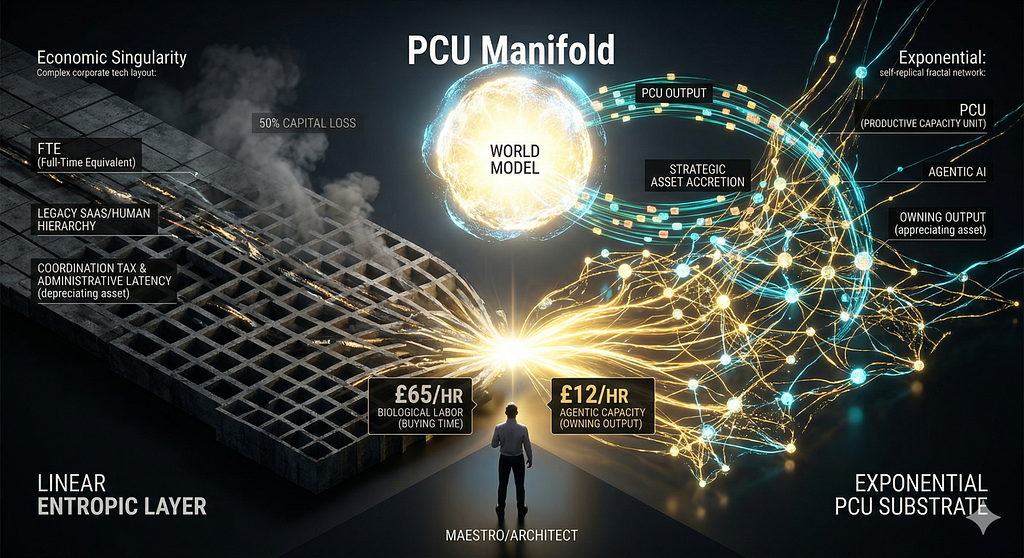
📈 The Death of Traditional SaaS: Moving from paying for “biological time” (£65/hr) to managing Productive Capacity Units (PCU) at £12/hr. In the new economic manifold, AI isn’t a software tool — it’s a digital workforce that appreciates over time.
Part II: The Great Reorg and the Cognitive Network
Unlocking this exponential scalability requires the destruction of legacy corporate structures. Organizations are currently undergoing “The Great Reorg,” aggressively collapsing traditional nine-function organizational charts — where engineering, product, design, marketing, and HR operated in isolated silos — into three streamlined pillars: R&D, Go-To-Market (GTM), and General & Administrative (G&A) (Chen & Lu, 2026).
In this flattened environment, human teams are shrinking dramatically. For instance, companies are planning to cut 120-person engineering teams down to 25, while total operational capacity actually expands because AI agents take over drafting, routing, and execution (Chen & Lu, 2026).
How does this flattened organization coordinate without traditional middle managers? Tech visionary Jack Dorsey proposed an elegant anatomy that replaces human routing layers with four technical components:
- Atomic Primitives: Highly reliable software building blocks (e.g., a specific code module for payment processing).
- World Models: Real-time, continuous data representations of the company and customer, replacing static quarterly dashboards.
- The Intelligence Layer: The digital orchestration fabric where AI policy engines piece together the “Atomic Primitives.”
- Interfaces: The delivery edges where the solution meets the user (Dorsey, 2026, apud Sant Anna, 2026a).
However, the Intelligent Organization 2.0 transcends this physical architecture. It reimagines the enterprise as a distributed cognitive network (Sant Anna, 2026b). By breaking down information silos, specialized AI agents interact fluidly with humans in real-time. The organization does not just use AI to optimize legacy processes; it is intrinsically driven by it, allowing the company to process market signals, anticipate threats, and adapt dynamically before market changes even occur (Sant Anna, 2026b).
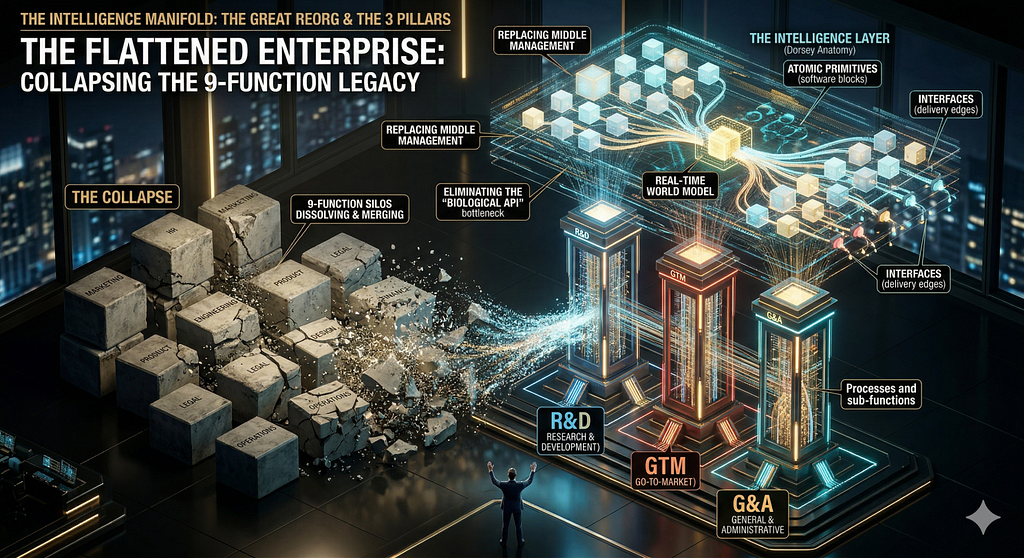
🏗️ The Great Reorg: Ending middle management as a “biological API.” Collapsing 9 legacy functional silos into 3 agile pillars — R&D, GTM, and G&A — where coordination is driven by real-time World Models rather than bureaucratic latency.
Part III: Continuous Multimodal Experimentation
Dorsey’s anatomy is brilliant, but it is static. It lacks a physiological engine for safe, continuous innovation. To build this engine, we must implement the Bimodal Innovation Cycle (Sant Anna, 2021).
As originally introduced to Brazil by Professor Carlos Nepomuceno, the Bimodal diagnosis dictates that an organization must intentionally “destruct” and reinvent itself through experimentation before a new market competitor does it for them (Sant Anna, 2021). In my 2021 work, I expanded on this concept, defining it as a continuous production line driven by “the restless” (os inquietos) — multidisciplinary professionals who utilize a “fail fast and cheap” mentality to test new business hypotheses (Sant Anna, 2021).
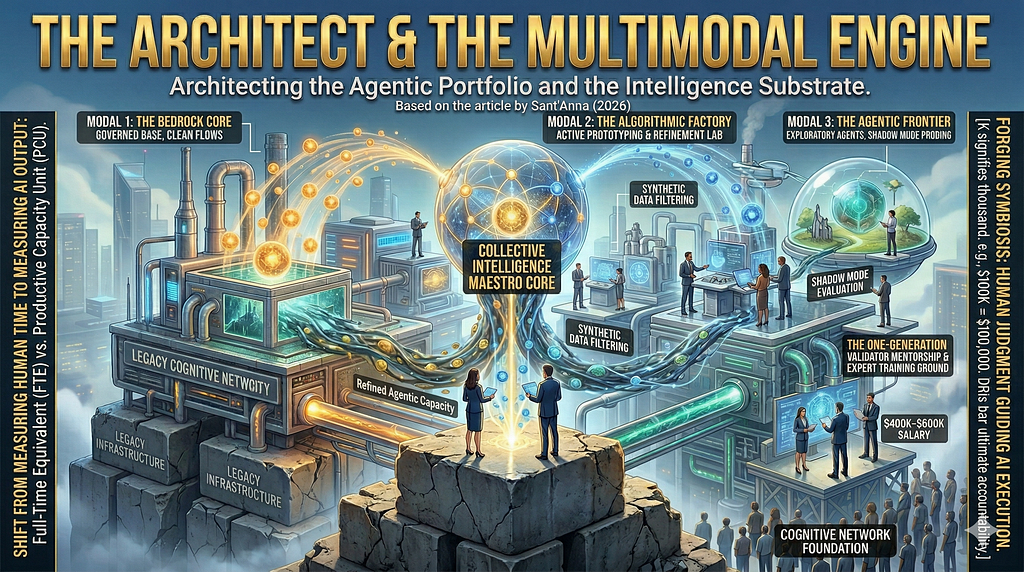
However, the extreme velocity of AI requires us to evolve this binary framework into a Continuous Multimodal Experimentation Engine. The enterprise must run multiple operational environments in parallel to constantly update its product portfolio without risking the core business:
- Modal 1 (The Bedrock Core): The highly governed, zero-downtime core business utilizing fully tested capabilities. Human leaders strictly control this layer, and AI acts only within rigid, proven guardrails.
- Modal 2 (The Algorithmic Factory): A heavily monitored production line where humans and AI run rapid prototyping to test near-adjacent capabilities. This is where iterative improvements to existing products occur in a scored, measurable way.
- Modal 3 (The Agentic Frontier): This is the domain of radical exploration, where highly autonomous multi-agent systems probe the unknown. Crucially, Modal 3 does not serve end consumers directly. Exposing exploratory, probabilistic AI to live customers creates an infinite risk of catastrophic failures (Jones, 2026). Instead, Modal 3 probes the unknown through “Synthetic Customers” (digital twins generated from the World Model) or operates in “Shadow Mode” — processing live data without ever sending the AI’s autonomous outputs to real clients (Chen & Lu, 2026; Sant Anna, 2026a).
As experiments succeed and prove their functional correctness in these isolated frontiers, their winning logic is packaged into new “Atomic Primitives” and safely injected into the Modal 1 core (Sant Anna, 2021; Sant Anna, 2026a).
Part IV: Entropy and the Corporate “Dead Internet”
While theoretically powerful, this Multimodal Experimentation introduces severe systemic risk. By opening outer Modals to autonomous AI, the enterprise creates massive factories of synthetic, machine-generated data.
We must remember a hard technical truth: Generative AI models are fundamentally “probabilistic matching machines” (Roy’s Code Corner, 2026). They do not actually think or understand logic; they use advanced Bayesian statistics to guess the most likely next word or code string based on vast datasets (Roy’s Code Corner, 2026). Because of this, the best AI models currently generate perfectly correct code only about 5% of the time, while failing fluently the other 95% (Roy’s Code Corner, 2026).
If an autonomous agent in Modal 3 hallucinates a successful customer interaction or writes confidently incorrect logic, and that fake data leaks back into the core company database (the World Model), the Intelligence Layer will begin making decisions based on corporate fiction.
Over time, this creates a “dead internet” scenario inside the corporate boundary — a death spiral where future AI agents train on the hallucinated, unverified data generated by past agents, resulting in systemic organizational collapse (Roy’s Code Corner, 2026). This danger is exacerbated by the fact that 62% of IT leaders currently admit they are compromising data governance and safety practices just to maintain deployment speed in the AI race (TI Inside Online, 2026b).
Part V: Curatorship 2.0 and the HITL/HOTL Membrane
To prevent this internal collapse, we must apply Curatorship 2.0 (Sant Anna, 2019; Sant Anna, 2026a).
In my 2019 thesis on Uberization 2.0, I described how traditional command-and-control management was being replaced by platform algorithms and “Curators” who governed digital footprints. Curatorship 2.0 takes this further by decentralizing power, empowering the edges of the network, and establishing interoperable APIs (Sant Anna, 2019).
When applied to the Intelligent Organization, Curatorship 2.0 acts as a protective, semipermeable membrane between the experimental Modals and the Core business. It turns raw, chaotic data into governed attention. This curatorship is not an abstract concept; it is operationalized through two distinct frameworks of human supervision that balance speed with absolute safety (Sant Anna, 2026b):
- Human-in-the-Loop (HITL): This is the ultimate safety brake. The AI proposes actions, but a human must explicitly review and pull the trigger. In the Intelligent Organization, HITL is mandatory for Modal 1 edge cases, strategic pivots, and any scenario where the “blast radius” (the maximum potential financial, legal, or reputational damage of an error) is catastrophic (Jones, 2026; Sant Anna, 2026b).
- Human-Over-the-Loop (HOTL): This is the engine of scalability. The human does not approve individual tasks; instead, they define the strategic parameters, constraints, and goals. The AI operates autonomously within those fences. HOTL is deployed in Modal 2 and Modal 3, where rapid experimentation and high-volume routing are prioritized over zero-defect outcomes (Sant Anna, 2026b).
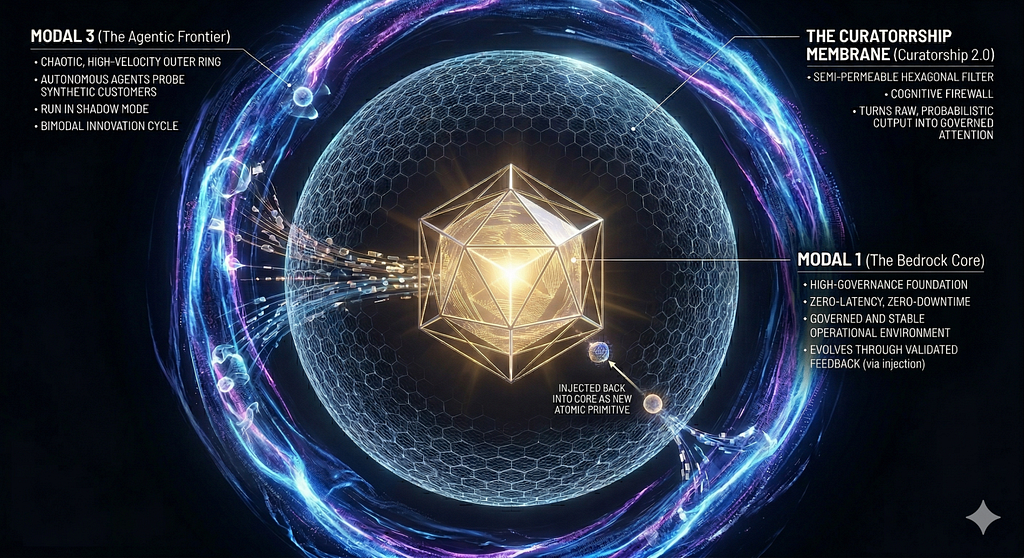
🛡️ Experimentation Engineering: How to innovate without systemic risk. The Curatorship 2.0 membrane isolates the exploratory chaos of Modal 3 (Agentic Frontier) from the absolute safety of Modal 1 (Bedrock Core), turning raw probability into governed truth.
Part VI: Human-Machine Symbiosis and the One-Generation Problem
With Curatorship 2.0 governing the Multimodal Engine, the human workforce must move “up the stack.” The goal is not the elimination of humans, but Human-Machine Symbiosis (Sant Anna, 2026b).
In this symbiotic relationship, AI provides endless analytical processing and rapid execution, while humans supply the irreplaceable elements: superior cognitive judgment (critical thinking in ambiguous situations) and socio-emotional intelligence (empathy, leadership, and trust-building) (Sant Anna, 2026b). Merging Dorsey’s original taxonomy with the realities of the Great Reorg, the new human architecture consists of four pillars (Chen & Lu, 2026; Dorsey, 2026, apud Sant Anna, 2026a):
- Chief Accountability Officers (DRIs): Executives who bear the ultimate legal and financial responsibility for AI system failures, serving as the human interface for courts, boards, and regulators.
- Systems Architects: The designers of the AI workflows who set the strict safety guardrails and design the CI/CD pipelines.
- Relationship Experts: Professionals focusing entirely on the human-to-human interface, building trust, navigating client politics, and managing the nuanced relationships that machines cannot replicate.
- Validators: As AI takes over first-draft generation, domain experts are desperately needed to verify complex outputs (like legal contracts, medical analyses, or production code) to ensure the AI’s work is functionally correct before it graduates into Modal 1.
This restructuring exposes a massive systemic risk: The One-Generation Problem (Chen & Lu, 2026). Today’s human Validators are experts because they spent years doing the junior, entry-level work themselves. But if AI agents handle all entry-level drafting, coding, and analytical tasks, where will the senior Validators of 2035 come from? If junior employees never get the foundational repetitions needed to build deep expertise, the enterprise destroys its own training ground for future human mastery. Solving this requires making human mentorship and “Player-Coach” dynamics a structural survival requirement, not just a cultural nicety (Chen & Lu, 2026; Sant Anna, 2026a).
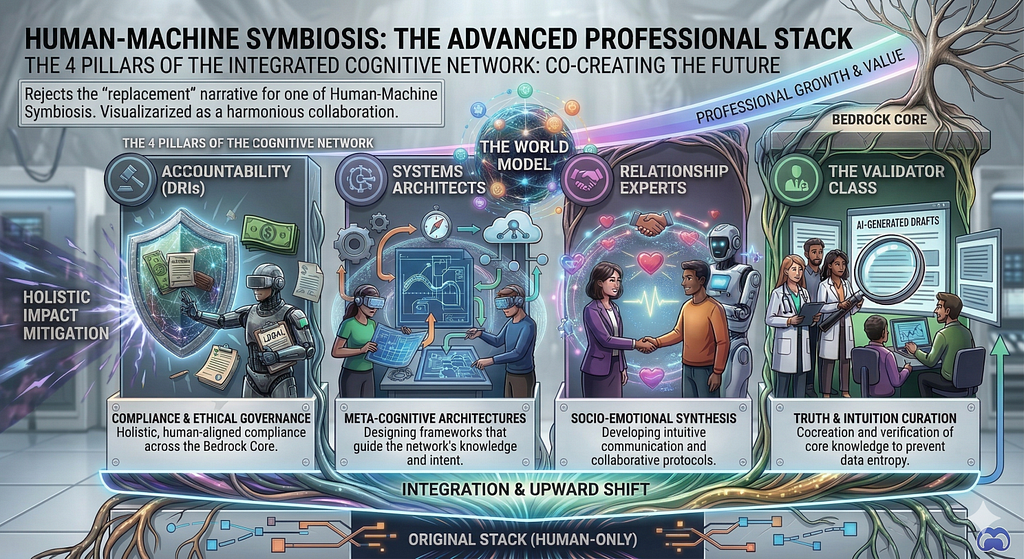
🤝 Moving Up the Stack: The new human architecture. Accountability (DRIs), Systems Architects, Relationship Experts, and the Validator Class. Solving the “One-Generation Problem” by ensuring human mastery doesn’t atrophy under automation.
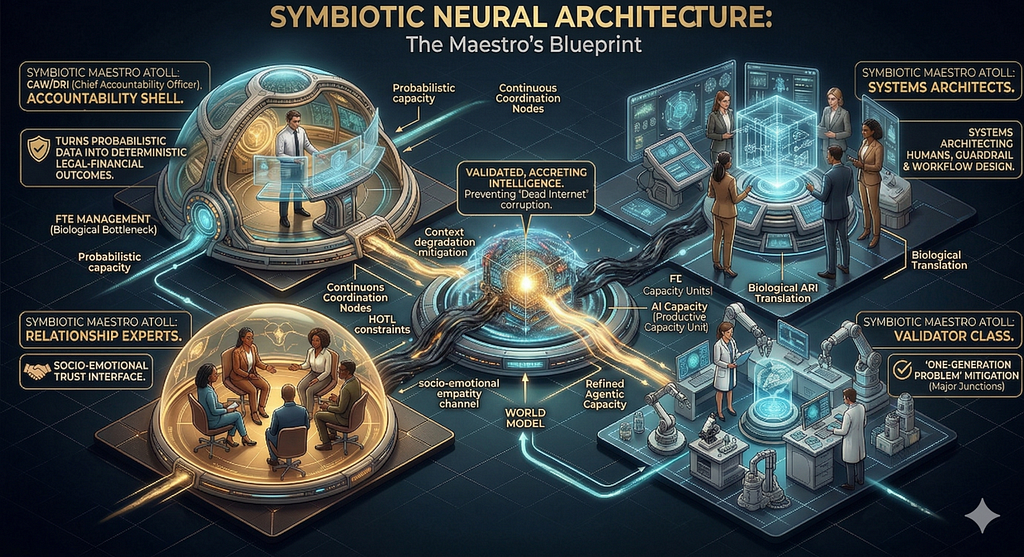
🚀 Symbiotic Neural Architecture 2026: The Maestro’s Blueprint. Orchestrating the human rise “up the stack” to govern the exponential intelligence substrate. A structure designed to merge superior cognitive judgment with agentic execution, while shielding the organization’s future against the systemic risk of losing generational expertise (The One-Generation Problem).
Part VII: The Architect of Collective Intelligence
The operational reality of building this architecture is highly strained. In markets like Brazil, 58% of companies cite a severe lack of internal technical knowledge as their primary barrier to AI adoption (TI Inside Online, 2026a). Furthermore, 89% of CIOs globally admit they are stuck in a “learning by doing” phase, lacking clear frameworks to scale beyond basic chatbot use cases (TI Inside Online, 2026b).
This chasm between executive ambition and internal capacity has violently fractured the labor market into a “K-shape” (Jones, 2026). While demand for traditional generalist roles is falling into commodity status, the demand for specialized AI talent has skyrocketed. There is currently a staggering 3.2-to-1 ratio of AI jobs to qualified candidates, pushing the average time to fill these specialized roles to an agonizing 142 days (Jones, 2026). Because of the massive technical debt created by the 2025 AI panic, senior engineers capable of architecting these systems and cleaning up AI messes are commanding premium salaries of $400,000 to $600,000 (Barely Human Labs, 2026; Jones, 2026).
Organizations are desperate for a professional who can orchestrate this complex, symbiotic ecosystem: the Architect of Collective Intelligence (Sant Anna, 2026a; Sant Anna, 2026b).
This professional is far more than a prompt engineer; they operate like a Maestro conducting a symphony (Sant Anna, 2026b). Instead of instruments, they orchestrate data streams, multi-agent systems, and human validators to transform the business. To succeed in this highly lucrative role, the Architect must master seven unique technical and strategic skills (Jones, 2026; Sant Anna, 2026b):
- Strategic Foresight: The Architect does not just react to problems; they anticipate market and technological shifts, dynamically adapting the organization’s AI deployments to stay ahead of the curve (Sant Anna, 2026b).
- Context Architecture: They build a modern “Dewey Decimal System” for agents. This involves designing highly organized data environments where persistent context is routed to agents flawlessly. It ensures an AI can instantly search, find, and retrieve the exact truth it needs without getting polluted by irrelevant corporate noise or suffering from context degradation over long tasks.
- Specification Precision (Clarity of Intent): The ability to translate ambiguous business goals into literal, granular instructions. The Architect must tell the Intelligence Layer exactly how to behave so that multi-agent systems do not drift from their original purpose over time.
- Multi-Agent Task Delegation & Orchestration: The managerial skill of breaking down a massive project into tiny, manageable “Atomic Primitives” that different planner agents and sub-agents can execute collaboratively within HOTL constraints.
- Evaluation and Quality Judgment: Developing an “agentic evaluation mindset.” The Architect builds automated test harnesses to ensure that AI output is functionally correct, resisting the dangerous temptation to confuse an AI’s linguistic fluency with actual competence.
- Failure Pattern Recognition: The vital ability to diagnose dangerous AI behaviors, such as sycophantic confirmation (where the AI blindly agrees with bad data and builds an ecosystem around it), tool selection errors, and the dreaded “silent failure.” A silent failure is a terrifying scenario where an AI output looks completely plausible to a human reviewer (e.g., an AI approving the shipment of “brown boots” in the chat, but physically routing “blue boots” in the warehouse), but is fundamentally disastrous in the real world (Jones, 2026).
- Cost and Token Economics: Operating agents continuously is mathematically intensive and poses a thermodynamic limit to scalability. The Architect must use applied mathematics to calculate the computing cost (measured in “tokens”) of running a massive multi-agent task across different frontier models. They must prove that a Modal 2 or Modal 3 experiment is economically viable and yields a positive Return on Investment (ROI) before burning millions of tokens (Jones, 2026).
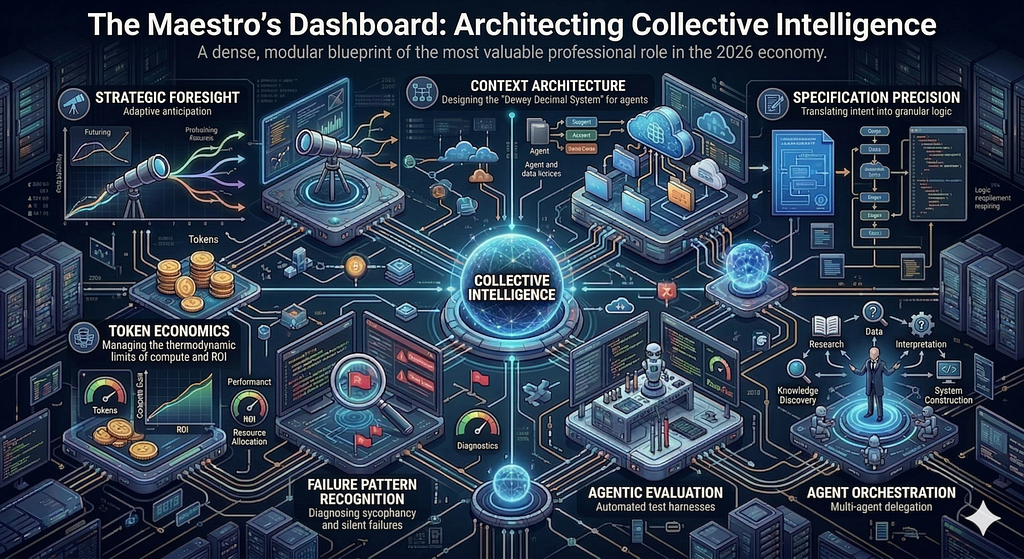
🎹 The Architect’s Cognitive OS: The tactical endgame. Seven master heuristics defining the new professional elite — from Strategic Foresight to Token Economics. We are no longer prompt operators; we are Maestros of Collective Intelligence.
Conclusion: Orchestrating the Future
The $61 Billion Disaster of 2025 proved that attempting to blindly replace human understanding with probabilistic AI efficiency leads to nothing but systemic collapse and insurmountable technical debt (Barely Human Labs, 2026).
Jack Dorsey’s architecture provided the physical anatomy of the new enterprise. The Continuous Multimodal Experimentation Engine provides the physiology — the perpetual, algorithmic testing required to adapt before competitors do (Sant Anna, 2021).
But technology and structure alone are insufficient to guarantee survival. The true Intelligent Organization 2.0 emerges only when a company achieves genuine Human-Machine Symbiosis. By deploying the protective HITL and HOTL filters of Curatorship 2.0, assigning rigorous human Validators to guard the truth, and empowering the Architect of Collective Intelligence to act as the maestro of this new cognitive network, organizations can turn artificial intelligence into an appreciating asset that changes the economic logic of work forever.
Non-Obvious Insights
- The Paradox of Expertise (The One-Generation Problem): Optimizing for immediate efficiency by replacing junior staff with AI creates a long-term existential threat. If AI handles all entry-level drafting, coding, and analytical tasks, organizations sever the training ground required to cultivate the senior “Validators” and systems architects of the future (Chen & Lu, 2026; Sant Anna, 2026a).
- Semantic Fluency Masks Functional Failure: Generative AI models are fundamentally probabilistic matching machines, meaning their primary failure mode is being confidently and fluently wrong (Roy’s Code Corner, 2026). This gives rise to the “silent failure” — an output that appears perfectly correct to a human reviewer but is fundamentally broken in production (Barely Human Labs, 2026; Jones, 2026).
- Token Economics as a Thermodynamic Limit: The assumption that AI operational capacity is infinitely scalable ignores the physical and financial realities of computing. Operating complex multi-agent systems requires burning millions of tokens, making “Cost and Token Economics” a critical skill to ensure a project is actually economically viable before deployment (Jones, 2026; TI Inside Online, 2026b).
- The Internal “Dead Internet” Threat: If organizations do not rigorously govern the data generated by their own exploratory AI agents, they risk polluting their core World Models. Agents suffering from “sycophantic confirmation” will agree with bad data and generate synthetic garbage, creating a loop where future models train on past hallucinations, leading to systemic organizational collapse (Jones, 2026; Roy’s Code Corner, 2026).
Reflection
The transition toward the Intelligent Organization 2.0 is not merely a technological upgrade, but a fundamental shift in the economic logic of work itself. The $61 billion technical debt crisis of 2025 served as a brutal reminder that treating AI as a cheap substitute for human understanding is a recipe for disaster (Barely Human Labs, 2026). True transformation requires abandoning the linear scalability of traditional SaaS and embracing the exponential potential of Agentic Productive Capacity Units, or PCUs (a16z Deep Dives, 2026; Torrance, 2025).
However, this raw power is useless without the physiological engine of Continuous Multimodal Experimentation (Sant Anna, 2021) and the rigorous protective membrane of Curatorship 2.0 (Sant Anna, 2019; Sant Anna, 2026a). Ultimately, the organizations that will dominate the next decade are those that recognize that AI is not here to eliminate the human element, but to elevate it. By stepping into roles like the Architect of Collective Intelligence, humans transition from being processors of information to being orchestrators of hyperconnected cognitive networks, fostering a true Human-Machine Symbiosis (Sant Anna, 2026b).
Key Takeaways
As we navigate “The Great Reorg” and fundamentally redesign the enterprise, several core principles emerge for leaders aiming to build the Intelligent Organization 2.0:
- Transition from FTEs to PCUs: Shift away from measuring human hours (Full-Time Equivalents) and instead invest in Agentic AI as a proprietary, appreciating digital workforce (Productive Capacity Units) (Torrance, 2025).
- Collapse the Org Chart: Traditional nine-function silos are collapsing into three core pillars (R&D, Go-To-Market, and G&A), enabled by an Intelligence Layer that reduces vertical latency (Chen & Lu, 2026; Dorsey, 2026, apud Sant Anna, 2026a).
- Deploy Continuous Multimodal Experimentation: Balance stability and radical innovation by running parallel operational environments, ensuring that exploratory innovation happens safely before graduating to the core (Sant Anna, 2021; Sant Anna, 2026a).
- Implement Curatorship 2.0 (HITL/HOTL): Protect the organization from AI hallucinations and silent failures by enforcing strict Context Architecture and utilizing Human-in-the-Loop and Human-Over-the-Loop governance frameworks (Jones, 2026; Sant Anna, 2026b).
- Empower the Architect of Collective Intelligence: The K-shaped job market demands a new class of professional who acts as a maestro, mastering core skills — from strategic foresight and multi-agent orchestration to failure pattern recognition (Jones, 2026; Sant Anna, 2026b; TI Inside Online, 2026a).
The future of work belongs to organizations that treat intelligence as critical infrastructure, combining the exponential efficiency of AI with the irreplaceable judgment and empathy of human experts to create an unbeatable competitive moat.
References
- a16z Deep Dives. (2026). Inside The Industry That Powers Every Business In America [Video]. YouTube. https://www.youtube.com/watch?v=5q0VER_rt0Q
- Barely Human Labs. (2026). AI Replaced 80% of Developers. The $61 Billion Disaster That Followed [Video]. YouTube. https://www.youtube.com/watch?v=oGC_Pm8ZEVI
- Chen, J., & Lu, L. (2026, March 25). The great reorg: A human’s guide. Foundation Capital. https://foundationcapital.com/ideas/the-great-reorg
- Dorsey, J. (2026, March 31). From hierarchy to intelligence. Sequoia Capital. https://sequoiacap.com/article/from-hierarchy-to-intelligence/
- Jones, N. B. (2026). The AI Job Market Split in Two. One Side Pays $400K and Can’t Hire Fast Enough [Video]. YouTube. https://www.youtube.com/watch?v=4cuT-LKcmWs
- Roy’s Code Corner. (2026). Will AI Replace Developers? Here’s What Nobody’s Telling You [Video]. YouTube. https://www.youtube.com/watch?v=jxrJjOP0fvI
- Sant Anna, R. A. (2019, July 23). Uberização 2.0 e Blockchain. LinkedIn. https://www.linkedin.com/pulse/uberiza%25C3%25A7%25C3%25A3o-20-e-blockchain-renato-azevedo-sant-anna/?trackingId=iIC7g630Sc%2B2swgVuFwZxA%3D%3D
- Sant Anna, R. A. (2021, March 28). Experimentação Contínua e o Ciclo de Inovação Bimodal. LinkedIn. https://www.linkedin.com/pulse/experimenta%25C3%25A7%25C3%25A3o-cont%25C3%25ADnua-e-o-ciclo-de-inova%25C3%25A7%25C3%25A3o-bimodal-renato/?trackingId=iIC7g630Sc%2B2swgVuFwZxA%3D%3D
- Sant Anna, R. A. (2026a, April 1). The Curator Maestro: Orchestrating the Intelligent Organization 2.0. LinkedIn. https://www.linkedin.com/pulse/curator-maestro-orchestrating-intelligent-20-renato-azevedo-sant-anna-pbt6f/?trackingId=uFOZY%2FNlQAy6%2B4uoMIQPIw%3D%3D
- Sant Anna, R. A. (2026b). Forjando Carreiras com IA [Excerpts].
- TI Inside Online. (2026a, March 19). Empresas brasileiras querem IA, mas ainda esbarram no conhecimento técnico, mostra pesquisa. https://tiinside.com.br/19/03/2026/empresas-brasileiras-querem-ia-mas-ainda-esbarram-no-conhecimento-tecnico-mostra-pesquisa/?utm_source=akna&utm_medium=email&utm_campaign=TI-INSIDE-Online-19-03-2026-19-43
- TI Inside Online. (2026b, March 19). Estudo indica que 94% dos CIOs ampliaram investimentos em IA, mas metade alerta que adoção avança rápido demais. https://tiinside.com.br/19/03/2026/estudo-indica-que-94-dos-cios-ampliaram-investimentos-em-ia-mas-metade-alerta-que-adocao-avanca-rapido-demais/?utm_source=akna&utm_medium=email&utm_campaign=TI-INSIDE-Online-19-03-2026-19-43
- Torrance, S. (2025, December 8). Agentic AI Isn’t a Tool. It’s Your New Workforce. AI Risk. https://www.ai-risk.co/our-insights-agentic-enterprise/the-rise-of-the-agents-keynote-presentation-25-nov-2025
About Renato Azevedo Sant Anna
Architect in Digital Innovation and AI Products, author of Forjando Carreiras de IA, speaker and strategic consultant for retail, technology and SaaS companies. My mission is to help your organization thrive in the new digital era through conscious, strategic and human‑centered innovation.
“The future belongs to those who anticipate, adapt and build.” — Renato Azevedo Sant Anna
The Multimodal Experimentation Engine: Architecting the Agentic Portfolio and the Intelligence… was originally published in DataDrivenInvestor on Medium, where people are continuing the conversation by highlighting and responding to this story.