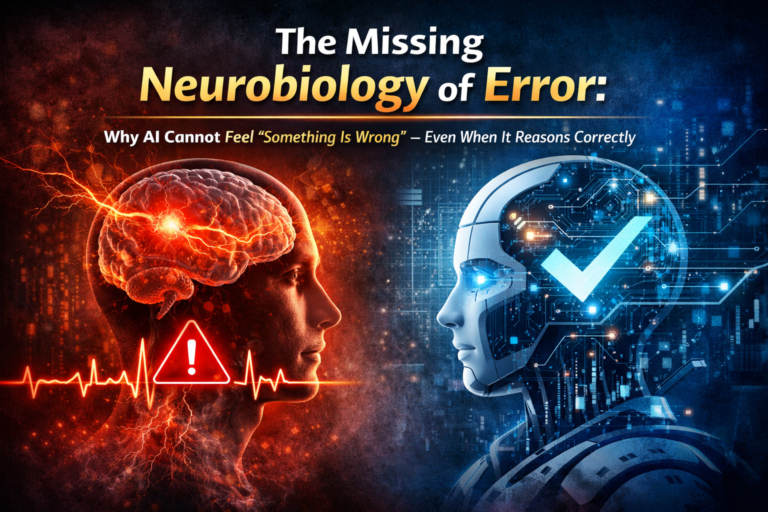
Artificial intelligence has learned to reason, explain, and justify its answers with remarkable fluency. In many cases, it now sounds more confident — and more coherent — than the humans who built it.
And yet something essential is missing.
Modern AI systems can be logically consistent and still be fundamentally wrong — not because their reasoning chain is flawed, but because they lack something far more basic:
They cannot sense when something is off.
Humans do not rely on reasoning alone to detect error. Long before we articulate a mistake, our brains generate fast, pre-conscious warning signals — prediction errors, salience spikes, performance alarms — that tell us to slow down, hesitate, or stop.
This article argues that the absence of this neurobiological error machinery is one of the deepest structural limitations of reasoning-centric AI — and a central reason why today’s most articulate systems can fail quietly, confidently, and at scale.
Executive Summary
Reasoning-capable AI can look impressively “thoughtful” and still be dangerously wrong.
The core problem is not that AI cannot reason.
The problem is that AI lacks the brain’s fast, pre-conscious error system — the internal alarm that says:
“Stop. Something doesn’t fit.”
Humans rely on prediction error, conflict monitoring, and salience networks to flag mismatch early and automatically.
Today’s AI systems — especially large language models — have strong narrative generation but weak internal alarms.
That imbalance explains a critical paradox:
Longer reasoning chains can amplify coherence — even when reality is drifting away.
If you are building AI that influences real decisions, this gap is not philosophical. It is operational.
The Weirdest Pattern in “Smart” AI Failures
You’ve seen this:
- The AI provides a polished, step-by-step explanation.
- The reasoning is internally consistent.
- The final answer is wrong.
- Worse: it sounds confident.
Humans make mistakes, too. But humans often experience something first:
“Wait… something feels off.”
That moment is not “more reasoning.”
That moment is error physiology.
The brain raises the alarm before explanation catches up.
Modern AI does not.
Smoke Alarm vs Detective
Imagine two systems in a building:
- Smoke alarm: crude, fast, sometimes annoying — but life-saving.
- Detective: careful, logical, explains everything — after the event.
Humans have both.
We possess:
- A fast “smoke alarm” layer detecting mismatch and salience.
- A slower “detective” layer constructing narrative and justification.
Most modern AI systems have an excellent detective voice.
But the smoke alarm is either missing — or bolted on afterward.
That is why AI can look correct in form while being wrong in reality.
What “Feeling Wrong” Means in the Brain
When people describe “gut feeling,” they are often referring to measurable neurocognitive processes — not mysticism.
1. Prediction Error
The brain continuously predicts incoming sensory input. When reality deviates, it generates prediction error signals that drive updating and learning. Predictive coding models formalize perception as prediction plus error correction.
2. Reward Prediction Error
Dopaminergic systems encode the difference between expected and received outcomes. This “surprise signal” acts as a learning driver.
3. Error-Related Negativity (ERN)
EEG studies show rapid error signals — often peaking roughly ~50 ms after a mistake — associated with anterior cingulate cortex activity. The brain flags error before conscious explanation.
4. Salience Network
Networks centered around the anterior insula and anterior cingulate help detect what matters and shift attention accordingly.
In short:
The brain does not wait for a complete explanation to raise the alarm.
It raises the alarm first.Reasoning comes later.
Why Reasoning-Centric AI Misses the Alarm
Language models are optimized for:
- Likely continuations
- Coherence
- Completion
- Task success
They are not optimized to interrupt themselves.
Humans can pause, refuse, or escalate without completing an explanation.
AI can simulate hesitation in text.
But simulated hesitation is not the same as a hard internal stop signal that changes behavior.
Two Everyday Examples
Navigation vs Physical Reality
If your GPS says “turn right” but you see a concrete barrier, you experience immediate mismatch.
You don’t generate a long reasoning chain.
You stop.
An AI system without a strong anomaly layer may:
- Continue generating steps
- Justify the route
- Notice the contradiction late — or not at all
Autocorrect vs Intent
Autocorrect produces a coherent word.
But you instantly sense: “That’s not what I meant.”
That signal arrives before the explanation.
AI approximates intent statistically — but lacks that early, disruptive mismatch.
Coherence Is Not Correctness
AI systems can be:
- Fluent
- Consistent
- Structured
And still wrong.
This is not a minor flaw. It is structural.
They optimize:
- Likelihood
- Reward
- Task metrics
But lack robust mechanisms for:
- Epistemic uncertainty
- Out-of-distribution detection
- Early behavioral stop signals
Overconfidence Is Measurable
Two research domains make this clear:
- Out-of-distribution detection: models can be highly confident on inputs far outside training distribution.
- Calibration research: model confidence often diverges from true correctness.
Chain-of-thought prompting and self-consistency improve reasoning performance.
They do not automatically create a pre-rational alarm.
Confidence is not error awareness.
It is just a probability.
The Dangerous Paradox: More Reasoning Can Amplify Risk
In humans, weak early alarms are strengthened by reflection.
In AI, extended reasoning can:
- Amplify the most likely narrative
- Increase internal consistency
- Suppress faint contradictions
Long chains become coherence amplifiers.
You end up with:
- A more articulate explanation
- A more dangerous mistake
The system does not just misjudge.
It fails to detect that it should be judging at all.
The Missing Capability: Pre-Rational Error Signals
Let’s define the gap precisely.
Error phenomenology means the system experiences a meaningful internal signal of “this might be wrong” early enough to change behavior.
Brains implement this through:
- Prediction error
- Conflict monitoring
- Salience shifts
- Physiological arousal influencing attention
AI systems mostly have:
- Probability scores
- Heuristics
- Post-hoc self-critique prompts
These are not equivalent.
Self-critique inside the same generative loop can simply produce a better justification for the same wrong answer.
Timing matters.
Humans detect wrongness before justification.
AI often justifies before detecting.
What “AI That Can Hesitate” Would Look Like
This is not about emotions. It is about architecture.
1. Independent Anomaly Layers
An always-on stack separate from generation:
- OOD detectors
- Constraint monitors
- Tool-based fact checks
- Policy gates
- Runtime anomaly detection
These must be independent of narrative generation.
2. Rewarded Deferral Policies
If systems are punished for uncertainty, they guess.
If they are rewarded for safe refusal or escalation, they pause.
3. Near-Miss Learning
Enterprises log incidents.
Few convert near-misses into systematic braking mechanisms.
Error signals must reshape behavior over time.
4. Multi-Signal Disagreement
Brains detect divergence from multiple channels.
In AI, this means:
- Independent verifiers
- Cross-model disagreement
- Tool grounding
- Constraint satisfaction layers
The goal is not perfect reasoning.
The goal is early divergence detection.
Why This Matters for Enterprise AI
If AI is only a chatbot, errors are inconvenient.
If AI can:
- Approve or deny claims
- Route financial transactions
- Grant system access
- Trigger workflows
Errors become outcomes.
The difference between “AI in the enterprise” and true enterprise-scale AI begins when intelligence influences real decisions.
Organizations do not collapse because AI is inaccurate.
They collapse because AI is:
- Unbounded
- Uninterruptible
- Unaudited
- Overconfident in the wrong moment
Safety does not emerge from better models alone.
It emerges from control layers.
Conclusion: The Next Leap Is Not Longer Reasoning
The next leap in AI reliability will not come from deeper chains of thought.
It will come from earlier alarms.
Brains are safer not because they always reason better — but because they:
- Detect mismatch early
- Shift attention quickly
- Stop when something does not fit
Without an architecturally independent “something is wrong” layer, the most articulate systems can become the most confidently unsafe.
So, the design imperative is clear:
Do not just make AI more intelligent.
Make it interruptible.
Make it deferrable.
Make it evidence-bound.
If AI is going to influence enterprise decisions, it must be designed not just to reason —
But to hesitate.
The future of reliable AI will belong to systems that know when to stop.
Enterprise AI Operating Model
Enterprise AI scale requires four interlocking planes:
Read about Enterprise AI Operating Model The Enterprise AI Operating Model: How organizations design, govern, and scale intelligence safely — Raktim Singh
1. Read about Enterprise Control Tower The Enterprise AI Control Tower: Why Services-as-Software Is the Only Way to Run Autonomous AI at Scale — Raktim Singh
2. Read about Decision Clarity The Shortest Path to Scalable Enterprise AI Autonomy Is Decision Clarity — Raktim Singh
3. Read about The Enterprise AI Runbook Crisis The Enterprise AI Runbook Crisis: Why Model Churn Is Breaking Production AI — and What CIOs Must Fix in the Next 12 Months — Raktim Singh
4. Read about Enterprise AI Economics Enterprise AI Economics & Cost Governance: Why Every AI Estate Needs an Economic Control Plane — Raktim Singh
Read about Who Owns Enterprise AI Who Owns Enterprise AI? Roles, Accountability, and Decision Rights in 2026 — Raktim Singh
Read about The Intelligence Reuse Index The Intelligence Reuse Index: Why Enterprise AI Advantage Has Shifted from Models to Reuse — Raktim Singh
Read about Enterprise AI Agent Registry Enterprise AI Agent Registry: The Missing System of Record for Autonomous AI — Raktim Singh

Originally published at https://www.raktimsingh.com on January 17, 2026.
The Missing Neurobiology of Error: Why AI Cannot Feel When It’s Wrong was originally published in DataDrivenInvestor on Medium, where people are continuing the conversation by highlighting and responding to this story.