The Loop Is the Bottleneck: Rethinking RWA Leverage for a Post-Composability DeFi
 Ibrahim Dajin5 min read·Just now
--
DeFi didn’t design leverage. It improvised it.
Deposit. Borrow. Re-deposit. Repeat.
The loop became a standard not because it was optimal, but because it was available. In a closed, crypto-native system, it worked well enough. Fast settlement masked inefficiencies. Composability hid coordination risk.
Then RWAs entered the system and exposed everything.
What looked like a clever strategy began to resemble a fragile workaround. Each additional loop didn’t just increase exposure. It increased dependency. More steps, more timing risk, more surface area for failure.
At small scale, this friction is invisible.
At scale, it becomes structural.
Systems don’t break at their strongest points. They break at the seams where coordination is assumed, not guaranteed.
Problem Breakdown
RWA looping fails for a reason that is often misdiagnosed.
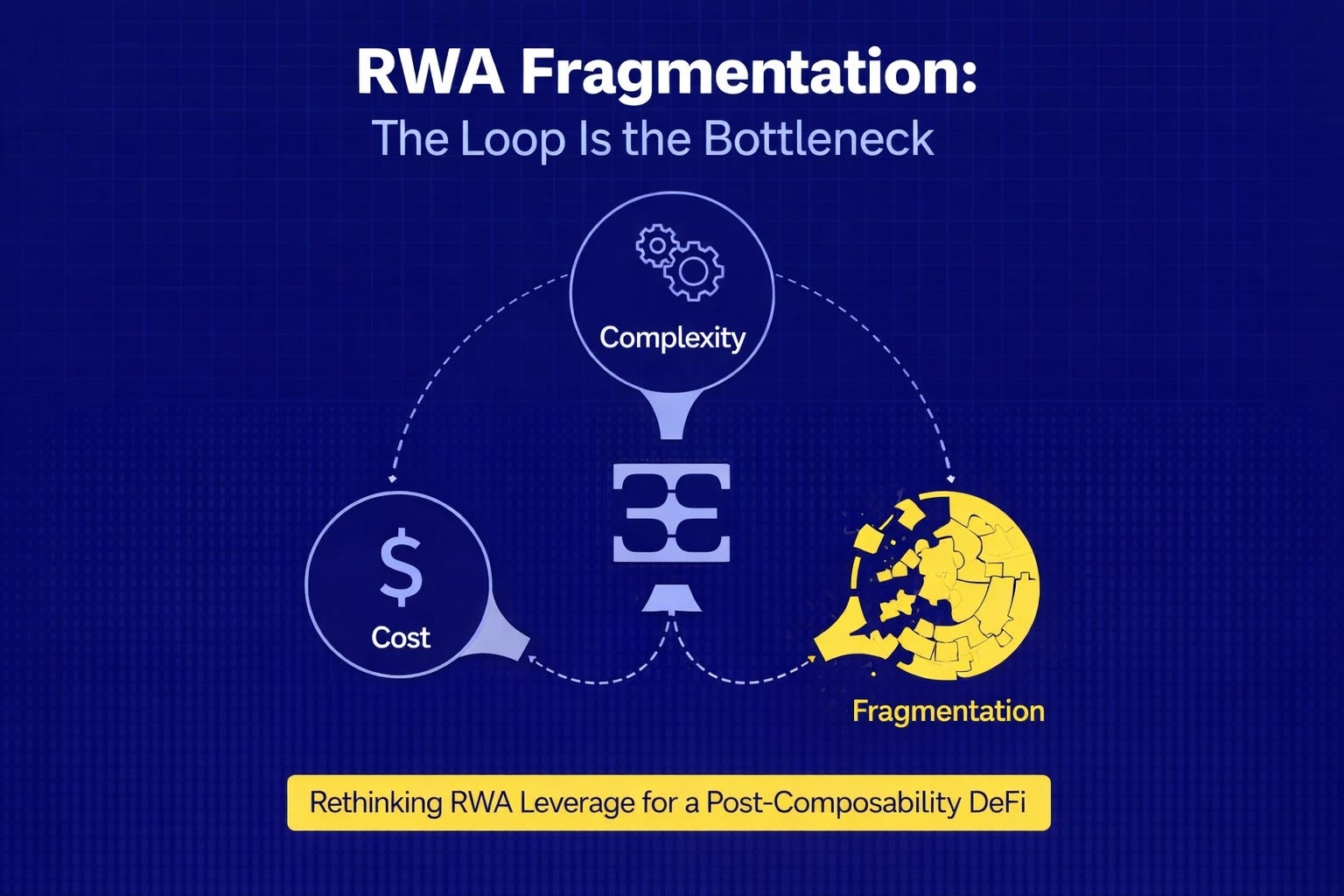
The issue is not primarily cost or complexity. It is fragmentation.
Every loop introduces a dependency chain. Execution timing must align. Pricing must remain favorable across venues. Liquidity must be available at each step. Bridges must settle as expected.
In a purely on-chain environment, these assumptions are tolerable. The system is relatively synchronous and self-contained.
RWAs disrupt that model.
They introduce asynchronous settlement, off-chain dependencies, and liquidity that exists across multiple domains. What was once a closed system becomes a distributed one.
The implication is subtle but critical.
Looping transforms from a composability advantage into a coordination liability.
Each additional step compounds uncertainty. Each dependency increases the probability of slippage, delay, or failure.
This is not a user experience issue.
It is a system design limitation.
And systems with compounding coordination risk do not attract institutional capital.
Shift in Design Paradigm
The failure of looping is forcing a more fundamental question.
Should leverage be constructed step by step, or delivered as a complete outcome?
This is where the transition from iteration to orchestration begins.
Instead of users managing multiple transactions across fragmented layers, execution is coordinated at the protocol level. Liquidity sourcing, bridging, and position structuring are unified into a single flow.
The concept of single-cycle settlement emerges from this shift.
Not as a feature, but as a design principle.
The objective is not simply to reduce steps. It is to remove the need for user-managed coordination altogether.
This changes the nature of DeFi interaction.
From assembling positions to receiving outcomes.
From managing risk across steps to relying on system-level precision.
For retail users, this is convenience.
For institutional capital, it is a prerequisite.
Introducing 3F
A small group of protocols has started to explore this design space with intent.
Among them, 3F Protocol, they approaches the problem at its root.
Rather than optimizing the loop, it eliminates it.
The system coordinates flash liquidity, bridge facilitation, and position structuring within a single execution cycle. The user initiates once. The protocol handles the orchestration.
This is not a superficial abstraction layer.
It is an attempt to re-architect how leverage is expressed in a multi-domain financial system.
The choice to build on Morpho reinforces this direction. Morpho’s model introduces more transparent and deterministic lending conditions compared to traditional pooled designs.
If execution is being abstracted, the underlying layer must remain legible.
Equally important is the protocol’s orientation toward institutional participation. Permissioned access pathways and structured integration flows indicate that the system is being designed for allocation, not just interaction.
This distinction matters.
Because the constraints of institutional capital are not technical. They are operational and perceptual.
And those constraints reshape how systems must be built.
The next phase of DeFi will not be defined by what it can do, but by how reliably it can do it under real-world conditions.
Execution Gap and Opportunity
Even as execution improves, a critical gap remains.
Legibility.
Not visibility in the raw sense, but structured interpretability.
For a system to attract institutional capital, it must do more than function correctly. It must communicate its state clearly and continuously.
Risk parameters need to be exposed in a coherent framework.
Vault performance must be intelligible without reconstruction.
Liquidation dynamics must be observable as they occur.
Without this layer, efficiency does not translate into trust.
And without trust, scale does not follow.
This is where many emerging systems remain incomplete.
They solve for execution but leave interpretation as an exercise for the user.
The opportunity lies in closing that gap.
Protocols that can align execution precision with reporting clarity will not just improve usability. They will redefine capital access.
Because institutions do not engage with opaque systems, regardless of their performance.
They engage with systems they can understand.
Forward-Looking Insight
DeFi is entering a new phase.
The first phase focused on access, bringing assets on-chain.
The second phase focused on composability, linking protocols into financial networks.
The emerging phase is coordination.
Systems must now operate across heterogeneous layers, integrating on-chain logic with off-chain realities. Execution must be reliable not just within a protocol, but across domains.
In this context, protocols like 3F Protocol are early indicators of where design is heading.
They are not simply introducing new features.
They are challenging the assumption that users should manage complexity.
The long-term question is not whether these systems can deliver higher yields.
It is whether they can deliver consistent, interpretable outcomes under varying conditions.
That is the threshold for institutional participation.
Conclusion
Looping was a functional adaptation to early DeFi constraints.
It was never a scalable solution.
As RWAs expand the scope of what DeFi interacts with, the limitations of iterative design become more pronounced.
Execution must become coordinated.
Risk must become legible.
Systems must become trustworthy by design.
The transition from iteration to orchestration is not incremental.
It is architectural.
And the protocols that internalize this shift early will not just attract capital.
They will define how it moves.
Capital does not flow to complexity. It flows to systems where complexity is resolved, risk is visible, and outcomes are predictable.
Written by: Ibrahim Dajin
Contact for Collaboration Telegram: @IbrahimDajin
Email: [email protected]