The Line They Drew
 Veyrain Paperrain3 min read·Just now
--
Eight hours for work. Eight hours for rest. Eight hours to remember you’re alive.
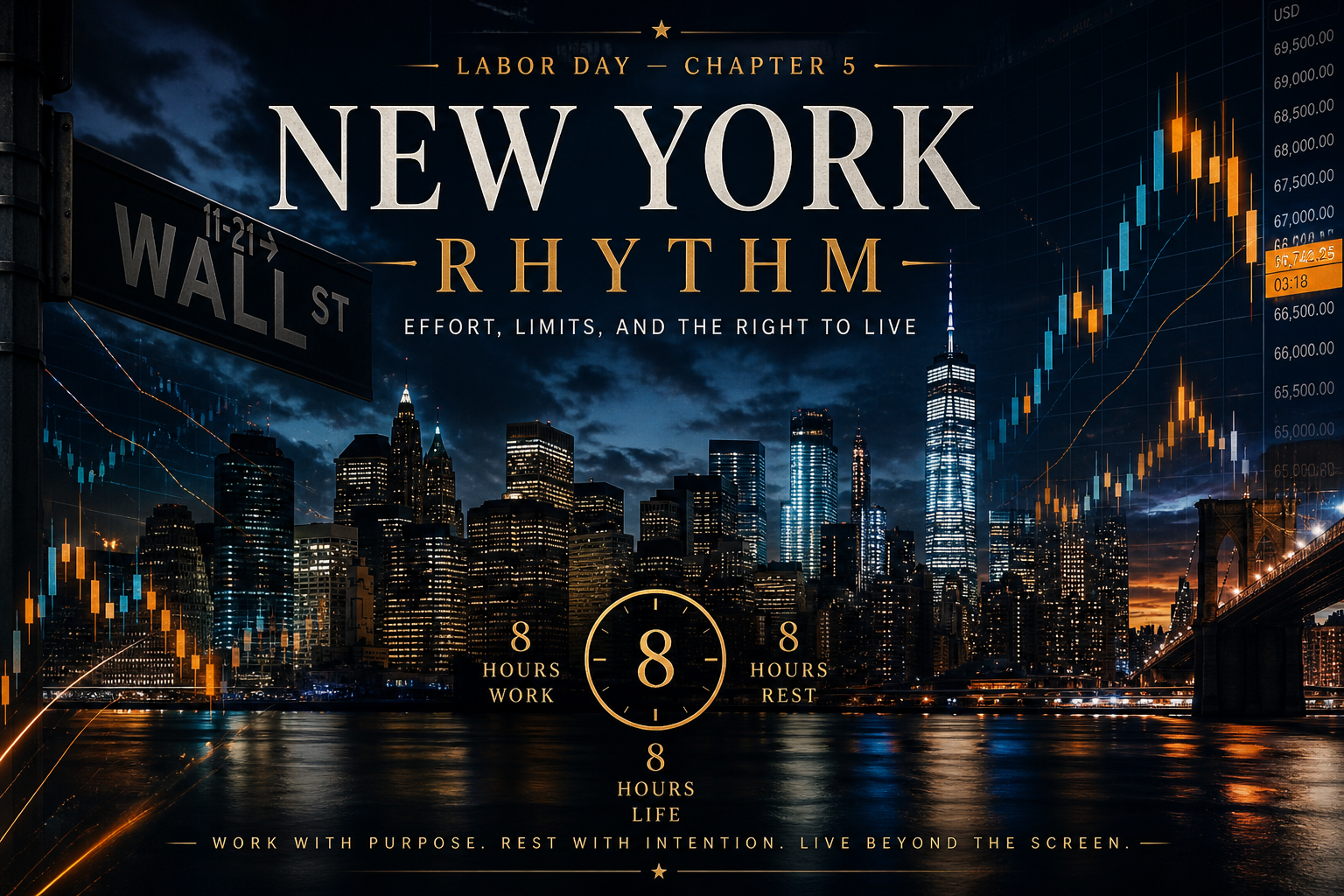
Labor Day — Chapter 5 New York — Rhythm Effort, Limits, and the Right to Live
I. When Work Had No Limits
In the late nineteenth century, many workers in the United States had no real boundary between labor and life.
Long hours. No weekends. Little safety. Fatigue wasn’t a complaint — it was just Tuesday. Injuries were common. And slowly, workers began to see what was happening:
Without limits, work would take everything.
That pressure gave rise to something powerful. Not a demand for less work. A demand for a human structure of time.
Eight hours for work. Eight hours for rest. Eight hours for life.
The 8–8–8 principle was never just about shorter shifts. It was about protecting the right to exist beyond what you produce.
II. The New York Session
The New York session is the loudest hour of the market.
Activity surges. Volatility spikes. Decisions come fast and don’t wait for you to feel ready.
This is where full effort is required — where discipline gets tested, where everything learned in Sydney, Tokyo, and London finally gets put to use.
And just like the workers of the industrial era, the challenge isn’t only surviving the intensity. It’s knowing when enough is enough.
Recognizing the limit. And stopping before the work starts taking more than it gives.
III. The Rhythm
The fight for 8–8–8 is a reminder that productivity has edges.
Without rest, performance erodes. Without balance, health follows. Without stillness, the mind slowly forgets what it’s working for in the first place.
Sustainable effort needs rhythm — intensity and recovery, movement and rest, labor and life. One can’t exist without the other for long.
The market will open again tomorrow. There will always be another candle, another setup, another session. But you — the person behind the screen — only have one body. One mind. One life.
Time isn’t only for working. Time is also for living.
And that’s what the workers of 1886 understood long before any of us ever touched a chart.
They drew a line across the endless day, and said: beyond this hour, we are free. Not lazy, not ungrateful — just the way that humans need to breathe, and rest, and be.
The New York hour will rage and then grow still, the candles close, the session finds its end. And those who trade with discipline and will know when to stop — and when to start again.
Eight hours given. Eight hours taken back. Eight hours left to live beyond the screen. This is the rhythm. This is what we lack — to work with purpose. Rest. And live between.
This article was originally published on my Substack: https://substack.com/@vpaperrain/note/p-196569287?r=77apwu&utm_source=notes-share-action&utm_medium=web