The Invisible Discipline of Data Minimization Systems
Why the Future of Technology Depends on Collecting Less, Not More
 Prashant Thinks5 min read·Just now
--
In a world where every tap, swipe, purchase, and pause is tracked, recorded, and analyzed, the idea of collecting less data sounds almost counterintuitive. For decades, the dominant philosophy in technology has been simple: more data leads to better decisions.
Companies built vast ecosystems designed to capture everything possible about users, believing that scale would automatically translate into intelligence.
But a quiet shift has been unfolding beneath the surface of modern digital infrastructure. Organizations are beginning to realize that unlimited data collection does not always produce better outcomes. In fact, it often creates the opposite problem: complexity, risk, inefficiency, and growing ethical concerns.
This is where data minimization systems enter the story not as a limitation, but as a redesign of how digital intelligence should work.
What Data Minimization Really Means
Data minimization is the principle that systems should collect, process, and store only the data that is strictly necessary for a defined purpose. Instead of gathering everything “just in case,” these systems are designed with intention and restraint.
At its core, data minimization is not about reducing capability. It is about refining it.
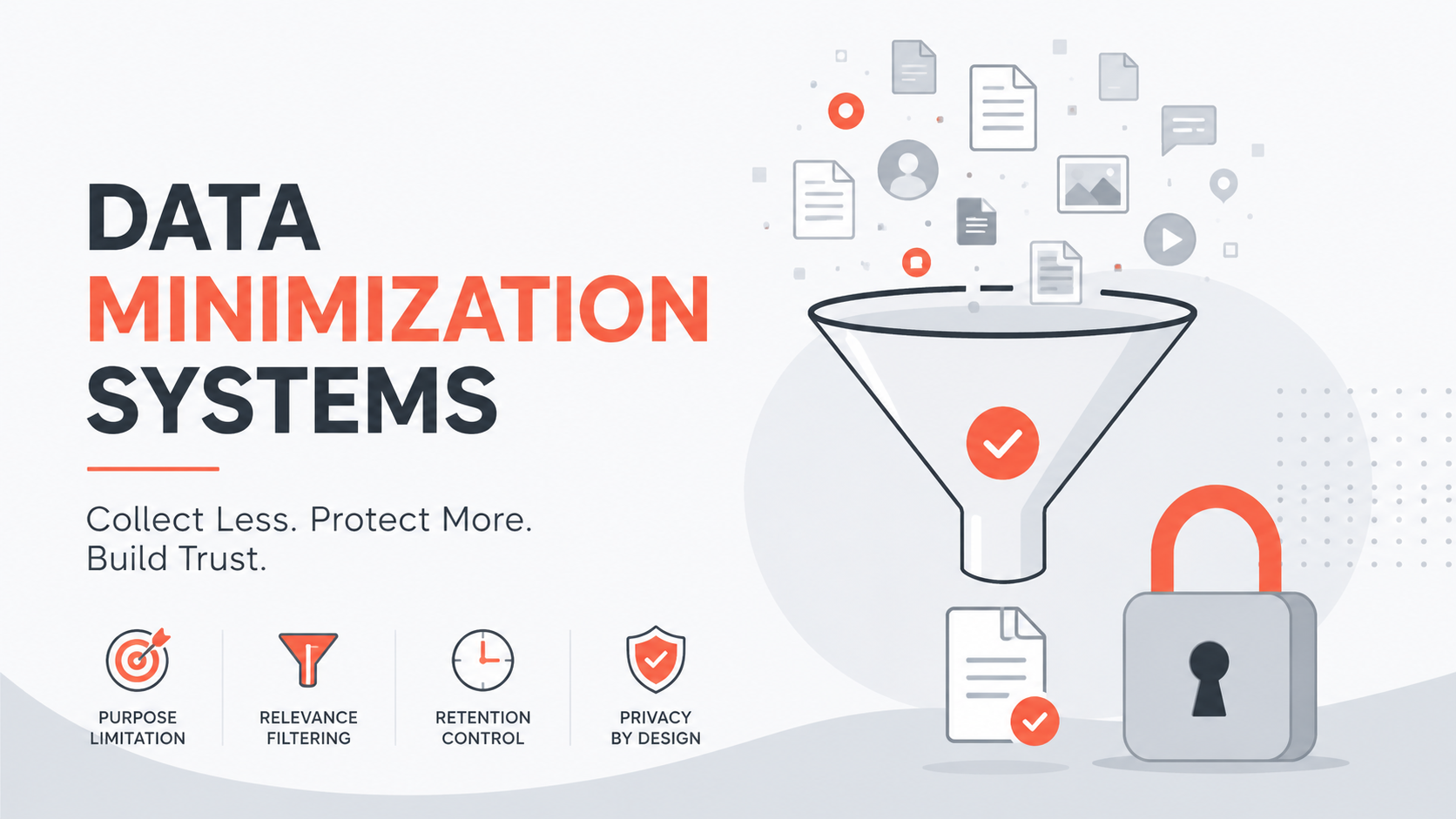
A properly designed data minimization system typically follows three core principles:
- Purpose limitation: Data is collected only for a clearly defined objective
- Relevance filtering: Only data directly relevant to that purpose is retained
- Retention control: Data is stored only for as long as necessary
This approach contrasts sharply with traditional data-driven architectures, where accumulation is often treated as a default behavior.
Why the Old Model Is Breaking Down
For years, organizations operated under the assumption that more data equals better insights. However, the modern digital landscape has revealed significant cracks in that logic.
Some of the most common challenges include:
- Rising storage and infrastructure costs
- Increased exposure to data breaches
- Regulatory pressure from privacy laws
- Low signal-to-noise ratio in massive datasets
- Ethical concerns over surveillance-like data practices
Ironically, the very systems designed to create clarity often produce confusion. Analysts spend more time cleaning and filtering data than actually interpreting it. Machine learning models become bloated with irrelevant inputs, sometimes degrading performance instead of improving it.
As a result, companies are now rethinking a fundamental question:
What if we only collected what we truly needed from the beginning?
The Architecture of Data Minimization Systems
Unlike traditional pipelines that emphasize mass ingestion, data minimization systems are built around controlled flow and selective retention. They introduce constraints at every stage of the data lifecycle.
A typical architecture includes:
1. Edge-Level Filtering
Instead of sending raw data to centralized servers, filtering happens closer to the source. Devices or local nodes remove unnecessary data before transmission.
2. Purpose-Bound Data Capture
Data collection is tied to specific user actions or system functions, not continuous tracking.
3. Ephemeral Storage Layers
Temporary storage is used for processing, after which non-essential data is automatically discarded.
4. Aggregation Over Individualization
Where possible, systems store aggregated patterns rather than individual-level records.
5. Privacy-Preserving Computation
Techniques like anonymization, differential privacy, and federated learning reduce the need for raw data exposure.
These layers work together to ensure that data is not treated as an infinite resource, but as a regulated input.
A Shift in Design Philosophy
The most important change brought by data minimization systems is not technical, it is philosophical.
Traditional systems ask:
“What data can we collect?”
Data minimization systems ask:
“What data do we actually need to solve this problem?”
This shift forces designers, engineers, and product teams to define intent more clearly. Ambiguity becomes expensive. Every additional data field must justify its existence.
This constraint often leads to better design decisions overall. When unnecessary tracking is removed, systems become easier to maintain, faster to process, and more transparent to users.
Real-World Applications Across Industries
Data minimization is not limited to privacy-focused startups or niche applications. It is increasingly being adopted across major industries.
Financial Services
Banks and fintech platforms use minimal data models for fraud detection. Instead of analyzing entire user histories, they focus on transactional anomalies and behavioral patterns.
Healthcare Systems
Medical platforms are adopting selective data capture to comply with strict regulations while still enabling accurate diagnostics.
E-Commerce
Retail platforms are reducing long-term behavioral tracking and instead relying on session-based personalization.
IoT and Smart Devices
Smart systems now process data locally on devices rather than streaming everything to the cloud.
In each of these cases, the goal is the same: reduce exposure while preserving utility.
Key Benefits of Data Minimization Systems
The advantages extend beyond privacy compliance. When implemented effectively, these systems create structural improvements across multiple dimensions.
- Improved security posture: Less stored data means fewer breach targets
- Lower infrastructure costs: Reduced storage and processing requirements
- Faster system performance: Smaller datasets lead to quicker computation
- Simplified compliance: Easier alignment with privacy regulations like GDPR principles
- Greater user trust: Transparent data practices improve credibility
One of the most overlooked benefits is system clarity. When unnecessary data is removed, teams can more easily understand what their systems are actually doing.
Challenges in Implementation
Despite its benefits, implementing data minimization is not straightforward. Many organizations struggle to transition from legacy systems built on accumulation.
Common challenges include:
- Legacy architecture dependencies on large datasets
- Fear of losing future analytical opportunities
- Difficulty defining “necessary” data objectively
- Resistance from data-driven business cultures
- Complexity in redesigning pipelines
Perhaps the biggest challenge is psychological. Teams are often conditioned to believe that deleting data is risky. In reality, not collecting irrelevant data can be more powerful than storing everything indefinitely.
The Role of Regulation and Ethics
Global privacy regulations have played a significant role in accelerating the adoption of data minimization systems. Frameworks like GDPR emphasize principles such as data minimization, storage limitation, and purpose restriction.
But regulation alone is not the driving force. Ethics is becoming equally important.
Users are increasingly aware of how their data is collected and used. Trust is now a competitive advantage. Companies that adopt minimal data practices are not just complying with laws, they are signaling respect for user autonomy.
This shift is redefining the relationship between users and digital platforms. Data is no longer seen as something to be extracted, but something to be handled responsibly.
The Future: Less Data, Smarter Systems
The next generation of digital systems will not necessarily be defined by how much data they collect, but by how intelligently they decide what not to collect.
Emerging trends include:
- On-device AI processing reducing cloud dependency
- Federated learning enabling model training without raw data transfer
- Context-aware systems that discard irrelevant signals in real time
- Privacy-first analytics frameworks built on aggregation rather than tracking
These developments point toward a future where intelligence is not proportional to data volume, but to data relevance.
Conclusion: Intelligence Through Restraint
Data minimization systems challenge one of the most deeply rooted assumptions in modern technology: that more is always better. Instead, they propose a different kind of intelligence, one built on discipline, clarity, and restraint.
In many ways, this is not a reduction of capability but a refinement of purpose. By collecting less, systems can actually understand more clearly what matters.
The future of digital infrastructure may not be defined by massive data lakes or infinite tracking pipelines. It may be defined by something far more subtle:
the ability to decide what should never be collected in the first place.
And in that decision lies a new kind of technological maturity, one where less data does not mean less intelligence, but more intentional intelligence.